• Thomas Learmonth o Erceldoune

By Erceldoune

~ Graeme Purves

By Erceldoune

Monthly Archives: March 2014

Scottish Environmentalism – The Contribution of Patrick Geddes

08 Saturday Mar 2014

Posted by Graeme Purves in The Land o Cakes

≈ Leave a comment

Tags

communities, environmental management, Environmentalism, Frank Fraser Darling, John Muir, Patrick Geddes, rural development, Wild Land

In his address to the Spring Gathering of the Dunbar John Muir Association in April 1995, Professor Aubrey Manning highlighted the distinctive contributions to modern environmental thought made by the Scottish naturalist-activists John Muir, Patrick Geddes and Frank Fraser Darling.  An article by Douglas Aberley in the Spring 1995 issue of the journal Reforesting Scotland also drew attention to the considerable influence of these three figures.

The contribution of John Muir to the conservation of wild land and our appreciation of the spiritual value of wilderness does not need to be stressed to the readers of this Journal.  However, the vigorous debate which the very terms “wilderness” and “wild land” continue to provoke in a Scottish context testifies to the problematic nature of Muir’s concept of “wilderness” in a country where the human species has been an integral part of the ecosystem for around 10,000 years and all but the most inaccessible areas have been profoundly altered by human activity.

As a result, even our wild land has strong historical and contemporary associations with human communities and our responses to it inevitably reflect the considerable cultural baggage which each of us carries with us.  As James Hunter points out in his seminal exploration of the relationship between people and nature in the Scottish Highlands, On the Other Side of Sorrow, the pronouncements of environmentalists on the natural heritage of the Highlands have too often shown scant appreciation of the history, culture and aspirations of the people who actually inhabit the land which they so earnestly seek to conserve.

The John Muir Trust has been a pioneer amongst environmental organisations in recognising the social and economic dimensions of conservation and committing itself to working closely with local communities to safeguard and restore wild land and develop sustainable land management practices.  However, it is the environmentalism of Patrick Geddes rather than that of Muir which is likely to have most to offer when it comes to discharging that commitment.

Patrick Geddes - portraitPatrick Geddes

Geddes, despite his acknowledged importance as a founding father of modern town and country planning, is a notoriously difficult personality to come to grips with.  His enthusiasms were diverse and idiosyncratic.  He is still variously described as a zoologist, botanist, sociologist or town planner and during the course of his career he was all of these, though never exclusively or conventionally any of them.  The sheer difficulty of categorising Geddes within any of the conventional academic disciplines has discouraged examination of his ideas and this task has only recently been attempted seriously.

Geddes was seventeen years younger than John Muir, being born in 1854.  Like Muir, he developed an interest in the natural world through childhood exploration of the countryside around one of Scotland’s historic burghs (in Geddes’ case it was Perth).  Subsequently, he studied under the eminent English biologist, Thomas Huxley before moving on to Paris where he encountered the ideas of the French sociologist, Frédéric Le Play.

In 1880, Geddes was appointed Assistant in Practical Botany at the University of Edinburgh and took up residence in the city’s Old Town.  He was appalled at the conditions he found there.  Following the construction of a gracious Georgian New Town beyond the Nor Loch, Edinburgh’s middle classes had abandoned the high tenements and narrow closes of the Castle ridge, and the Old Town had rapidly degenerated into a noisome slum.  Geddes responded by throwing himself into the promotion of an ambitious programme of civic and environmental renewal, involving local people in the rehabilitation of tenement property, the improvement of open spaces, and the creation of gardens where the urban population could enjoy the restorative effects of contact with nature.

Geddes was also acutely aware of the significance of the Old Town as the historic home of Scotland’s political and cultural institutions.  The loss of the Scottish Parliament in the early 18th Century had left a vacuum at the centre of the city’s political and cultural life and by the late Victorian period the city had lost the intellectual pre-eminence which it had enjoyed during the golden years of the Enlightenment.  Geddes drew direct inspiration from Edinburgh’s cultural and intellectual heritage and the great variety of environmental and educational projects which he promoted in the city were primarily aimed at stimulating a cultural and intellectual revival.

An appreciation of Geddes’ close engagement with the fate of Edinburgh as a national culture-capital is crucial to an understanding of the particular perspective which he brought to land use planning.  His conception of the nature and purpose of planning was quite different from that of other planning propagandists.  For Geddes, the central concern was not with the technical problems of urban expansion or the creation of brave new utopian settlements but with the task of inspiring communities to an active participation in their own cultural and social renewal.

From his starting point as a natural scientist, Geddes attempted to apply the principles of Darwinian evolutionary theory to the study of modern society.  The objective was to gain sufficient understanding to enable the raw evolutionary forces which were shaping society to be harnessed and guided in positive directions towards the greater fulfilment of Mankind.  Thus his aims were ultimately spiritual rather than material.  What he sought was the restoration of a “harmony” or “balance” to human life and social relationships which he believed to have been lost during the trauma of the industrial revolution; in short, the recreation of physical and social environments in which human beings could enjoy greater personal fulfilment and creative expression.

Geddes’ distinctive contribution to the development of regional theory stressed the interaction between the environment, economic activity and community, expressed in the triad “Place/Work/Folk”.  He saw the modern region as the product of continuous interaction between the human species and its environment; each of its communities adapted to its particular geographical setting and responding to changing circumstances by a process of cultural evolution.  He therefore rejected standardised solutions to environmental and social problems, believing that proposals should be individually tailored to local conditions, with due regard to existing customs and systems of social organisation.

Geddes looked forward to the coming “neotechnic” age in which clean and efficient new technologies would replace the polluting industrial activities of the past.  He also believed that electricity and modern communications would liberate industry from the old locational constraints, enabling its benefits to be distributed more evenly between town and country and encouraging a revival of skilled craftsmanship.  In lectures delivered before the First World War, Geddes and his associates argued that the early Norwegian hydro-electric schemes offered new hope for the Highlands and suggested that the experiments in co-operative agricultural production then being pioneered in Denmark and Ireland pointed the way forward for Scottish rural communities.

While Geddes worked primarily in an urban context, his son-in-law, Frank Mears, applied the same approach to cultural and environmental renewal in his pioneering planning work in rural Scotland.  In the early ‘fifties, Mears addressed the problem of rural depopulation in its most acute form in a strategy for the revitalisation of the County of Sutherland.  Against the prevailing wisdom of the time, he rejected the notion that the problem of rural decline could be solved “by a simple process of decanting a given proportion of large-scale industries into partially depopulated areas”.  Instead, in a plan strongly influenced by Fraser Darling’s Preliminary Report on the West Highland Survey, he advocated a strategy based on the regeneration of the crofting economy through measures such as land rehabilitation, tenure reform, investment in agriculture, forestry and fishing, and the encouragement of small rural industries based on indigenous resources.

John Muir is rightly acknowledged internationally as one of the founding fathers of the modern conservation movement.  However, the contemporary land debate would benefit from a wider appreciation of the contributions of figures such as Geddes, Fraser Darling and Mears to the development of a distinctively Scottish environmental perspective which accords human communities a central role in conservation and land renewal.  More particularly, Geddes’ commitment to community empowerment and the active involvement of local people in the restoration and improvement of their own physical and cultural environments can provide valuable inspiration to the Trust in its work with rural communities.


This article was first published in the John Muir Trust Journal & News No. 22 in January 1997.  I think it remains relevant to contemporary debates about environmentalism, environmental management, rural development and wild land.

Culture Cities and Urban Renaissance

04 Tuesday Mar 2014

Posted by Graeme Purves in The Land o Cakes

≈ 2 Comments

Tags

Andy Wightman, Cities, Culture, Lesley Riddoch, Patrick Geddes, Richard Florida, Stephen Maxwell

At a European planning conference I attended in Vilnius in December the City Architect quoted Wellington Webb, the first African American mayor of Denver, as claiming that:

“The 19th century was a century of empires, the 20th century was a century of nation states. The 21st century will be a century of cities.”

On that timetable, Scotland may be running about a century late.

In thinking about our aspirations for Scotland’s cities and urban living in the 21st Century, there could hardly be a better place to start than the pioneer Scottish planner, Patrick Geddes.  My own research was on Geddes’ son-in-law, Frank Mears, and how he sought to apply Geddes’ ideas in the practice of urban and regional planning in the mid-20th Century.  Both Geddes and Mears were interested in cities as hubs of cultural creativity and, influenced by Darwin, they saw the job of the planner as being to foster progressive cultural evolution.  They both had a strong engagement with the health of Scotland’s culture and sense of itself.  Hugh McDiarmid, the dominant figure in the literary revival of the nineteen-twenties which came to be known as the Scottish Renaissance, acknowledged Geddes as one of its progenitors.

Patrick Geddes

Patrick Geddes

Geddes’ initial inspiration was the historic culture-capital of Edinburgh and there was an anti-imperial and anti-metropolitan dimension to his thinking.  His knowledge of Scotland’s post-Union history led him to the general conclusion that the excessive dominance of the great imperial capitals of the world was having a negative impact on the social and cultural life of the lesser cities over which they held sway.  He believed that only with the removal of the imperial yoke would it be possible for the subordinate cities to realise their full social and cultural potentials and it was this conviction which drew him to the historic culture-capitals of Dublin and Jerusalem as they each re-emerged from long periods of enforced provincialism.

Geddes and Mears were ultimately concerned with spiritual more than material welfare. Insofar as their criteria for defining evolutionary social progress were ever made explicit, they were described largely in spiritual rather than material terms.  What they sought was the restoration of a “harmony” or “balance” to human life which they believed to have been lost during the trauma of the industrial revolution; in short, the recreation of physical and social environments in which human creativity could once again find full expression.  In this respect, their ideology had closer affinities with the modern environmental or “Green” movement than with the technocratic planning of the mid-20th Century and, considering its distinctly religious aspect, it is perhaps not so surprising that in extolling the environmental virtues of Perth, Mears should describe it as a “Garden of Eden”.

Scotland’s Cities

Scotland’s cities offer urban environments of a high quality and have a key role as drivers of the economy. They are each distinct manifestations of a Scottish urban tradition dating back to the foundation of the burghs by the Canmore kings.  That has physical dimensions such as urban form, tenement living and building in stone, but it has also been reflected in distinctive civic, mercantile and administrative cultures and traditions.  Scottish cities are still arguably more like Continental European cities than most other cities in the UK, though Glasgow wears its love affair with America on its sleeve.  For a small country, Scotland is regionally diverse and our cities reflect that.

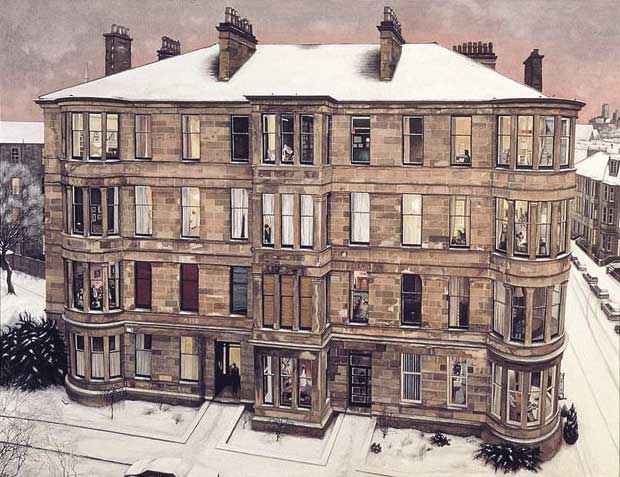
Glasgow tenement

That Glasgow tenement

Scotland’s economy has changed dramatically over the last century and physical and cultural environments have changed to match.  Nowhere is that more evident than Glasgow.  Manufacturing and heavy industry have given way to a more diverse knowledge economy.  Both Glasgow and Edinburgh are strong knowledge economy centres in European terms.  However, past industrial activity, economic change and poor urban management have left a legacy of social and environmental problems.  A sizeable proportion of the population has seen little benefit from opportunities in the new economy. We still have wide geographical disparities in wealth, economic opportunity, health, life expectancy and environmental quality, with persistent concentrations of disadvantage in parts of the West of Scotland and problems of economic overheating in the East.  While Glasgow has seen an economic and physical transformation since the 1980s, the differences between the social profiles of the West and East of Scotland remain.  In employment terms, Glasgow has been less resilient than Edinburgh in the period since the economic crash.

For the past 40 years Aberdeen has played a distinctive role as a major centre for the oil and gas industry. It is now seeking to build on its offshore and engineering strengths to diversify into renewables technologies.  Dundee has transformed the quality of its city centre and is working to transform its waterfront. It has enhanced its cultural facilities and established new centres of expertise in key sectors of biotechnology and the knowledge economy.  A key challenge is to retain a higher proportion of the people who study there once they graduate.

And our four historic cities have recently been joined by three new ones – Stirling, Inverness and Perth.  Inverness is developing its role as Highland capital while Stirling and Perth sit at important strategic locations at the interface between Highland and Lowland Scotland.

Cultural Renaissance

The old imperial cities Geddes talked about are largely gone – we may be witnessing their final swan-song – but we live in an age of global capital where a handful of global mega-cities dominate world markets and the commercial media and have a huge influence on our economic prospects, culture, and tastes.   A recent Centre for Cities report found that the current economic recovery is strongly focused on the South-East of England and deepening the divide between London and most other UK cities.  Professor Tony Travers of the London School of Economics said recently: “London is the dark star of the economy, inexorably sucking in resources, people and energy. Nobody quite knows how to control it.”

In Scotland we are familiar with the challenge.  One of the things the referendum campaign has done is to stimulate a lot of creative thinking about possible futures for Scotland.  So it seems an appropriate time to be asking what our aspirations are for our cities.  What should we be looking for in a Scottish urban renaissance?

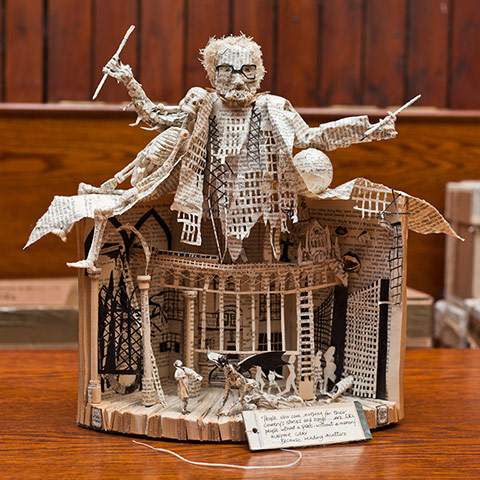
I think some of the developments we have seen in the 20th Century are very much in tune with what people like Geddes and Mears were looking for.  Today Scotland has a very vibrant and diverse urban culture.  In many ways our arts and literature are thriving, and no-one symbolises this better than Glasgow’s ultimate Renaissance man, Alasdair Gray, who urges us to work as if we lived in the early days of a better nation.

Alasdair Gray's Lanark

Alasdair Gray – paper sculpture

Our cities are also much more diverse and cosmopolitan than they were in the post-War years.  Our response to recent immigration has generally been much more enlightened and positive than it was to Irish immigration in the 19th and early 20th Centuries, but our urban culture still bears the dark scars of sectarianism as a legacy of that experience.

Edinburgh has its constellation of Festivals, including the biggest and longest running international arts festival in the world.  Edinburgh is the place to be in August, when the place is buzzing with entertainment and ideas.  But isn’t it odd that amidst all this creative ferment, the organisers of the International Festival seem reluctant to find a space at the table for Scottish culture and concerns?  Festival Director Sir Jonathan Mills has said that he does not intend to include works relating to Scotland’s referendum in the 2014 programme.

In Glasgow the Celtic Connections festival has recently had another great year.  What started as a brave attempt to fill venues at a slack time of year has turned into a major cultural and economic success, with ticket receipts in excess of £1 million for the seventh successive year.  Celtic Connections has raised the international profile of the city and brightened up the dark midwinter.  It has had all sorts of benefits and spin-offs for Scottish musicians and the wider music scene.  For example, we now have Celtic Music Radio broadcasting Scottish, Irish and Roots music across the globe.

And, of course, in August Glasgow hosts the Commonwealth Games.  That will be a great international celebration of culture as well as sporting prowess and a lot of work is being done in the east of the City to provide the facilities and leave a lasting legacy.

But one sector which is conspicuously failing to step up to the mark is film and broadcast media.  The level of cultural activity in Scotland is a tremendous resource for our media to draw on, but much of their output is timid, stale and provincial. Taggart was fun in its day, but Scottish popular drama output looks very dated and derivative in comparison to contemporary Scandinavian Noir!  Why aren’t BBC Scotland and STV signing up Festival talent for Scottish-based television series?  The world-class media facilities at Pacific Quay, incorporating the headquarters of BBC Scotland and Scottish Television, offer the potential for Scotland to become a globally significant player in television and film production for the whole English-speaking world.  There is also scope for building on the media infrastructure and expertise which exists in Aberdeen to develop its role as a media centre for the North East.  There is little sign of anything like this happening at present and I don’t see the potential being realised without a “Yes” vote.

Successful and Sustainable Cities

At the time I was working on Scotland’s first National Planning Framework, between 2004 and 2008, Richard Florida’s book The Rise of the Creative Class was having a lot of influence. Everyone at Scottish Enterprise seemed to have been given a copy for Christmas. Florida’s essential message is that to be competitive cities must be well connected and able to offer high quality environments and a first-class quality of life.  Work on the West Coast of America has shown that cities which are good places to live are better at weathering recession.  People tend to stick around and create new opportunities rather than seeking employment elsewhere.

Richard Florida

Richard Florida

City Collaboration was another big idea, and then the emphasis was on collaboration between Glasgow and Edinburgh.  In this technocratic vision the two cities were to function as complementary economic and cultural hubs of a Central Belt conurbation large enough to compete on a global scale.  But thinking has moved on. Now a partnership of all seven of Scotland’s cities is working in collaboration with the Scottish Government under the umbrella of the Scottish Cities Alliance.  The Action Plan for Scotland’s cities states that successful cities tend to be:

  • Connected Cities; with strong digital and transport infrastructure.
  • Sustainable Cities; maximising the benefits and competitive advantage that the transition to a low carbon economy brings for the City, its region and its residents.
  • Knowledge Cities; with high performing research and educational institutions, high value sectors and access to a highly skilled labour pool; and
  • Vibrant and Cultural Cities, which have a distinct quality of place, amenities, retail and cultural offerings to attract and retain talent, investment and visitors.

City investment plans are being prepared to identify key investment and development opportunities in each city.

However, in practice, the challenge of urban renewal is clearly giving us problems.  In Aberdeen, Glasgow and Perth ambitious schemes for transforming the city centres have become mired in public controversy and, of course, Edinburgh has had its tram saga. Repeatedly we are seeing opportunities for progressive change squandered as a result of flawed processes, rampant egotism and cynical party politicking.

The Scottish Government is keen that Scotland should be both an exemplar and a focus of expertise in tackling the challenges of climate change and with transport, buildings and business activity accounting for a high proportion of emissions, their reduction will require substantial changes in our urban fabric.  It has been taking that agenda forward through the Scottish Sustainable Communities Initiative, which seeks to create high quality exemplars of 21st Century low impact development.   However, to date efforts to promote sustainable living and reclaim our cities from the motor car have been fitful, piece-meal and half-hearted in comparison with Continental exemplars.

Eighteen months ago, I heard the Danish architect and design consultant, Jan Ghel, give the Patrick Geddes Memorial Lecture to a packed lecture theatre in Edinburgh.  He pointed out that the transformation of Copenhagen into a people and bicycle-friendly city hadn’t happened over-night.  It is something which demanded consistent commitment from civic leaders and officials over a period of 40 years.  That is something we need to learn.

There is an urgent need for debate about how we agree and deliver the changes needed to create sustainable and liveable cities for the 21st Century. I am somewhat sceptical about technocratic visions of sustainable cities.  There is a widespread feeling that our local government is already far too centralised, technocratic and remote, and that our politicians have become disconnected from the communities they are supposed to serve. In his book Arguing for Independence: Evidence, Risk and the Wicked Issues, Stephen Maxell wrote:

“After 10 years of devolution, decision-taking remains highly centralised with local authorities enjoying only marginally more spending discretion than in the rest of the UK…”

He believed that there is a need “to consider constitutional reinforcement to the rights of local government and of local communities” in an independent Scotland.

I suspect most of us would want civic change to be led by an active citizenry rather than big capital and power elites.  But how do we mobilize that citizenry and build consensus for a positive programme of action?  How do we achieve an ongoing commitment to delivering that programme?  How do we ensure that the forces of cautious conservatism and negativity will not inevitably prevail?

On the positive side, there is abundant evidence of community spirit and a desire to be active in making our cities more socially and environmentally rewarding places.  We see that in the demand for allotments, the proliferation of community festivals, markets and orchards, phenomena such as urban and guerrilla gardening, and the growing interest in community ownership of a wide range of public assets.  Unfortunately, too often elected representatives see civic activism as a threat to their authority and officialdom finds it difficult to engage with it in a positive way.  We need to build a genuinely local and participative system of local government.  As Lesley Riddoch argues in her book, Blossom: What Scotland Needs to Flourish:

“Capable, connected, powerful communities – based on the kind of dynamism demonstrated by development trusts – could generate electricity, supply district heating, find work for unemployed young people, tackle local flooding problems, fix derelict buildings, build and manage housing and keep an eye on old folk…”

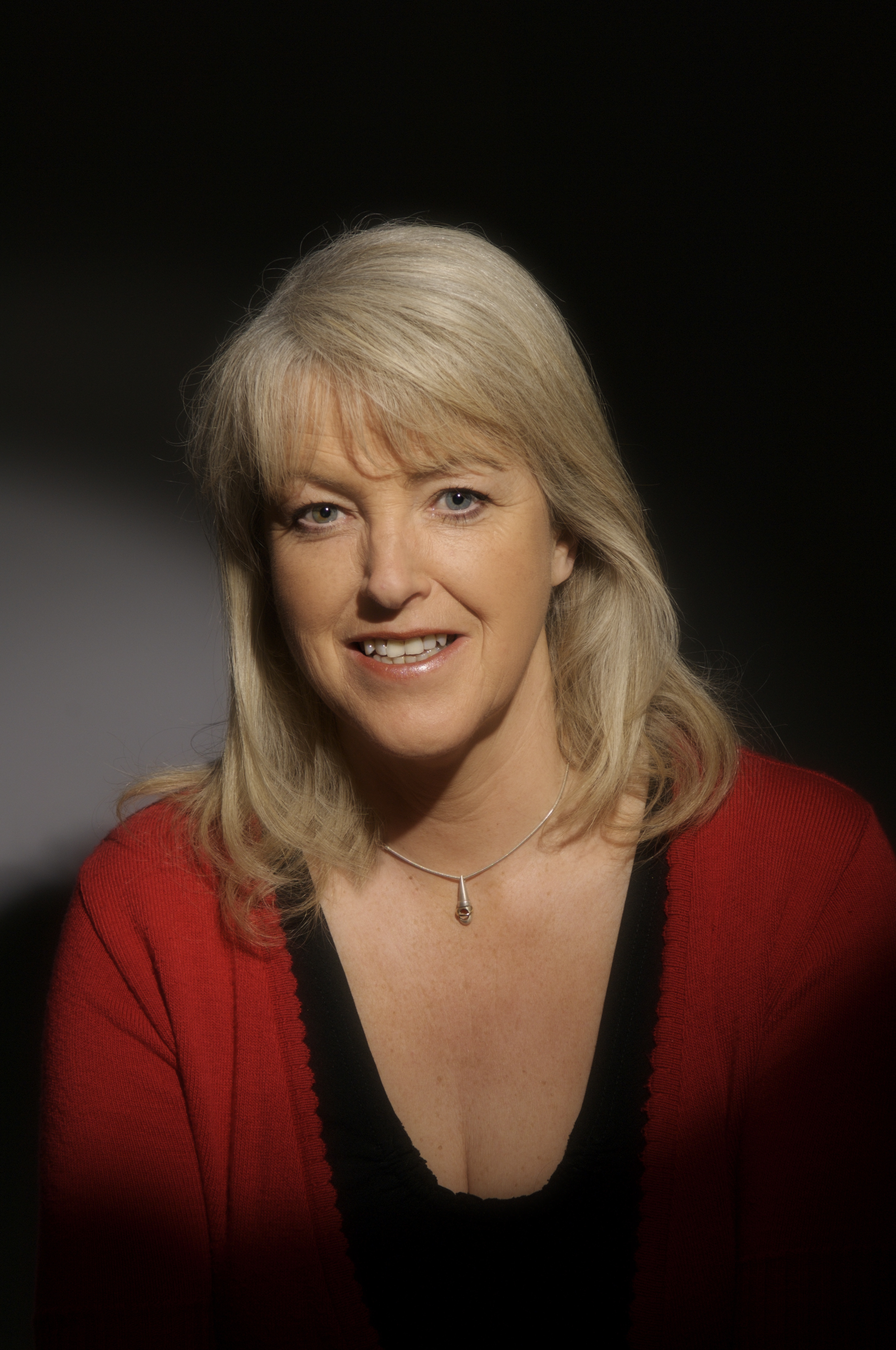
Lesley Riddoch-for use by Lesley Riddoch in all media

Lesley Riddoch

There are also fundamental questions around who benefits from urban development.  As Edinburgh’s new tram line nears completion attention is turning to the development opportunities associated with it.  Campaigners like Andy Wightman argue that radical changes to land ownership and taxation are required to ensure that the benefits from the uplift in land values associated with development accrue to communities rather than rentiers.

As I indicated earlier, Scotland is remarkably diverse for a small country. Its cities are economic and cultural hubs for distinctive surrounding regions and it is important that we do not lose sight of the national and regional dimensions in our desire to give greater power to communities. While we should be guided by the dictum that small is beautiful, we must be realistic enough to recognise that Scotland does not have a Hobbit economy.  Like the Scandinavian neighbours we aspire to emulate, we need democratic structures capable of making big strategic decisions on infrastructure and other matters in the national or regional interest.

Conclusion

As we move towards Scotland’s date with destiny, there are a lot of positive things we can say about our cities.  We have a vibrant, diverse, outward-looking and increasingly confident urban culture and the independence debate has stimulated discussion about possible futures. There has been a flowering of civic and community activism and we have a good understanding of the things which are socially and culturally enriching in urban life.  There is a broad commitment to making our cities more sustainable and liveable places and a recognition that they need to collaborate as well as compete.

However, if we are to get closer to the sort of urban renaissance that Patrick Geddes envisaged, we need to think radically about how best to empower communities and re-engage citizens with decision-making.  We need local government which is genuinely local.  We need to get a lot better at building popular consensus around programmes of urban renewal and seeing them through to delivery over the long term.  We need to pursue the changes in land ownership and taxation required to ensure that communities benefit from the uplift in land values resulting from development.  We need to nurture the role of our cities as the economic and cultural capitals of their respective regions.  We need to reflect Scotland’s strong regional dimension in our approach to decision-making in a way which is consistent with the return of power to communities.


This article was prepared as a paper for the Re-imagining Our Urban Future conference which the International Christian College had planned to host in Glasgow on 21 February 2014. It was published in Bella Caledonia on 5 March 2014.

Keeping Up With Developments in Writing

03 Monday Mar 2014

Posted by Graeme Purves in The Land o Cakes

≈ Leave a comment

Tags

Aye Write!, Mitchell Library, Scottish independence

5_cuniform_tablet

What are you reading on your tablet?

In recent years I have enjoyed the events I have attended at Glasgow’s Aye Write! Festival and I look forward to my annual jaunt to the Mitchell Library in the spring.  The opening of the Airdrie – Bathgate line has made the festival readily accessible from Edinburgh by rail, and offers the opportunity for a snack and glass of wine with friends at the Baby Grand at Charing Cross.  So it was with some enthusiasm that I fell upon the Aye Write! 2014 programme which came with The Herald.  I have to own to some disappointment.  Perhaps that is because it is still a book festival and the focus on books rather than writing contributes to it feeling rather behind the pace.

And in this year of decision, there is not much to set the pulse racing.  There is the familiar list of esteemed veterans and crowd pleasers.  Alasdair Gray, Tam Dalyell, Liz Lochhead, William McIlvanney, Tom Devine, Louise Welsh and Alistair Moffat can be relied upon to fill a hall and put on a good turn.  BBC divas are also out in force, with Kirsty Wark and Sally Magnusson both having product to shift; and the organisers cannot be oblivious to the parodic association with Australia’s First Lady conjured up by the title, “An Audience With James Naughtie”.

Again, it’s the usual suspects when it comes to the political content of the festival.  Lesley Riddoch and Gerry Hassan, Iain Macwhirter and Jim Sillars are on the bill, and all will have wise and pertinent things to say about the great debate we are having.  And Douglas Alexander has deftly placed himself beyond satire by choosing the title “Influencing Tomorrow” for his book of essays on UK foreign policy.  But with the exclusive focus on books, what is conspicuously and sadly missing from the programme is any hint of the explosion of web-based writing on Scotland’s future which the referendum campaign has stimulated.  Thus you will look in vain for a session on the excellent new media writing being pioneered by Wings Over Scotland, Bella Caledonia, National Collective, or even The Scottish Review.  And wouldn’t it have been great to have had a session with Robin McAlpine on The Common Weal, or one with Derek Bateman on the art of political blogging?

Similarly, on the literary front there is too much reliance on the tried and familiar.  Margaret Drabble and Bernard MacLaverty are there inevitably, and it is no surprise to find Alan Taylor and Rosemary Goring on the programme given their plucky efforts to turn Scottish literature into a family business.  However, it is disappointing that none of the new authors with books included in The Association of Scottish Literary Studies’ Best Scottish Books of 2013 list appears to have made it into the programme.

I’ll be at The Mitchell in April and I’ll enjoy myself, but I’ll also heave a little sigh that the opportunity to make this an excitingly special and up-to-the-minute festival has been missed.  Perhaps thought should be given to dropping the word “book” from the festival title in 2015, so that the focus can be, as it should be, on good contemporary writing.

Aye Write! – Glasgow’s Book Festival runs at The Mitchell Library, Glasgow, from 4 – 12 April 2014.

Subscribe

  • Entries (RSS)
  • Comments (RSS)

Archives

  • March 2025
  • March 2022
  • December 2021
  • March 2021
  • November 2020
  • August 2020
  • May 2020
  • February 2020
  • February 2019
  • October 2018
  • August 2018
  • May 2018
  • April 2018
  • July 2017
  • April 2017
  • February 2017
  • January 2017
  • September 2016
  • July 2016
  • May 2016
  • March 2016
  • December 2015
  • November 2015
  • August 2015
  • June 2015
  • May 2015
  • November 2014
  • October 2014
  • August 2014
  • July 2014
  • June 2014
  • May 2014
  • April 2014
  • March 2014
  • June 2013

Categories

  • Frank Mears
  • Reviews
  • Spatial Planning
  • The Land o Cakes
  • Travellers' Tales

Meta

  • Create account
  • Log in

Blog at WordPress.com.

  • Subscribe Subscribed
    • By Erceldoune
    • Join 29 other subscribers
    • Already have a WordPress.com account? Log in now.
    • By Erceldoune
    • Subscribe Subscribed
    • Sign up
    • Log in
    • Report this content
    • View site in Reader
    • Manage subscriptions
    • Collapse this bar
 

Loading Comments...