• Thomas Learmonth o Erceldoune

By Erceldoune

~ Graeme Purves

By Erceldoune

Category Archives: Frank Mears

Proposals for Expansion and Redevelopment of the University of Glasgow

05 Thursday Jan 2017

Posted by Graeme Purves in Frank Mears

≈ Leave a comment

Tags

Frank Mears, Gilmorehill, Hillhead, University of Glasgow

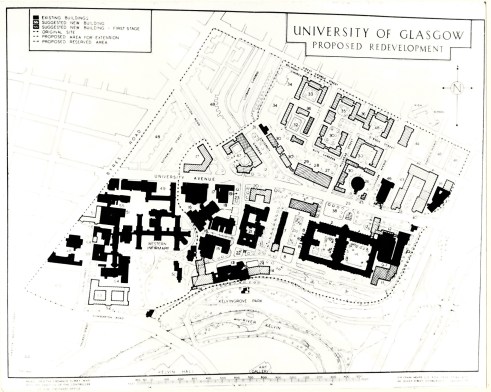
glasgow-universityIn 1951, Frank Mears submitted proposals for a major expansion of the University of Glasgow northwards into Hillhead.  In the eighty years since the construction of Gilbert Scott’s monumental Gothic edifice, the University had outgrown its Gilmorehill site and much of the original accommodation had proved to be ill-suited to the requirements of modern academic disciplines.

With a view to maintaining a sense of unity in the expanded university precinct, Mears proposed the progressive transformation of the space between the existing Reading Room and the Scott Building into a “Great Central Court”.  This would involve moving the main entrance of the Scott Building from its south to its north side, the grouping and design of new buildings on both sides of University Avenue in careful relation to the old, and the closing of the Avenue to through traffic to reduce noise and promote safety.

As with his earlier schemes for Jerusalem and Edinburgh, he sought to “combine the maximum of adaptability in construction of buildings with adherence to planning principles which will promote an environment of academic dignity” and he suggested that this could best be achieved by the development of a system of courts and quadrangles linked by tree-lined footpaths.  As at Jerusalem, he recommended that, wherever possible, internal partition walls should be erected independently of the main structure in order to facilitate the rearrangement of accommodation as needs changed.

Perhaps with an eye to developments in Edinburgh, The Glasgow Herald commented in an editorial that: “The mistake will not be made at Glasgow that has been made at universities elsewhere of dispersing activities that ought to be part of the central framework of academic and corporate life.”

Greenock Plans Ahead

21 Wednesday Sep 2016

Posted by Graeme Purves in Frank Mears

≈ Leave a comment

Tags

American Parkway, Frank Mears, Garden City, Greenock, Planning, reconstruction, redevelopment

greenockflats

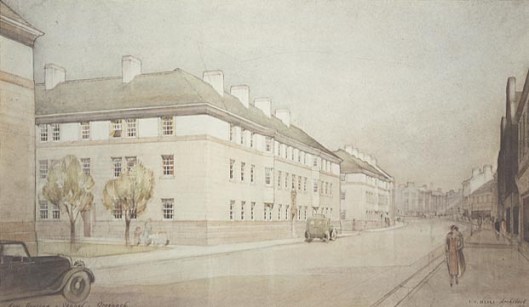
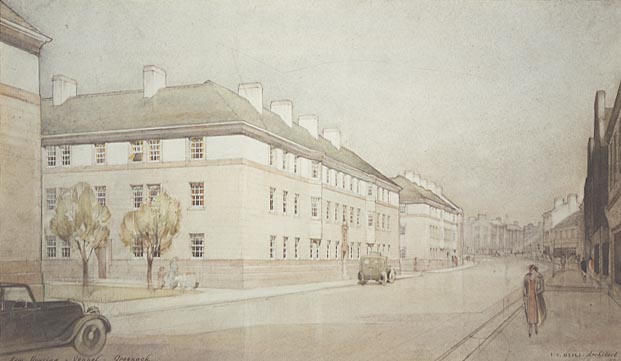
Council flats on the Vennel, Greenock, by Frank C. Mears

Frank Mears was appointed planning consultant to the Corporation of Greenock in 1940.  It was the only consultancy in which he directly confronted the problems of the industrial west of Scotland.  The plan he prepared, entitled Greenock: Portal of the Clyde, was published in 1947.  It outlined a programme for the long-term development of the part of Renfrewshire lying to the north of a line between Kilmacolm and Wemyss Bay.  Besides Greenock, it encompassed the burghs of Port Glasgow and Gourock and the villages of  Inverkip and Wemyss Bay.

During the Depression, the slump in shipbuilding had resulted in high levels of unemployment in Greenock and Port Glasgow.  As in Scotland’s mining areas, reliance on a single heavy industry had resulted in a particular vulnerability to recession.  Mears argued that future security depended on diversification of the area’s industrial base, with particular emphasis on the creation of employment for women.

On the basis of an analysis which traced Greenock’s history to its 18th century origins, Mears concluded that the town should should seek to build on its long-standing local industries based on tobacco, sugar, distilling and marine engineering, and that priority should be given to industries geared to export.

greenock-open-space-deficiency

Clyde Valley Regional Plan, 1949

Patrick Abercrombie’s Clyde Valley planning team had identified a serious deficiency of open spaces in the lower part of the town.  In Greenock: Portal of the Clyde (1947) Mears proposed redevelopment at lower densities, the creation of new industrial areas, and accommodation of the displaced population in a constellation of new neighbourhoods laid out in the Kip Valley on American Parkway lines to create a “federal Garden City”.

Mears also prepared layouts and designs for council housing in Greenock and a scheme for the redevelopment of part of the town centre which had been badly damaged by wartime bombing.

Mears’ proposals for Greenock received considerable publicity.  The work of the documentary film-maker John Grierson had stimulated an interest in film-making in Scotland.  The Scottish Office had been quick to appreciate the usefulness of film as a means of informing and influencing the public and had sponsored a number of documentaries on aspects of social and economic reconstruction.  Inspired by these precedents, in 1948 Greenock Corporation commissioned a documentary film on Frank Mears’ planning work in the burgh to complement an exhibition in the Town Hall. Greenock Plans Ahead was directed by Hamilton Tait and narrated by Frank Phillips.

A Man with a Plan

24 Sunday Jul 2016

Posted by Graeme Purves in Frank Mears, Reviews

≈ Leave a comment

Tags

Frank Mears, Frank Tindall, Planning, woodland


Frank Tindall

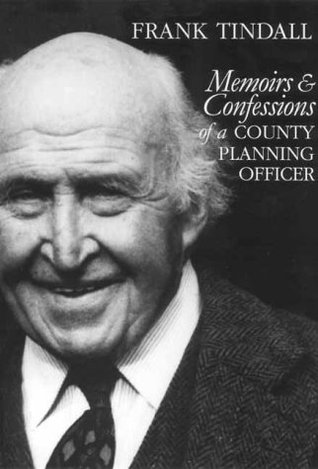
‘Memoirs and Confessions of a County Planning Officer’ by Frank Tindall (1998), The Pantile Press

This book provides a fascinating account of the professional career of Frank Tindall, who was Planning Officer for the County of East Lothian between 1950 and 1975.

Tindall acknowledges his debt to the holistic planning philosophy of Patrick Geddes and his son-in-law Frank Mears. Indeed, he followed directly in the footsteps of Mears, who was planning consultant for East Lothian from 1937 until 1950. Between them, Mears and Tindall established a tradition of sensitive conservation and renewal from which the area has greatly benefited.

Like Mears, Tindall promoted policies designed to check rural depopulation. Considerable effort was put into the improvement of infrastructure and the environment, safeguarding rural schools and consolidating villages through the provision of new housing, small workshops and community facilities.

The book contains numerous references to Tindall’s efforts to safeguard and extend woodland cover. Notable achievements included the saving of a number of the County’s remaining fragents of ancient oakwood, securing public access to Pressmennan Wood and the transformation of Woodhall Bing at Pencaitland into a popular recreational woodland. He made a particular point of encouraging tree planting in development schemes and concern over the potential impact of commercial afforestation of the Lammermuir Hills led him to advocate that planning control be extended to cover forestry schemes.

For the last ten years of his working life Tindall was Director of Physical Planning for Lothian Region. During that time he was instrumental in creating the Regional Council’s Land Reclamation Unit. He was also responsible for the establishment of the Central Scotland Woodlands Project, which had its origins in Mears’ Central and South-East Scotland Plan of 1949.

Survey work for the County Development Plan revealed the extent of neglected and degraded woodland in East Lothian. Tindall and his staff sought to promote positive woodland management and were ground-breaking in encouraging the planting of upland catchments to tackle problems of flooding and erosion. There remains considerable scope for extending tree cover in East Lothian and a renewal of effort in that area would be a fitting tribute to Frank Tindall’s memory.

_________________________________________________________________

This review first appeared in Reforesting Scotland 20, Spring 1999.

The Planning and Building of the Hebrew University, 1919 – 1948

02 Monday May 2016

Posted by Graeme Purves in Frank Mears

≈ 2 Comments

Tags

Benjamin Chaikin, Diana Dolev, Frank Mears, Hebrew University, Jerusalem, Patrick Geddes, Zionism

Hebrew University

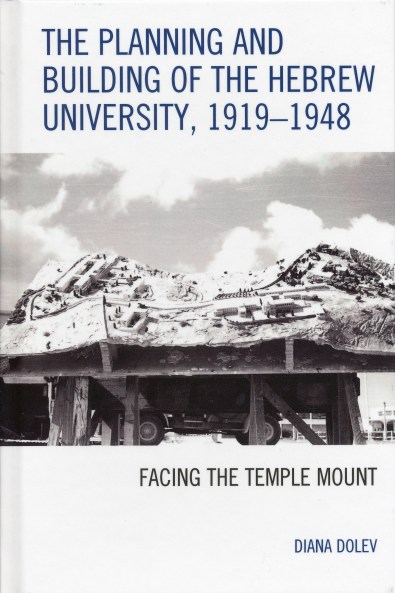
After a hectic few weeks, I’m finally getting round to reading Diana Dolev’s important new book about the planning and development of the Hebrew University of Jerusalem.

‘Review to follow!


Mears Drawings Sold at Auction

11 Wednesday Nov 2015

Posted by Graeme Purves in Frank Mears

≈ Leave a comment

Tags

Charles Denny Carus-Wilson, Elgin, Frank Mears, Invermoriston, Peebles, Ramsay Traquair, Scottish National War Memorial, Stirling

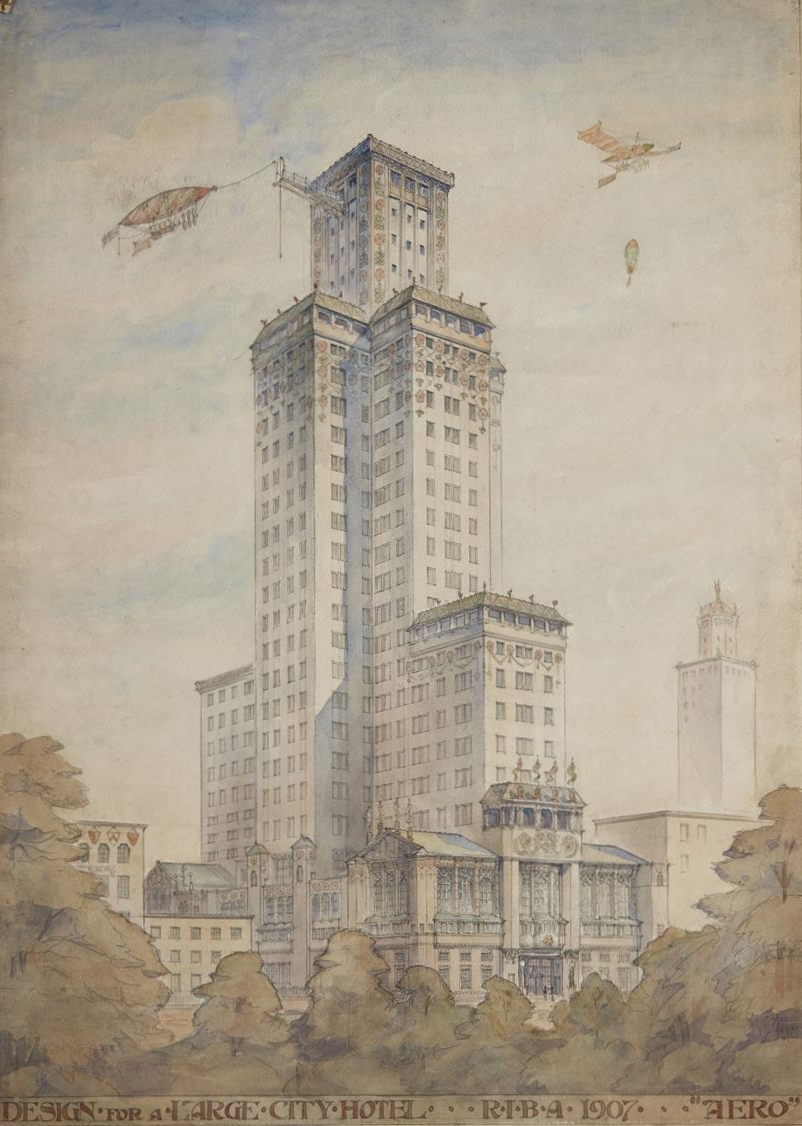
Large City Hotel -1907

Aero Hotel, 1907

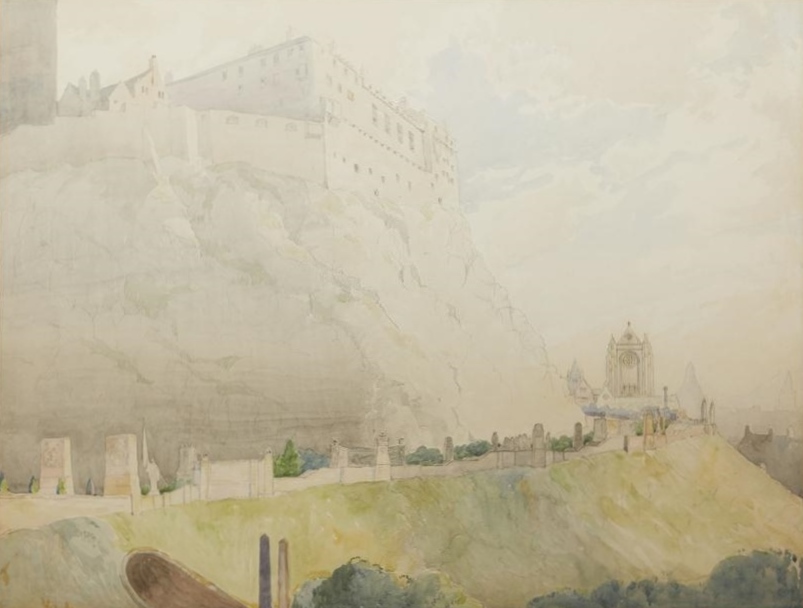
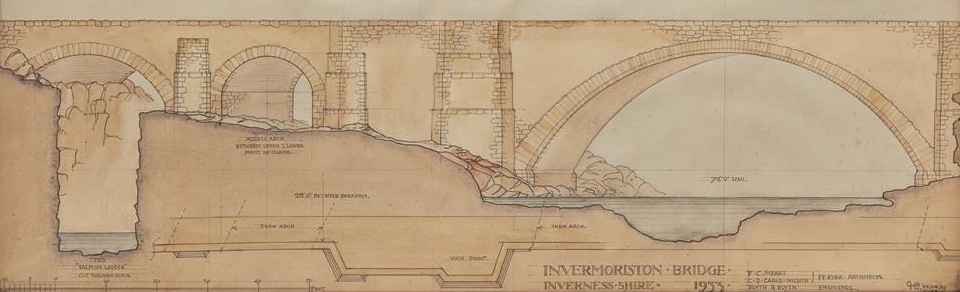
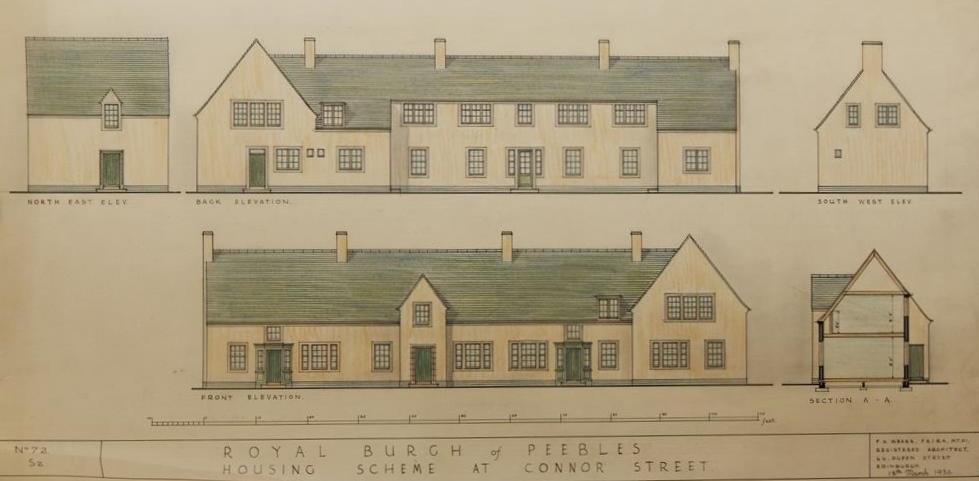
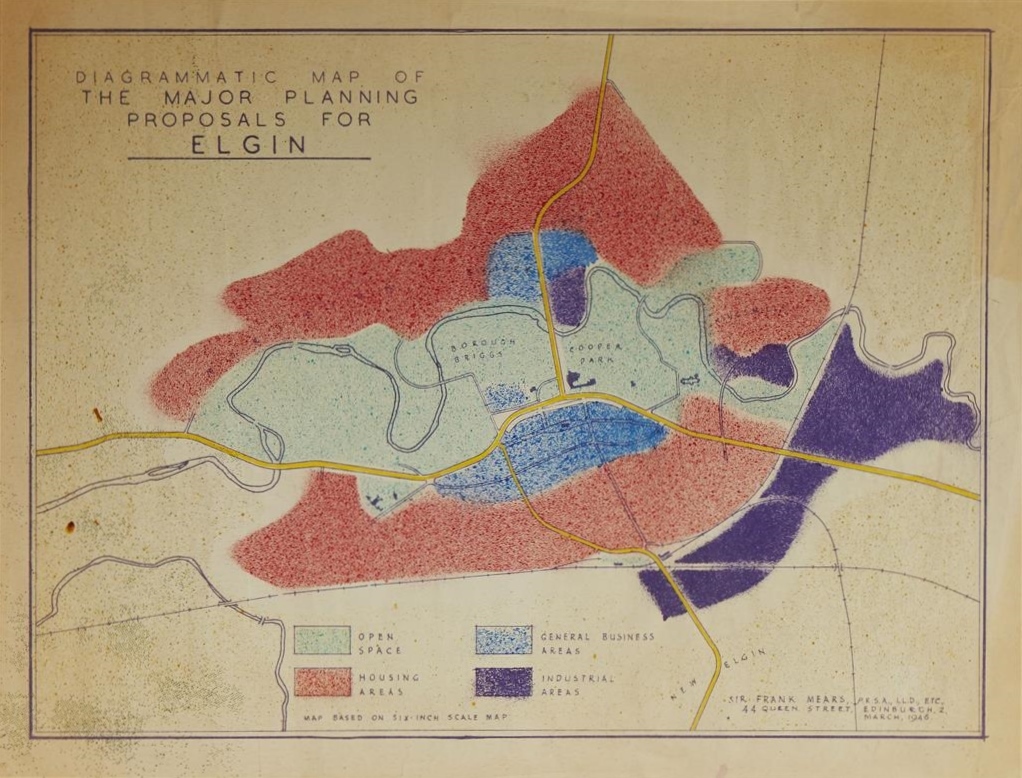
A historically important collection of drawings and plans by the architect and planner Sir Frank Mears was sold at auction this week.  The collection, previously held by the firm of Frank Mears and Partners, featured as four lots in the the Decorative Arts sale at Lyon & Turnbull in Edinburgh on Wednesday 11 November.

Scottish National War Memorial as Via Sacra 01

Scottish National War Memorial as Via Sacra (1919)

In the course of his career, Frank Mears prepared a number of schemes for monuments and memorials.  The collection includes a sketch by Mears and the architect Ramsay Traquair for a memorial to Edward VII & I at the foot of the Canongate in Edinburgh (1911), a watercolour of his proposal for a Scottish National War Memorial as Via Sacra (1919), and a watercolour by the architect Robert Naismith of Mears’ Royal Scots Regiment Monument in Princes Street Gardens (1950).

Invermoriston Bridge 1933

Invermoriston Bridge (1933)

In 1930, Frank Mears and Charles Denny Carus-Wilson were appointed consultant architects for five new road bridges on the A82 in the Highlands.  The collection includes a watercolour panel of their design for the Oich Bridge (1930) and watercolour elevations of their bridges at Fort Augustus and Invermoriston (1933).

Connor Street, Peebles 1936

Housing Scheme at Connor Street, Peebles (1936)

From 1932, Mears prepared plans and designs for a number of housing schemes in the Royal Burgh of Peebles.  The collection includes plans and elevations for schemes at Neidpath Road (1935) and Connor Street (1936).

Baker Street, Stirling 1943

Reconstruction of Baker Street, Stirling (1943)

In 1936, Stirling Town Council engaged Mears to advise on the redevelopment of Baker Street in the burgh’s historic core.  The collection includes watercolour sketches for the reconstruction of Baker Street dated 1940 and 1943.

Elgin - Major Planning Proposals

Major Planning Proposals for Elgin (1946)

In 1938, Mears was engaged by Elgin Town Council to advise on a scheme for the historic part of the town.  Work was suspended following the outbreak of hostilities in 1939, but in 1944 the Council asked him to prepare a development plan for post-war reconstruction.  The collection includes his plans for major new residential development and the road improvements required to support it (1946).

The drawings have been acquired for the national collection by Historic Environment Scotland.

David Livingstone Memorial

13 Saturday Jun 2015

Posted by Graeme Purves in Frank Mears

≈ Leave a comment

Tags

Blantyre, Charles d'Orville Pilkington Jackson, David Livingstone, Frank Mears

The David Livingstone Trust has been successful in gaining a grant of £3.5 million from the Heritage Lottery Fund to transform the David Livingstone Centre at Blantyre into a leading heritage attraction.

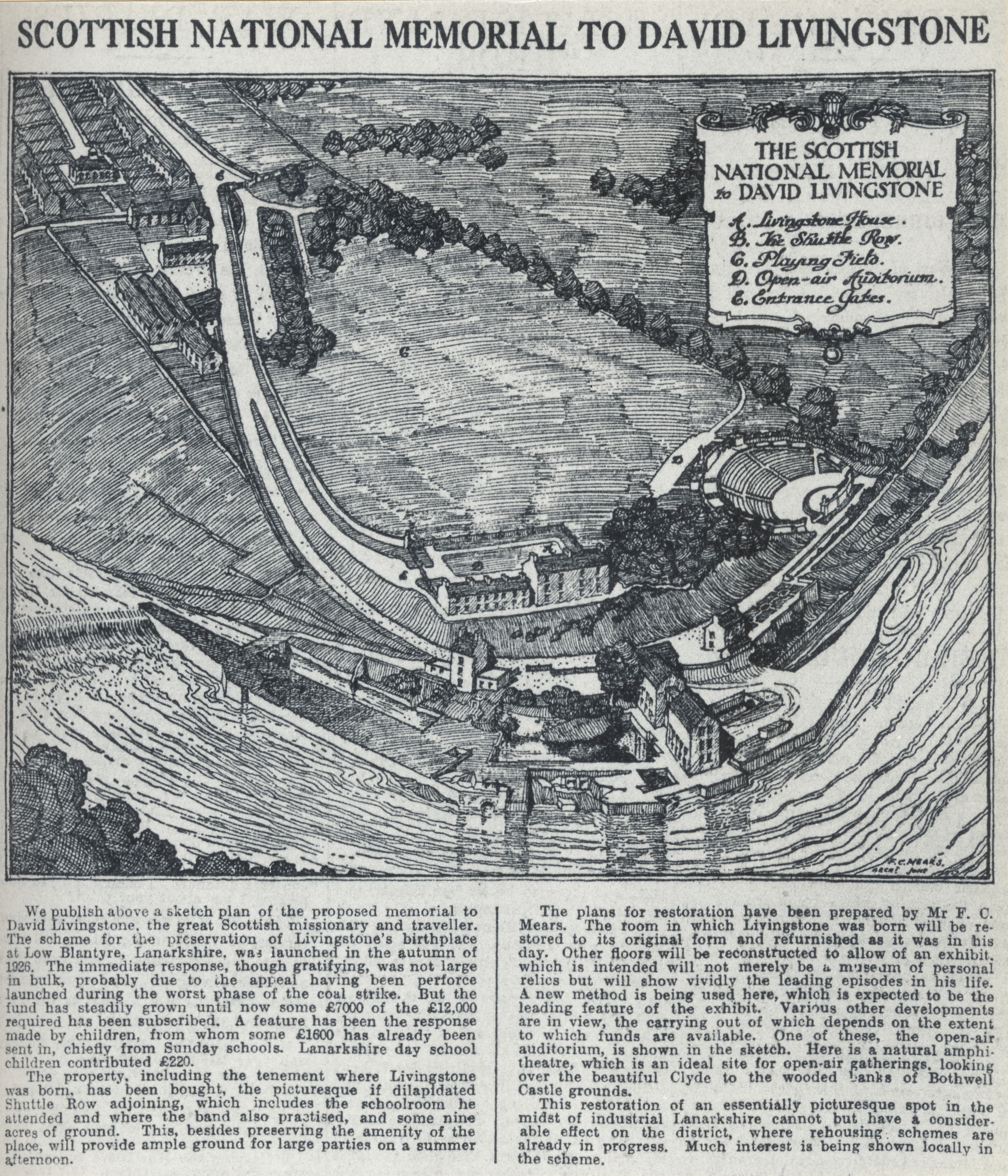
Livingston Memorial

Report in The Glasgow Herald, June 1927

The David Livingstone Memorial was developed in the early 1930s according to a scheme devised by the architect and planner, Frank Mears. It incorporates important work by the sculptor, Charles d’Orville Pilkington Jackson, including the Patrick Geddes inspired World Fountain.

The village of Low Blantyre was built on the banks of the Clyde near Hamilton in about 1785 to house the workers at the nearby cotton mill founded by David Dale. After production ended in 1904, the settlement was progressively abandoned.  The houses fell into decay and the local council embarked on a programme of gradual clearance so that, by the early 1920s, the tenement in which David Livingstone was born in 1813 was one of the few buildings left standing.  On a visit in 1925, the Rev. Dr. James I. Macnair and the local Congregational minister, the Rev. D. N. Thomson, found it in a ruinous condition and Thomson suggested that an effort should be made to acquire the property and surrounding grounds to create a permanent memorial.

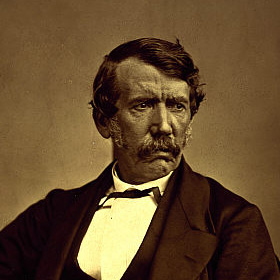
David Livingstone

David Livingstone

There were three remaining buildings on the site: a three-storey tenement of 24 single-ends, one of which was Livingstone’s birthplace; an adjoining row of two-storey cottages, and a lodge in its own grounds.  An option over the properties was secured from Messrs. Baird & Co., the local coal mining company, and a temporary Memorial Committee was established.  In order to promote the scheme, the Committee recruited the support of an impressive array of Scottish dignitaries, including J. M. Barrie, John Buchan, Ramsay Macdonald, the Duke of Hamilton, Field Marshal Lord Haig, the Earls of Elgin and Home, the leaders of the Scottish churches, the principals of the Scottish universities and the provosts of the cities and principal towns.  An appeal was launched in 1926 but, in the uncertain climate created by the National Strike, wealthy benefactors were reluctant to come forward.  It was not until the following year, after an approach had been made to Scottish Sunday schools and bible classes, that sufficient funds were raised to allow the project to proceed.

The Rev. Dr. Donald Fraser of the United Free Church suggested that Professor Patrick Geddes was the most suitable person to prepare a restoration scheme.  However, Geddes was by this time ensconced in France, busy with his university project at Montpellier.  The Memorial Committee’s Secretary, Mr. J. G. Harley, pointed out that Geddes had a son-in-law, Frank Mears, who was “a man filled with the same idealism” and “had great experience in the restoration of old buildings”.  On this recommendation, Mears was invited to Blantyre to give his opinion.  He was inspired by the opportunity to be involved in a restoration project of such national significance and, after his visit, he greatly expanded on the Committee’s original idea of turning Livingstone’s birthroom into a place of pilgrimage.  James Macnair later acknowledged that “It is to our architect, Frank Mears, that we mainly owe the unique form which the Memorial gradually assumed”.

In its early days, the Memorial’s main attraction was the Livingstone Gallery, which sought to convey the essential aspects of Livingstone’s character in a series of eight relief tableaux.  The concept was devised jointly by Mears and Pilkington Jackson.  Mears created the long, low gallery by throwing four of the tenement’s little rooms together and used their bed recesses as niches for displaying the tableaux.

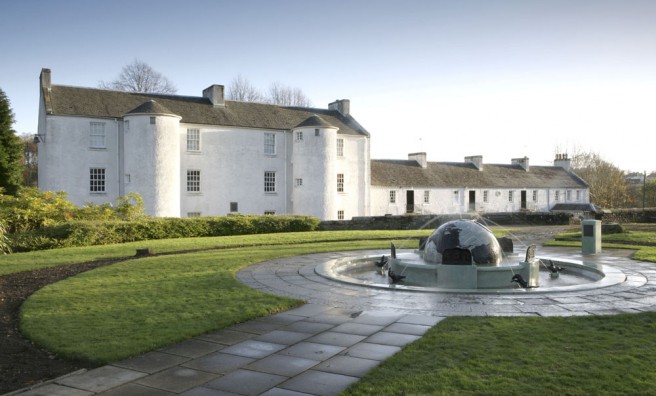
Livingstone Memorial

Shuttle Row buildings and the World Fountain

Some years after work on the Shuttle Row buildings was completed, a gift from the widow of one of the early trustees allowed the construction of the World Fountain in the adjoining grounds.  The design, which displays a strong Geddesian influence, was conceived by Frank Mears and executed by Pilkington Jackson.  It takes the form of a globe of the world about 6 feet in diameter rising from the centre of a basin filled with water.  The globe is tilted so that Blantyre lies on its summit and it is oriented so that, at any time, the area of its surface which is illuminated by the sun corresponds to that part of the world which is then in daylight.  Five plaques around the edge of the fountain portray Geddes’ “elementary occupations of mankind” while, from the basin, bronze figures are positioned to throw fine sprays of water over the globe’s surface.

It is to be hoped that the new project will respect the work by Mears and Pilkington Jackson.

55.801821 -4.083363

Frank Mears – a Pioneer of Scottish Planning

20 Monday Oct 2014

Posted by Graeme Purves in Frank Mears

≈ 2 Comments

Tags

Edinburgh Zoo, Frank Mears, Patrick Geddes, regional planning, rural regeneration, Thomas Whitson, urban conservation

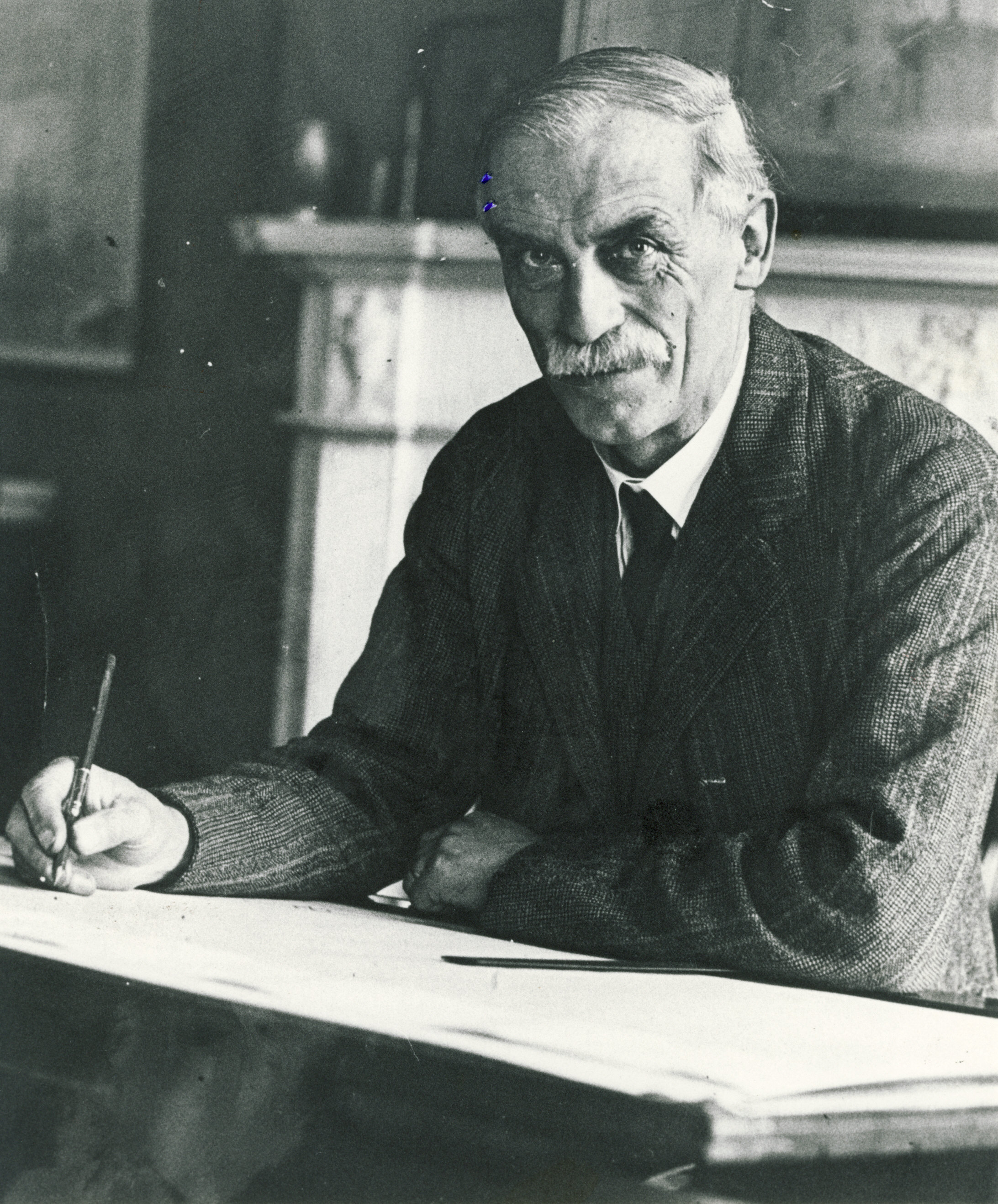
Sir Frank Mears

Sir Frank Mears

Frank Mears was Scotland’s leading planning practitioner during the 1930s and 40s.  In 1944 he was elected President of the Royal Scottish Academy, in 1945 he received an honorary doctorate from Edinburgh University and in 1946 he was knighted in the New Years Honours.  Yet in the period since his death in 1953, his distinctive contribution to the early development of planning in Scotland has been largely forgotten.

Mears was born in 1880.  His architectural training in Edinburgh at the turn of the Century had a strong Medieval emphasis and as an apprentice he worked on a number of important ecclesiastical projects, such as the Coates Memorial Church in Paisley.

It was as a result of his work with Patrick Geddes that Mears developed an interest in planning.  In around 1908, Mears became involved with the circle of artists, intellectuals and civic activists associated with Geddes’ Outlook Tower.  Geddes lamented the loss of the intellectual pre-eminence which Edinburgh had enjoyed during golden years of the Enlightenment, and the great variety of environmental and educational projects which he promoted in the city were designed to stimulate a cultural and intellectual renascence. Early in their relationship, he wrote to Mears of his hopes for Edinburgh in the following terms:

“The scheme is a great one – that of planning the cultural future of Edinburgh – a renascent capital – and of Scotland as again one of the great European powers of culture.”

An appreciation of Geddes’ close engagement with the fate of Edinburgh as a national culture-capital is crucial to an understanding of the particular perspective which he brought to planning.  His conception of the nature and purpose of planning was quite different from that of other planning propagandists.  For Geddes, the central concern was not with the technical problems of urban expansion or the creation of brave new utopian settlements but with the task of inspiring communities to an active participation in their own cultural and social renewal.

Mears soon became one of Geddes’ principal assistants and played a key role in a number of important projects, including the Survey of Edinburgh and the preparation of the award-winning Cities Exhibition. In his subsequent career, Mears was the planner who most faithfully sought to translate Geddes’ ideas on social and cultural renewal into practice.

In 1913, Geddes and Mears were engaged to lay out Edinburgh’s new Zoological Park at Corstorphine.  Much of the work was done by Mears and Geddes’ daughter, Norah, whom Mears later married.  He was keen to avoid the use of traditional cages as far as possible and his designs for rock dens and enclosures was influenced by the innovative approach to the display of animals pioneered at New York and Hamburg.

Dublin Reconstruction - 1922

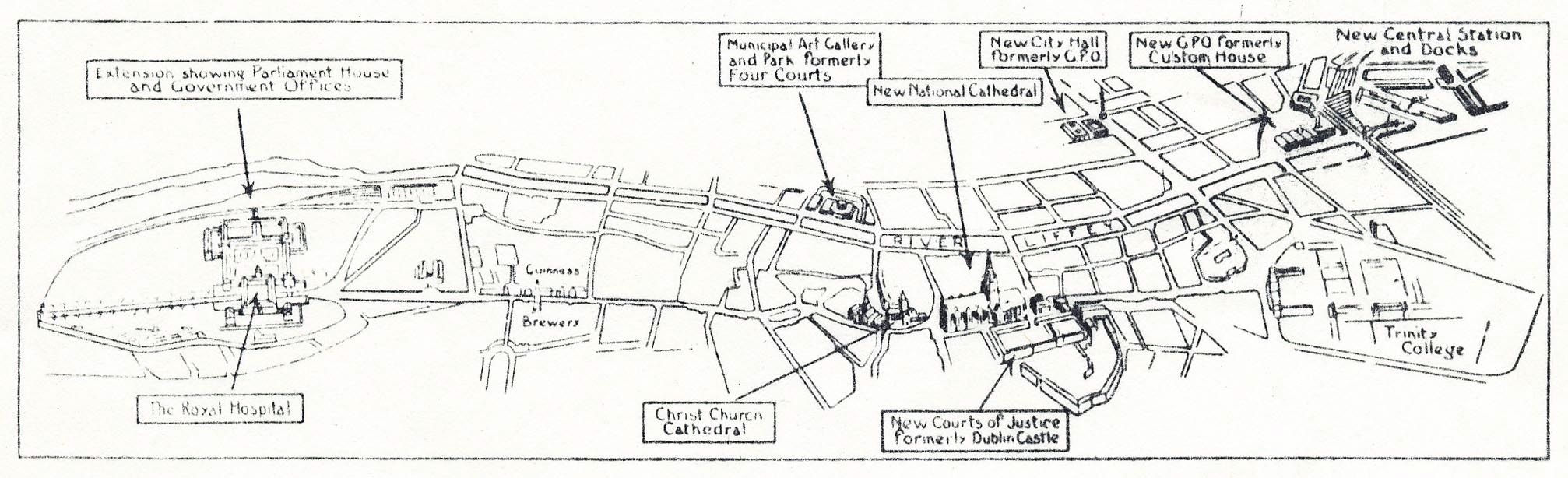
Greater Dublin Reconstruction Movement proposals, 1922

After the Great War, Mears undertook important work in two other culture-capitals during crucial periods of transition.  In 1919, Geddes and Mears were commissioned by the Zionist Commission for Palestine to prepare plans and an architectural design for the Hebrew University of Jerusalem.  In 1922, Mears assisted the Greater Dublin Reconstruction Movement with the preparation of plans for civic renewal and the accommodation of new national institutions in the early days of Irish independence.

During the twenties and thirties, Mears maintained a close interest in planning and development issues in Edinburgh.  He had an close ally in Councillor Thomas Whitson and when Whitson became Provost in the late twenties, Mears was commissioned to prepare preliminary suggestions for the City Centre.  The vision which he offered was of the historic city renewed as a modern Scottish capital and the plan placed emphasis on meeting the needs of expanding national and civic institutions.

greenockflats

New tenement housing for Greenock

Mears was a pioneer of conservation in Scotland’s historic burghs.  In Edinburgh, he campaigned for the renewal of the Royal Mile and undertook the restoration of Huntly House and Gladstone’s Land.  In the period between 1936 and his death in 1953, he acted as planning consultant to the burghs of Dumfries, Elgin, Girvan, Greenock, Perth, Stirling and Thurso.  Perhaps the best example of his reconstruction work in historic burghs is his scheme for the renewal of Stirling’s Old Town.

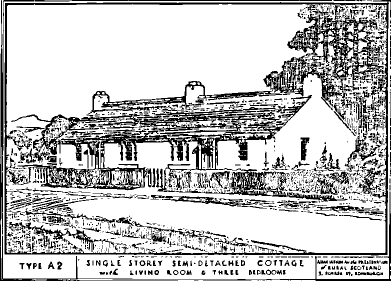
Mears was keenly interested in rural issues and played a key role in the establishment of the Association for the Protection of Rural Scotland.  He stressed the importance of providing modern services and infrastructure in rural areas and in East Lothian and the Borders he applied community planning principles to the development of strategies for rural resettlement.  He was also concerned about the quality of new development in the countryside and, on behalf of the APRS, he prepared standard designs for low-cost rural houses.

cottage

One of Mears’ designs for low-cost rural housing

Mears was a strong advocate of regional planning.  In 1943, under the autonomous administration established by wartime Secretary of State, Tom Johnston, he was asked to prepare a regional plan for Central and South East Scotland, an area encompassing the entire Forth and Tweed catchments.  The Plan reflected Mears’ strong concerns about the impact of rural depopulation and advocated the return of approximately 10% of the urban population to the rural areas.  It included a strategy for the resettlement of depopulated Border valleys and its proposals for the reafforestation and recolonisation of the Slamannan Plateau laid the foundation for what was to become the Central Scotland Forest.

Towards the end of his career, Mears addressed the issue of rural depopulation in its most acute form in a strategy for the revitalisation of Sutherland.  Against the prevailing wisdom of the time, he rejected the notion that the problem could be solved “by a simple process of decanting a given proportion of large-scale industries into partially depopulated areas.”  Instead, in a plan strongly influenced by Frank Fraser Darling’s Preliminary Report on the West Highland Survey, he advocated a strategy based on the regeneration of the crofting economy through measures such as land rehabilitation, tenure reform, investment in agriculture, forestry and fishing, and the encouragement of small rural industries based on indigenous resources.

Following the 1945 General Election, the initiative in matters of planning and reconstruction passed from the Scottish Office to Whitehall and in the post-war period a technocratic planning profession was to become increasingly preoccupied with systems, procedures and regulation.  In this climate, those aspects of Mears’ planning philosophy which did not conform to British planning orthodoxy were largely disregarded.  Today, his commitment to social, cultural and environmental renewal, and the emphasis he placed on urban conservation and rural regeneration can be seen to have abiding relevance.  


This article was first published in the Autumn 1999 issue of the Saltire Society Newsletter. In 1981 the Society awarded me a Robert Hurd scholarship to enable me to undertake research on Frank Mears.

The Hebrew University and the Expression of National Identity

18 Saturday Oct 2014

Posted by Graeme Purves in Frank Mears

≈ Leave a comment

Tags

architecture, Benjamin Chaikin, Frank Mears, Hebrew University, national identity, nationalism, orientalism, Patrick Geddes

Mears & Chaikin - model_edit

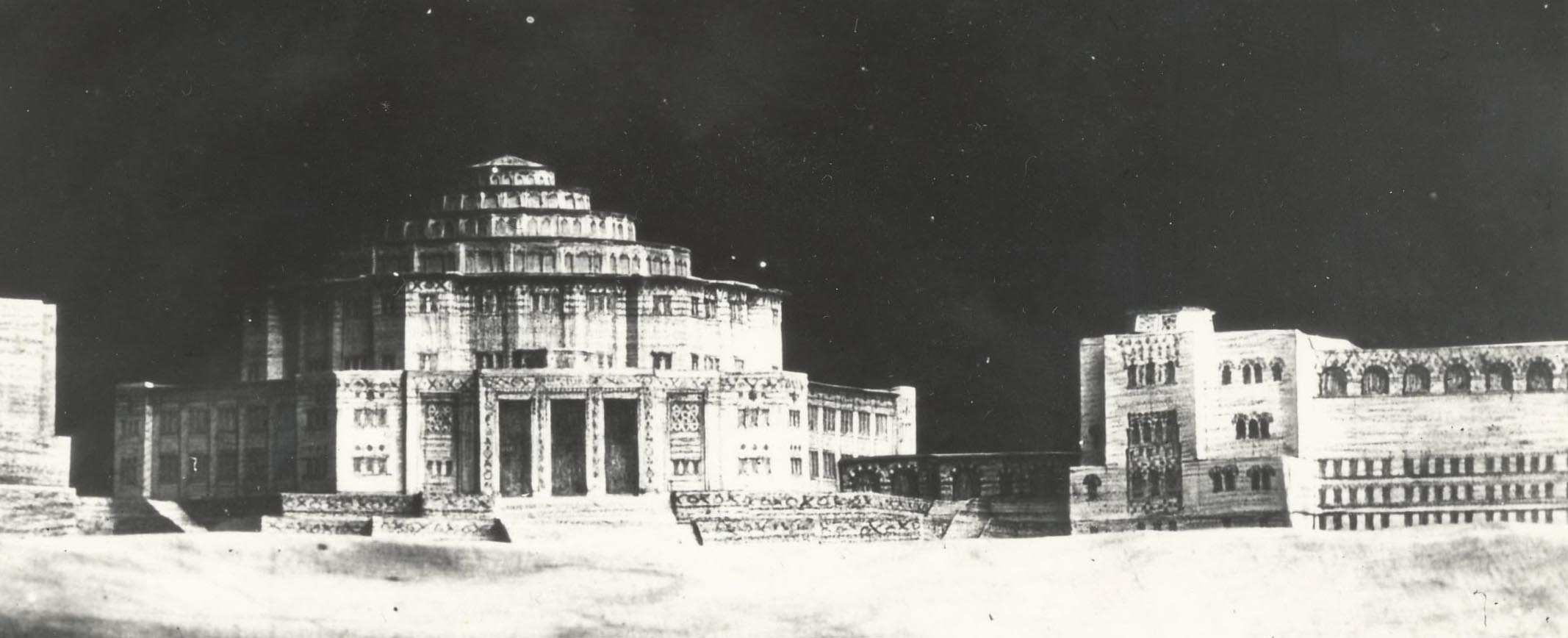
Model based on plans for the Hebrew University by Mears and Chaikin, 1928

Dr. Diana Dolev of the Holon Institute of Technology in Israel is writing a book about the development of the Hebrew University campus in Jerusalem which will include a reassessment of the architectural collaboration between Frank Mears and Benjamin Chaikin from 1925 to 1929.

Dr. Dolev teaches architecture at the Holon Institute and researches the relationship between national identity and architecture.  In 2000 she was awarded a Ph.D. for her thesis on the influence of nationalist ideology on the masterplans prepared for the Hebrew University between 1919 and 1974.  She has written on architectural orientalism in the Hebrew University and the militarisation of the university campus on Mount Scopus.

In 1919 Patrick Geddes and Frank Mears were engaged by the Zionist Organisation to prepare a scheme for a Hebrew University.  In 1925 Geddes and Mears began to collaborate with Jerusalem-based architect, Benjamin Chaikin, on the preparation of the detailed architectural drawings required to realise the scheme.

Material relating to the involvement of Geddes, Mears and Chaikin in the development of the Hebrew University of Jerusalem is now distributed between a number of institutional collections, including the Zionist Archives and Hebrew University Archives in Israel, the National Library of Scotland, the Geddes collections of Strathclyde and Edinburgh universities, and the Royal Commission on the Ancient and Historic Monuments of Scotland.  In the 1990s, Volker Welter prepared a comprehensive catalogue of the material from Geddes’ Cities Exhibition held by Strathclyde University.  Currently, Grant Buttars of the Special Collections Department at Edinburgh University is working on a programme of cataloguing, conservation and digitisation of the Geddes material held in the Edinburgh and Strathclyde collections to make it more accessible and facilitate dissemination.

With these resources to draw upon, Dr. Dolev’s work offers the welcome prospect of a much fuller understanding of what Geddes, Mears and Chaikin were seeking to achieve in their work on the Hebrew University.  It is expected that her book will be published in the autumn of 2015.


See my article, A Vision of Zion, from the Spring 2000 issue of the Scottish Review.

31.779299 35.197143

Observations on the Western Front

04 Monday Aug 2014

Posted by Graeme Purves in Frank Mears

≈ 2 Comments

Tags

Alasdair Geddes, Frank Mears, kite balloon observers, Patrick Geddes, Western Front, World War I

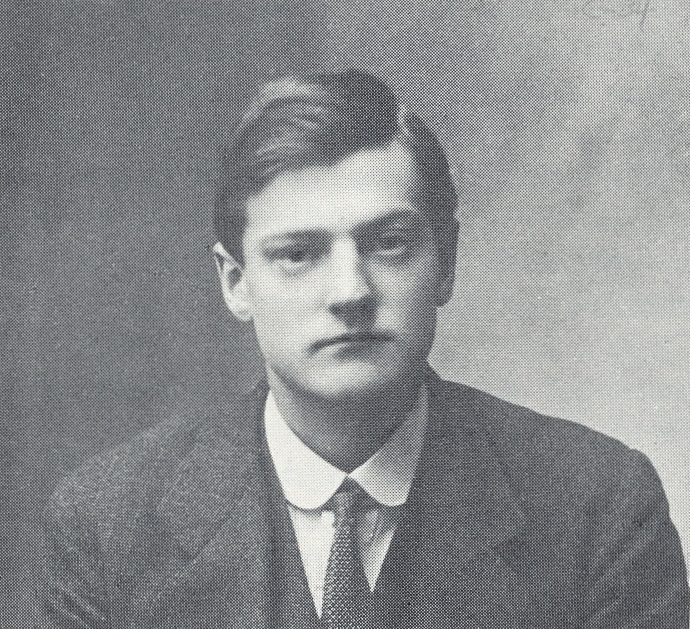
Alasdair Geddes

Alasdair Geddes

It has become a truism that the First World War deprived a generation of many of its most gifted representatives.  One who can be counted amongst these is Alasdair Geddes, eldest son of the botanist, planner and sociologist, Patrick Geddes.  Professor Geddes entertained great hopes that Alasdair would one day succeed him, taking forward his work in civics and regional survey.  To this end, he devised a unique educational programme for his son.  Geddes senior had little time for the dry academic curriculum provided by the schools of the time and so Alasdair was taught almost exclusively by his parents, with the emphasis on observation, artistic expression and practical gardening.  His studies at home were interspersed with periods of work experience in various crafts and industries under the guidance of skilled practitioners.

His father’s insistence on imposing his own educational regime upon his children was frowned upon by the more conventional sections of Edinburgh society, but critics were confounded when Alasdair went on to enjoy a successful university career culminating in the award of prizes and research scholarships.  He provided invaluable assistance to his father in many of his projects, organising the display of the influential Cities Exhibition in Dublin, Ghent and Madras, for example.  At that time, he showed every sign of becoming an able successor.

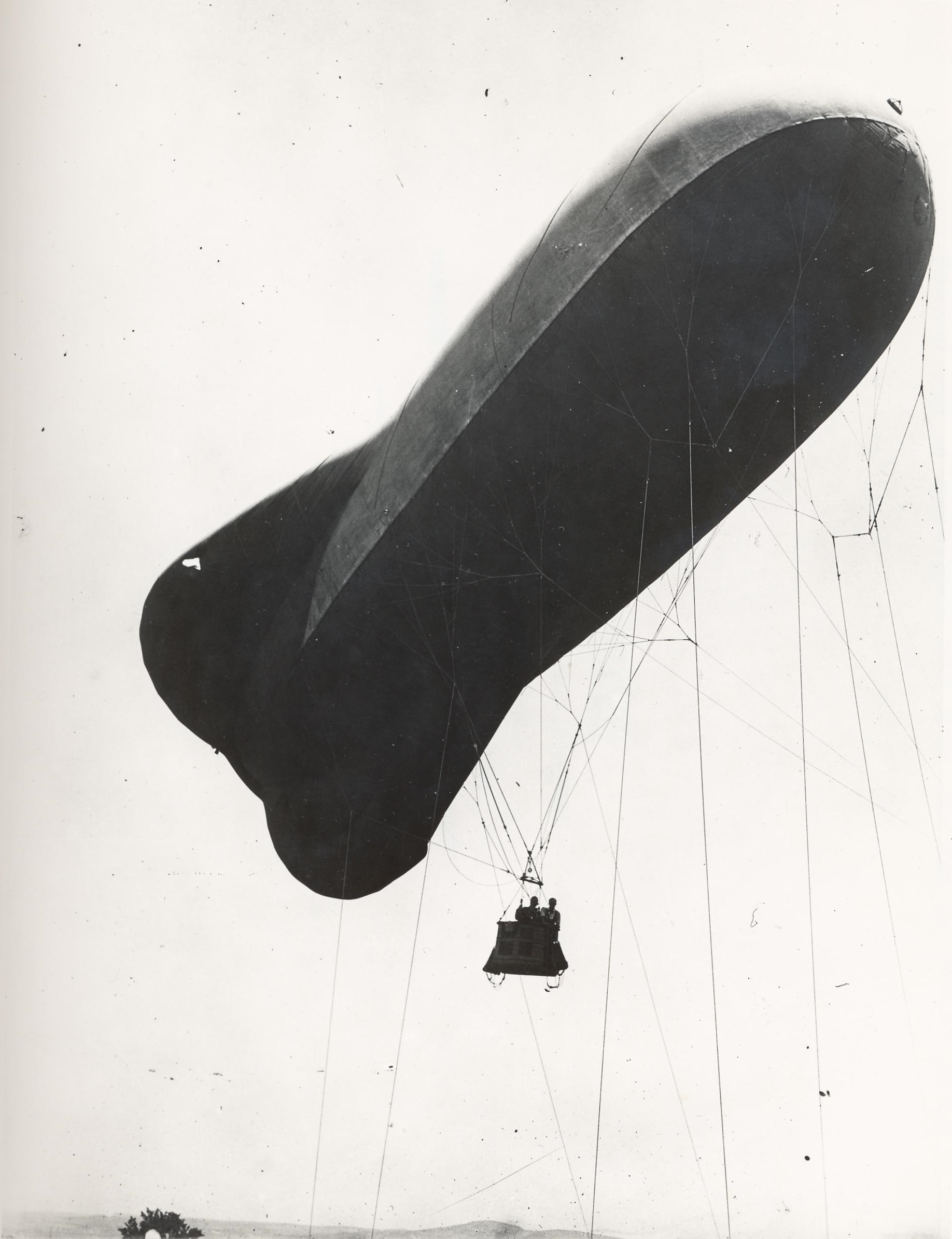
However, like so many young men of his generation, Alasdair was to have his career brought to a halt by the outbreak of the Great War.  He was outraged by the destruction of the Belgian and French towns which he had come to know and love during his travels on the Continent with his father and, in 1915, he volunteered for service with the Royal Naval Air Service.  He was subsequently transferred to the Royal Flying Corps and served as a kite balloon observer on the Western Front.  By the end of 1916 he had been promoted to the rank of Major, the youngest in that branch of the Army and, in recognition of his outstanding ability as an observer, he was awarded the Military Cross.

Kite Balloon

Kite Balloon on the Western Front

His brother-in-law, Frank Mears, served alongside him at this time and, after the war, wrote the following account of their experiences:

“When I went out to France in August 1916, our section went first to the village of Forceville near Albert, but I found myself almost at once transferred to Alasdair’s section which, fortunately, was only a few miles away, just South of Bouzincourt and west of Albert.

The section was in tents, living a peaceful life clear of any shelling and on clear ground. I was supposed to be on loan from my section (No. 18) in order to learn the job quickly and then go back to them.  There was some jealousy, I think, in 13 and 18 Sections, about this alleged “nepotism” as at this time everyone was out for putting in as much time as possible in the air: a little later, ballooning ceased to be such a source of enjoyment.  Balloons up to the Spring of ’17 were comparatively rarely attacked or shelled.  They were only beginning to be taken seriously in the course of ’16, and wer few in number and widely spaced on the line. Later, when there were 50 or so on the British Front, they began to look like beads on a string.

Our work was comparatively simple, straightforward shooting at points, but Alasdair was beginning to get keen on “Counter Battery” work and was constantly in touch with the Corps CB office.  As I look back, I feel as if he regarded it as a sort of club.  He was always in hobnobbing with them.  This work ws really very important.  It consisted of marking down enemy batteries, by their flash, and reporting them either as, if already known, active, or as new positions, in either case to be noted by CB office for strafing.  Sometimes we got one of our batteries turned on on the spot, and later this neutralisation became a very important part of balloon work.  It was this sort of work which Alasdair liked, since it involved good observation of a more difficult order than that required for ordinary, straightforward target work.  It its results were less immediate than the latter, this work counted for more in the end, since on successful countering of enemy batteries depended the success of operations on an attack day.  Our batteries would register by trial rounds on the enemy positions and then on attack day would plaster them with shells and so try to stop them from firing.  On occasion too, we would shoot up one of these enemy positions with a heavy howitzer battery.

Headquarters made a great boom of observations of Alasdair’s on Thiepval, on one of the first occasions when tanks were used.  The balloons were too far back for observation of movements of men in the attack, but Alasdair succeeded on this occasion in following the fortunes, or rather misfortunes, of several poor tanks, and reported their course stage by stage.  He was always very careful with his observations, checking and cross-checking each, and he had a very good memory for what had been, before shelling turned everything but a few landmarks into a sea of shellholes and mud.  He also made a strong point of new observers going to visit batteries so as to get an inkling of the gunners’ point of view.  During the Winter of ’16/17, we all had to spend a fortnight with a battery, in addition to ordinary visits on dull days.

Before this he had the problem of moving his section so as to get a better light for observation during the best part of the day. As a result of the attacks of July 1916, 13 Section Balloon had come to be in a position facing a salient with Thiepval at its apex.  We were thus looking North Eastward, and rather along our part of the line instead of fronting it.

After some prospecting, he got permission for us to go into the next army area, and chose a site in a clearing in Fricourt Wood, three miles East of Albert.  From this site we looked North with the sun behind us and, being in effect in advance of our Corps batteries, we were able to stay in this area until the Germans did their big retreat in March.

The place was far from delectable.  Fricourt had formed a slight salient of the original German front line, the vallage resting on a little ridge with the wood behind it.  Thus it had ample opportunity to get into a thoroughly filthy and shell bespattered state and, in the wet Autumn weather, we were pretty well surrounded by liquid mud.  The village and chateau had disappeared but the trees remained enough to give shelter.  We first had tents, but with indications of the beginning of night bombing and a railway near which drew shells we went in for semi-dugouts.

Although the surface was muddy, one could dig down four feet or so without much dampness.  Two of the other men started a hole but got fed up and in the course of chat Alasdair and I, who had rather favoured tents, became involved in furnishing it.  The work finally devolved mainly on me, since Alasdair was busier.  It became a rectangular hole, eight feet wide by twelve or fourteen long.

I annexed some of the heavy timbers of the belfry of the destroyed church, some Germans having brought them into the wood.  One stuck up at each end supported a great roof beam.  Two tiers of ammunition boxes surrounded the hole forming a series of open lockers, and shhets of corrugated iron spanned over from the beam onto the thrown out earth on each side. An oil drum stove, moveable, could be used to dry one end, and then be moved to the other, and canvas was stretched from the beam to the sides, and hung as a dado to hide the earth sides.  Altogether it wasn’t so bad, but would have been no use against a serious attack.  However, it was never tested.  We shared this hole for a time, but Alasdair was soon moved away on his promotion.

I think he first smelt powder here – as I did.  One night, the Germans, about to retire, threw about a few speculative shells to get rid of them.  We heard an endless long-drawn wail, followed by a crash one hundred yards away and, thinking it was a bomb, and so no more likely to fall near, we two went out to see if it had been too near our balloon.  When we got near the place, we heard a fresh wail getting nearer and nearer and another one plumped down not very far away.  We got under a half fallen tree till the rain of clods etc. ceased and then went home.  These shlls had been fired at very extreme range and made a curiously tired sound in the air.  They were quite active on arrival however.

We had a more strenuous experience one afternoon.  When we got up, we found a heavy gale blowing and couldn’t do much owing to the tossing of the balloon.  I was being sick over my end and Alasdair seemed intent on observation, if rather quiet; he was just showing his head over the edge, back towards me.  I admitted, a little shame-facedly, to sickness, and then found that he was much worse than me and his observation had been mostly downwards.  However, we soon had other things to think of, for a heavy high velocity gun began to explore our area, including ourselves. 9½ inch shells began to drop up and down the clearing and as we could do no work and couldn’t come down we sent the whole crew away to a deep German dugout (where they had their lights blown out by the concussion of one shell) and endured the performance by ourselves.  They did some damage to our camp, pushing in one or two of the shelters, but no-one was touched.  We could see the flash of the gun, at Fremicourt behind Bapaume, and then had to wait 57 seconds for the shell to arrive.  I saw one coming; it must have passed just under our basket.  We struggled at an early stage into our parachute harnesses (this was before the days when we wore them all the time) but we would have been over the line before we knew where we were, with that wind.

After a while the firing ceased, so we made shift to come down, but whether this annoyed them, or whether they had only adjourned for tea, they began again.  An added annoyance was that our 9 inch railway gun was waiting to reply with its nose cocked up ready, but the observing plane which they had arranged for never turned up.  They wouldn’t fire on our observation alone, not that we could have done much at that long distance.  We were a sorry couple when we were finally hauled down.”

On a later occasion, the two men were forced to jump by parachute when their balloon was attacked by an enemy aircraft.  In the evening of 3rd April 1917, Major Geddes and Lieutenant Mears ascended in Balloon FM 26 to a height of 2,800 feet.  In the words of Mears’ subsequent report:

At 7.10 pm the order was given to haul down as anti-aircraft shots were heard and a hostile aeroplane was seen. This descended on the starboard side, flew behind and slightly above the balloon, went on for some distance and then turned sharply back and flew straight at the balloon firing a stream of incendiary bullets many of which pierced the envelope.  The aeroplane then banked and swerved behind the balloon, turned again, and went in the direction of 18 Section.

After jamming with the first three shots, the Section gun got off a burst of 92 shots and jammed again.  By this time the aeroplane was well over towards 18 Section’s balloon and it would have been useless to fire further.  A good deal of rifle and machine gun fire was indulged in by troops in the vicinity.”

As soon as the plane turned to fire, the observers prepared to jump out.  Alasdair Geddes was first to leave the basket.  His parachute opened well and the balloon fell past him about 50 yards away.  However, Frank Mears lost a few seconds in getting out owing to the violet swaying of the balloon which had burst into flames.  His parachute came out of its case but became entangled with the balloon’s handling guys, and did not break loose until he had fallen for some distance with the burning balloon.  When the parachute came free, some of its bridles were broken and others were tangled so that it did not open properly for some time.  When it finally did so, the descent became normal and Mears survived unscathed.

Shortly afterwards, while returning on foot from a ground observation post, Alasdair Geddes was struck and instantly killed by a shell fragment.  He was 25.

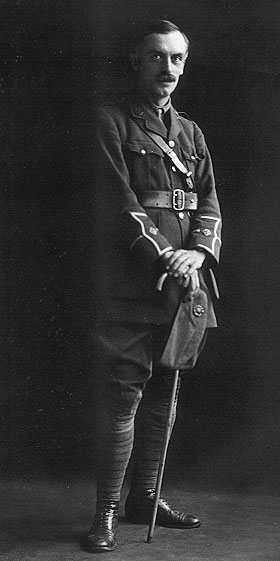
Captain Frank Mears

Captain Frank Mears

After the War, it was Frank Mears who served as Patrick Geddes’ principal assistant and he was to go on to distinguish himself by advancing the cause of town and regional planning in Scotland and giving practical expression to Geddes’ visionary ideas.


This article is based on extracts from the Geddes Papers held by the National Library of Scotland which are reproduced by kind permission of the Library’s Trustees. 

50.026925 2.610125

A Vision of Zion

23 Wednesday Jul 2014

Posted by Graeme Purves in Frank Mears

≈ Leave a comment

Tags

Benjamin Chaikin, Frank Mears, Hebrew University, Patrick Geddes, Zionism

Nearly ninety years ago a ceremony was held in East Jerusalem to mark the inauguration of a Hebrew University.  This article describes the involvement of two Scotsmen in a project central to the aspirations of the founders of modern Israel.

On 2nd April 1925, a foundation stone was laid on a site on Mount Scopus, to the East of Jerusalem, to mark the formal inauguration of the city’s Hebrew University.  For one of the guests at the ceremony, the pioneer environmentalist, Professor Patrick Geddes, it was an event of particular significance.  In 1919, he had been engaged by the Zionist Commission for Palestine to prepare preliminary plans for the University and advise on a number of other projects which the Zionists were initiating in Palestine.

In November 1917, the Balfour Declaration had committed the British Government to the establishment of a “national home for the Jewish people” in Palestine, thus precipitating large-scale migration to the Holy Land by Eastern European Jews determined to start a new life free from the restrictions and periodic pogroms which they had suffered in the collapsing empires of Russia and Austria-Hungary.  The idealism and dedication of the Zionist pioneers had captured the imagination of many non-Jews, Geddes among them.  Geddes’ biographer, Philip Boardman, suggests that the Professor’s Presbyterian upbringing, with its Old Testament emphasis, made him particularly susceptible.  However, Geddes also saw that the Zionist passion to renew both spiritual and physical contact with the soil of Palestine accorded well with the emphasis which his own social theories placed on restoring the economic and cultural links between communities and their historical environments.

Geddes began work on his proposals for the University during his first visit to Jerusalem in the autumn of 1919.  He had discussed the project at length with the Zionist Leader, Dr. Chaim Weizmann, and his subsequent report to the Zionist Commission was prepared with the assistance of his son-in-law, the architect, Frank Mears.  While Geddes was primarily responsible for the overall conception set out in the initial report, over the ten-year period during which the two Scots were associated with the University project, the task of adjustment and realisation, through the preparation of detailed architectural drawings, was to fall increasingly to Mears.

For Geddes, the self-styled “critic of universities”, the project was a major opportunity to put his ideas for educational reform into practice, and he fell to the task with enthusiasm.  He was immediately inspired by the commanding site on Mount Scopus, writing in a letter published in The Scotsman that it was “…one of the most magnificent in the world, on one side looking West over the most historic of cities, on the other, over that unique and tremendous cosmic spectacle – the perspective view of the desert hills, plunging down to the great rift of the Dead Sea and rising again into the Moab Mountains behind”.

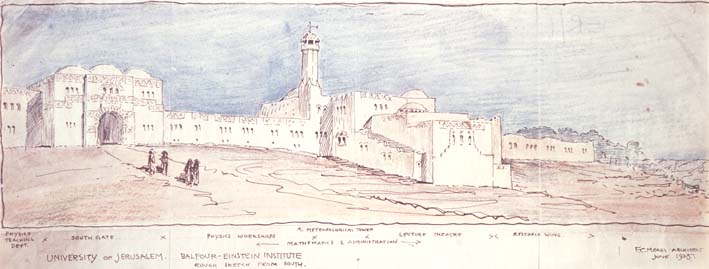
Geddes was critical of previous European architects whose designs for institutional buildings on the hills around Jerusalem had incorporated high towers.  These he regarded as being out of scale and inappropriate, dwarfing the landscape and lacerating the skyline.  For the University, he proposed a series of simple, economical buildings which together would present a long, low architectural profile on the summit of Mount Scopus.  Never­theless, he regarded it as essential that there should be a strong central feature and he proposed that this should take the form of a hexagonal Great Hall, or “Aula Academica”, surmounted by a large dome which he dubbed the “Dome of Synthesis”.  On either side of the Great Hall were to be ranged the various departments of the University, each carefully linked to its neighbours according to a scheme for the organisation of related fields of knowledge.
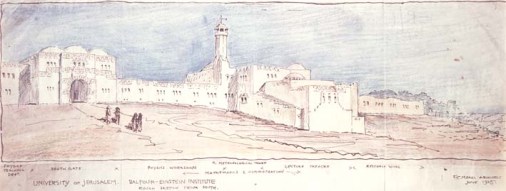
sketch

Perspective sketch of the Hebrew University by Frank Mears

Back in Scotland, Mears discussed the project with the Edinburgh Rabbi, Rev. Dr. Salis Daiches.  David Daiches remembered discussions between his father and Mears and that, on at least one occasion, Patrick Geddes visited the family home.  Mears also sought advice on modern laboratory design from Professor Francis Baily of the Department of Electrical Engineering at Heriot-Watt College.

The University project made little progress until 1924 when the Zionist Organisation set up a University Committee in Jerusalem and fund-raising began for buildings to house the University Library and an Einstein Institute of Physics.  In April 1925, Geddes and Mears were appointed superintendent architects for the Library and Physics buildings.

The two Scotsmen had always believed that the detailed planning of the University should be undertaken by the staff and students of its own Department of Planning and Architecture and envisaged that work on the University and other projects throughout the territory would provide the foundation for a “School of Palestinian Architecture”.   They responded positively, therefore, when, in the summer of 1925, the Zionists suggested that they should collaborate with local Jewish architects.  After an exchange of correspondence, they agreed to work with Mr. Benjamin Chaikin, a Jerusalem-based architect who seemed sympathetic to their scheme.  However, approaches to a German Jewish architect, Alexander Baerwald, met with a less congenial response.  He replied that his experience in Berlin had convinced him that the sort of co-operation which Geddes and Mears proposed would involve an unacceptable compromise of his artistic integrity.  Instead, he proposed that he should prepare his own design for the University Library, leaving detailed work to be completed by Chaikin.  Mears was angered by Baerwald’s attitude and wrote a strongly-worded letter to his father-in-law, saying: “He [Baerwald] has the daring to reply to an invitation to co-operation with an attempt to scoop the job without the risks of competition.  It is a priceless effort and I fear for any dealing with him.  …he is really looking for trouble, it oozes out all through his letter and his weakness is that its not on behalf of his brother Jewish architects but for himself alone”.

From the middle of 1926 onwards, relations with the University’s promoters became progressively more difficult.  Responsibility for various aspects of the scheme was divided amongst a number of committees and there were strong disagreements over policy between different factions in the Zionist Organisation.  In October, Chaikin reported to Mears that the local Architectural Society, of which Baerwald was a leading member, had issued a statement to the Jewish press opposing the appointment of non-Jews to design the University.  Similar criticism appeared in a letter from a “Mr. Berliner” published in the German Jewish periodical, Juedische Rundschau, in January 1927.

In early 1926, Mears heard that a wealthy American widow, Mrs. Rosenbloom, had announced her intention to provide funds for the erection of buildings for the University.  In March, the Rosenbloom Trustees invited Geddes and Mears to prepare detailed plans for the Great Hall and an Institute of Hebrew Studies.  Difficulties soon arose, however, over the design and location of the Great Hall.  Many of the Zionists were unhappy with Geddes’ “Dome of Synthesis”, taking the view that domes were a feature of Moslem rather than Jewish architecture.  Mears was sympathetic to this criticism, and made efforts to modify the design in order to overcome it without detracting from the Hall itself.

By September 1926, a new problem had arisen.  Mears received word from the University Principal, Dr. Magnes, that the Hebrew Studies Council had pressed on Mrs. Rosenbloom the importance of their Institute being the principal building of the University and she had agreed.  In fact, Magnes had himself been instrumental in securing the establishment of the Institute of Hebrew Studies and was strongly committed to it.

Mears travelled to Paris for a hurriedly-arranged meeting with Mrs. Rosenbloom and  Dr. Weizmann.  The Zionist Leader was concerned that the religious lobby was exerting too powerful an influence on the development of the University, so that it “ran the risk of becoming a theological seminary”.  He and Mears argued that, important though the Institute of Hebrew Studies was, it should not be allowed to displace the Great Hall.  A central location was unsuitable for a major department which would require room for further expansion.  Weizmann also stressed that the Great Hall would serve a vital role as the living centre of the University.  Recalling Geddes’ Report of 1919, he pointed out that, in the context of the Zionist struggle, it would not be just another University hall such as one might find on any American campus, but a Hall for gatherings of Jews from all of Palestine and the world beyond.

By the end of the meeting, Mears was convinced that they had won Mrs. Rosenbloom over, although she would not give a decision before consulting her Trustees.  He seemed to have been proved correct when, in November, he received a letter saying that the Trustees had agreed that he should proceed with his plans for the Great Hall and the Institute of Hebrew Studies and that Mrs. Rosenbloom was willing to provide a little more money if necessary.  Early in the New Year, however, the Rosenbloom Trustees reversed their decision and Mears received a cable from the U.S.A. stating:  “Aula idea abandoned.  Substituting central building for Jewish and Oriental Studies with adequate University Hall, await letter”.

It was the symbolism inherent in Geddes’ conception of the Great Hall which aroused the suspicion of many of the Zionists.  Geddes claimed that the domed central hall represented “the great Unity which it is the glory of Israel to have first realised and taught, and which Christian and Moslem alike, despite all their hostility have the candour to confess they have thus inherited”.  However, its detractors argued that it could be interpreted as a commitment to the political unity of the various religious communities in Palestine, and this they were not prepared to countenance.  Geddes afterwards contended that it was intended to have only spiritual and not political significance.  While it is difficult to separate the political from the spiritual considerations in Geddes’ writings on the subject, there is evidence that Weizmann regarded the domed Hall as important from a purely political standpoint.  In 1925, Mears wrote that the Zionist Leader intended it to give assurance that the older domes of the historic city, those of the Dome of the Rock and the Church of the Holy Sepulchre, would remain safely in Moslem and Christian hands.

The University Principal, Dr. Yehuda Leib Magnes, was one of those who were hostile to the symbolism implicit in the concept of the Great Hall and afterwards Mears wrote that: “Dr. Magnes never disguised his dislike of Dr. Weizmann’s ideas for the University.  I had a most difficult task.  My first loyalty was to Dr. Weizmann, and I felt it a duty to maintain what I could of his great conception.  Whenever I hinted Dr. Weizmann’s ideas, Dr. Magnes showed a bitterness, and indeed anger, which led me to avoid the subject most carefully.  Thus we had no real guidance and no-one to whom we could turn for instructions as to policy”.

However, Mears tried to make the best of things and agreed to Dr. Magnes’ proposal that Chaikin be given the position of architect while he and Geddes acted as consultants.  In November 1927, Mears accepted an invitation to return to Jerusalem to prepare plans for a centrally-located Institute of Hebrew Studies incorporating a scaled-down University hall.  In the following January, he returned to the city for the last time and spent three months working on plans for the Institute of Hebrew Studies based on a schedule of accommodation supplied by the Principal’s office.  In accordance with the wishes of Dr. Magnes and the Rosenbloom Trustees, the central dome was abandoned in favour of a stepped roof design.

The final blow fell in May 1929, when Mears received a letter from the University’s lawyer informing him that the Board of Trustees had decided not to avail themselves any further of the services of Geddes, Mears and Chaikin in connection with the design of the Rosenbloom Memorial Building.  The letter blamed the architects for repeated delays and claimed that their design had finally been judged “not acceptable”.  The Rosenbloom Trustees felt that “no useful purpose would be served by any attempt to modify or improve the existing design”.

Mears wrote to Magnes that he was quite at a loss to understand the statement that the design had been found unacceptable.  He had kept very closely to the plan approved by the Principal and Mrs. Rosenbloom and taken great care to incorporate the suggestions of the University staff.  Any delays, he claimed, had arisen out of repeated alterations to specifications initiated by the promoters of the University themselves.

Geddes believed that the decision to terminate their engagement had been taken arbitrarily by Dr. Magnes and the Rosenbloom Trustees and hoped to be able to appeal to the General Body of the University which had originally appointed them.  However, although Geddes’ Zionist friends in Europe and America were sympathetic, they were unable to be of much practical assistance since virtually all responsibility for the University had by then been transferred to Jerusalem.

All hope that the University buildings would be completed in the foreseeable future was abandoned in late 1931 when Mrs. Rosenbloom announced that the economic depression compelled her to postpone the building of the Institute of Hebrew Studies for the time being.  Less than five months later, in April 1932, Geddes died suddenly at his Collège des Ecossais in Montpellier.  Only the Library and the Balfour Institute of Mathematics were ever built to Mears’ designs.
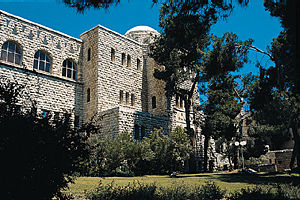
Hebrew University

The University Library

Although Geddes was retained by the Zionist Commission, much of his work in Jerusalem was directed towards the development of the civic and cultural institutions which he believed to be essential to the full and vigorous expression of an ethnically-plural Palestinian polity.  Unfortunately, the cultural inheritance of the territory was more complex and fraught with conflict than he was prepared to allow and, ultimately, his vision for the University was to prove incompatible with the aspirations of Jewish cultural nationalism.  Today, the issues of identity and cultural philosophy which the University project raised remain as potent and problematic as ever.

Charles Ashbee, the pro-Arab architect who worked with Geddes on town planning schemes for Jerusalem, wrote in 1923 that: “Geddes’ chief work out here has been the plans, en ebauche, for the Zionist University, a magnificent scheme and a wonderful report.  But it has cleft Jewry in twain.  The orthodox and the ritualists have no use for a Universitas in the real sense of the word, such as he desires, nor have the political propagandists for the scholar and the man of science.  Will it be a university or only a Zionist university?  Geddes has thrown down the glove to Jewry.  It is another challenge to the theocratic state and the old devil of sectarianism who stands between us and our search for truth.  Will the challenge be taken up? …But when all’s said and done, Pat is right.  His prophecy is likely to sound the farthest.  You can have no sectarian university”.

After the event, and from a very different standpoint, the staunch Zionist, Dr. David Eder, came to a very similar judgement.  He wrote:  “That this magnificent conception has not yet been realised is due, not to Geddes, nor to the architects who worked with him and under his directions – Frank Mears of Edinburgh and Chaikin of Jerusalem.  It was not wholly due to want of money, for Geddes was an economical builder and planner…  I do not want to be drawn into any harsh judgements.  Suffice it to say that there are few who could rise to the lofty heights of Geddes’ imagination or of his practical knowledge.  Petty minds have endeavoured to bespoil what Geddes and his two assistants had conceived on noble and enduring lines”.

Dr. Weizmann, the great Zionist Leader whose vision transcended all sectarianism, later wrote in his memoirs that: “The ideal of the Hebrew University was for many of us the noblest expression of our Zionist humanism.  On it were concentrated the dreams of our youth and the endeavours of our manhood.  A Hebrew University in Palestine would mean release from the pariah status which was the lot of Jewish youth in so many of the Universities of Eastern and even Central Europe.  It would provide a focus for the free development of the Jewish spirit.  It would give scientific guidance and moral inspiration to the builders of the new Zion.  It would pave the way for a synthesis between the spiritual heritage of our people and the intellectual movements and aspirations of our age…  I still hope before I die to see the great assembly hall which Geddes designed rising on the slopes of Scopus”.


This article is based primarily on manuscript material held in the National Library of Scotland and the Zionist Archive in Jerusalem. It was first published in The Scottish Review in Spring 2000.

See also Diana Dolev, Architecural Orientalism in the Hebrew University – The Patrick Geddes and Frank Mears Master-Plan.
← Older posts

Subscribe

  • Entries (RSS)
  • Comments (RSS)

Archives

  • March 2025
  • March 2022
  • December 2021
  • March 2021
  • November 2020
  • August 2020
  • May 2020
  • February 2020
  • February 2019
  • October 2018
  • August 2018
  • May 2018
  • April 2018
  • July 2017
  • April 2017
  • February 2017
  • January 2017
  • September 2016
  • July 2016
  • May 2016
  • March 2016
  • December 2015
  • November 2015
  • August 2015
  • June 2015
  • May 2015
  • November 2014
  • October 2014
  • August 2014
  • July 2014
  • June 2014
  • May 2014
  • April 2014
  • March 2014
  • June 2013

Categories

  • Frank Mears
  • Reviews
  • Spatial Planning
  • The Land o Cakes
  • Travellers' Tales

Meta

  • Create account
  • Log in

Blog at WordPress.com.

  • Subscribe Subscribed
    • By Erceldoune
    • Join 29 other subscribers
    • Already have a WordPress.com account? Log in now.
    • By Erceldoune
    • Subscribe Subscribed
    • Sign up
    • Log in
    • Report this content
    • View site in Reader
    • Manage subscriptions
    • Collapse this bar
 

Loading Comments...