The Hebrew University and the Expression of National Identity

Tags

, , , , , , ,

Mears & Chaikin - model_edit

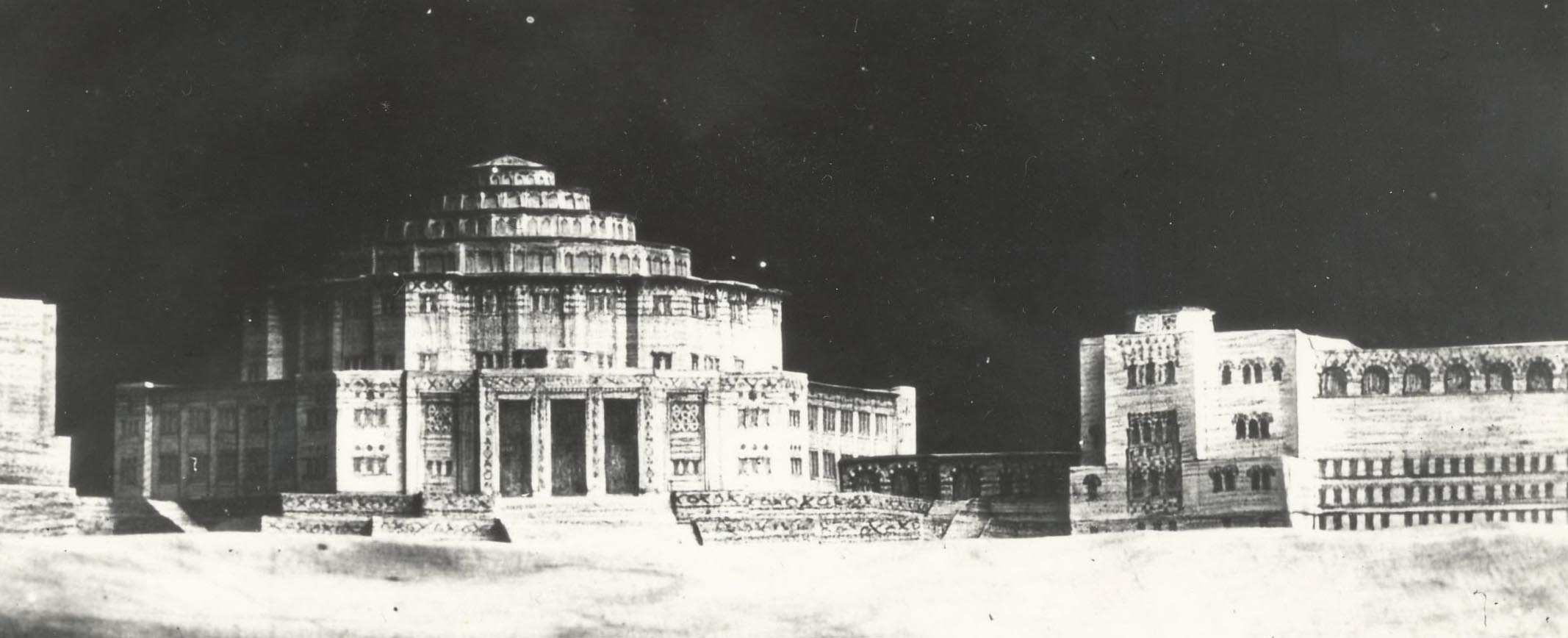
Model based on plans for the Hebrew University by Mears and Chaikin, 1928

Dr. Diana Dolev of the Holon Institute of Technology in Israel is writing a book about the development of the Hebrew University campus in Jerusalem which will include a reassessment of the architectural collaboration between Frank Mears and Benjamin Chaikin from 1925 to 1929.

Dr. Dolev teaches architecture at the Holon Institute and researches the relationship between national identity and architecture.  In 2000 she was awarded a Ph.D. for her thesis on the influence of nationalist ideology on the masterplans prepared for the Hebrew University between 1919 and 1974.  She has written on architectural orientalism in the Hebrew University and the militarisation of the university campus on Mount Scopus.

In 1919 Patrick Geddes and Frank Mears were engaged by the Zionist Organisation to prepare a scheme for a Hebrew University.  In 1925 Geddes and Mears began to collaborate with Jerusalem-based architect, Benjamin Chaikin, on the preparation of the detailed architectural drawings required to realise the scheme.

Material relating to the involvement of Geddes, Mears and Chaikin in the development of the Hebrew University of Jerusalem is now distributed between a number of institutional collections, including the Zionist Archives and Hebrew University Archives in Israel, the National Library of Scotland, the Geddes collections of Strathclyde and Edinburgh universities, and the Royal Commission on the Ancient and Historic Monuments of Scotland.  In the 1990s, Volker Welter prepared a comprehensive catalogue of the material from Geddes’ Cities Exhibition held by Strathclyde University.  Currently, Grant Buttars of the Special Collections Department at Edinburgh University is working on a programme of cataloguing, conservation and digitisation of the Geddes material held in the Edinburgh and Strathclyde collections to make it more accessible and facilitate dissemination.

With these resources to draw upon, Dr. Dolev’s work offers the welcome prospect of a much fuller understanding of what Geddes, Mears and Chaikin were seeking to achieve in their work on the Hebrew University.  It is expected that her book will be published in the autumn of 2015.


See my article, A Vision of Zion, from the Spring 2000 issue of the Scottish Review.

Planning for a Revival in Hutting

Tags

, , , ,

The importance of the reference to huts in the new Scottish Planning Policy.

Simple huts for recreational use have been a feature of our rural landscape since the 1920s.  They played an important part in the development of the interwar outward bound movement, providing a way for people of modest means to get out of the cities and enjoy the countryside.  Scotland’s hutting movement is part of a wider tradition most frequently associated with Scandinavia, but found right across northern Europe.

In the post-War period, hutting went into decline in Scotland.  In the 1960s, rising disposable incomes ushered in the era of package holidays abroad.  Tenure was found to be precarious as new landowners proved to be less sympathetic to the movement than their predecessors and sought to remove huts from their land.  But the successful campaign by the Carbeth hutters to secure their future through community ownership of their site has contributed to a revival of interest in hutting more generally.

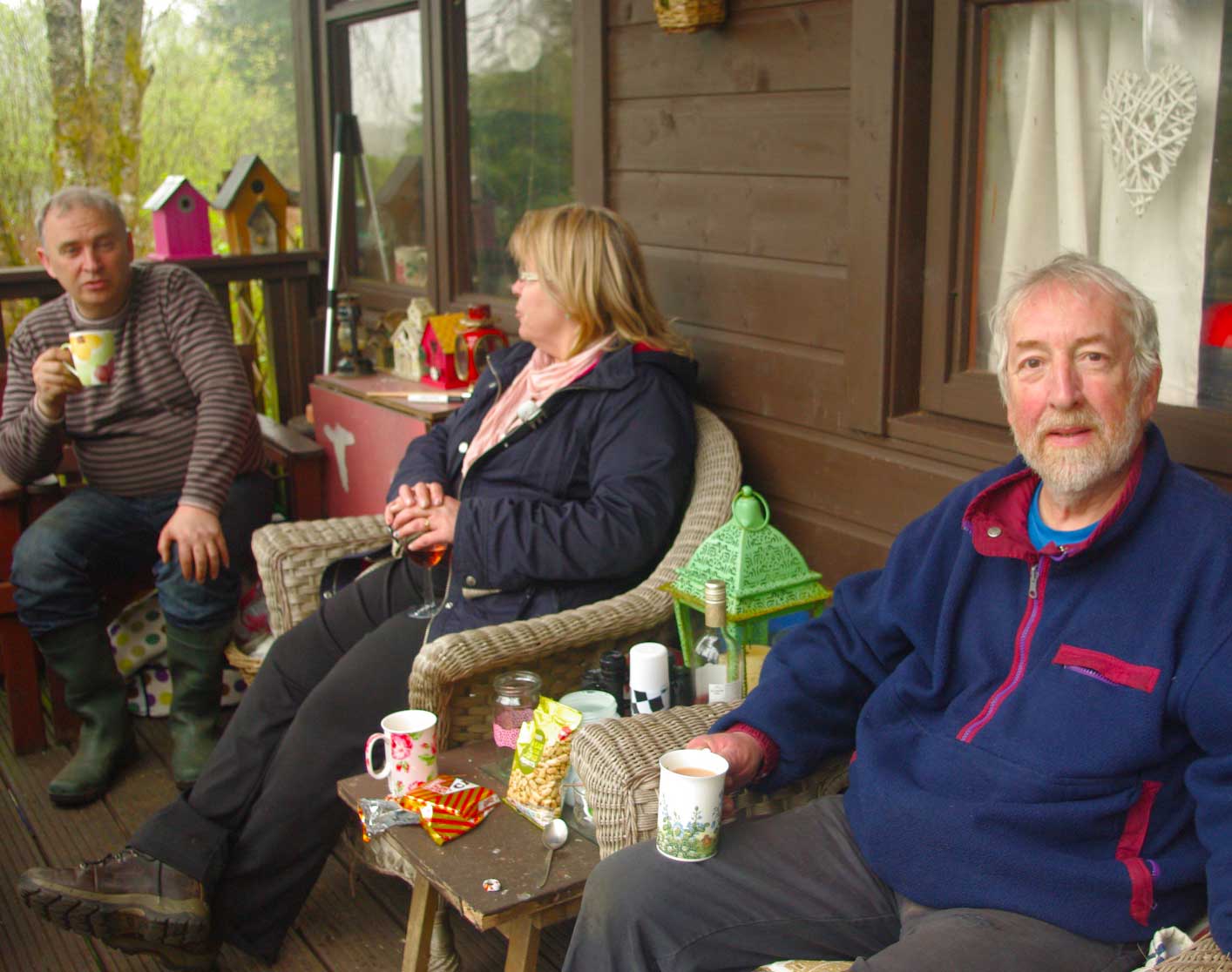
Tea-with-the-neighbours---credit-M-Gregor Hutters relaxing at Carbeth

The inclusion of a supportive reference to huts in the new Scottish Planning Policy (SPP) is seen as important to the revival of our hutting tradition. Until now, there has been no specific provision for huts in Scottish policy or legislation and many aspiring hutters have seen this as an obstacle to new development.  Paragraph 79 of Scottish Planning Policy identifies huts as one of the types of leisure accommodation for which development plans should make provision where appropriate.   A hut is defined as “a simple building used intermittently as recreational accommodation (i.e. not a principal residence); having an internal floor area of no more than 30m2; constructed from low impact materials; generally not connected to mains water, electricity or sewerage; and built in such a way that it is removable with little or no trace at the end of its life.”  SPP indicates that huts may be built singly or in groups.

One of the attractions of hutting is the opportunity it offers to apply or develop design and building skills.  For many, the community dimension of hutting is an important element of its appeal and for groups of huts an accessible site will be important.  However, for some, the goal may be a secluded retreat in a more remote rural location.  There is room in Scotland’s countryside to accommodate both types of development provided care is taken to avoid adverse impacts on communities and the environment.

DSC_9178

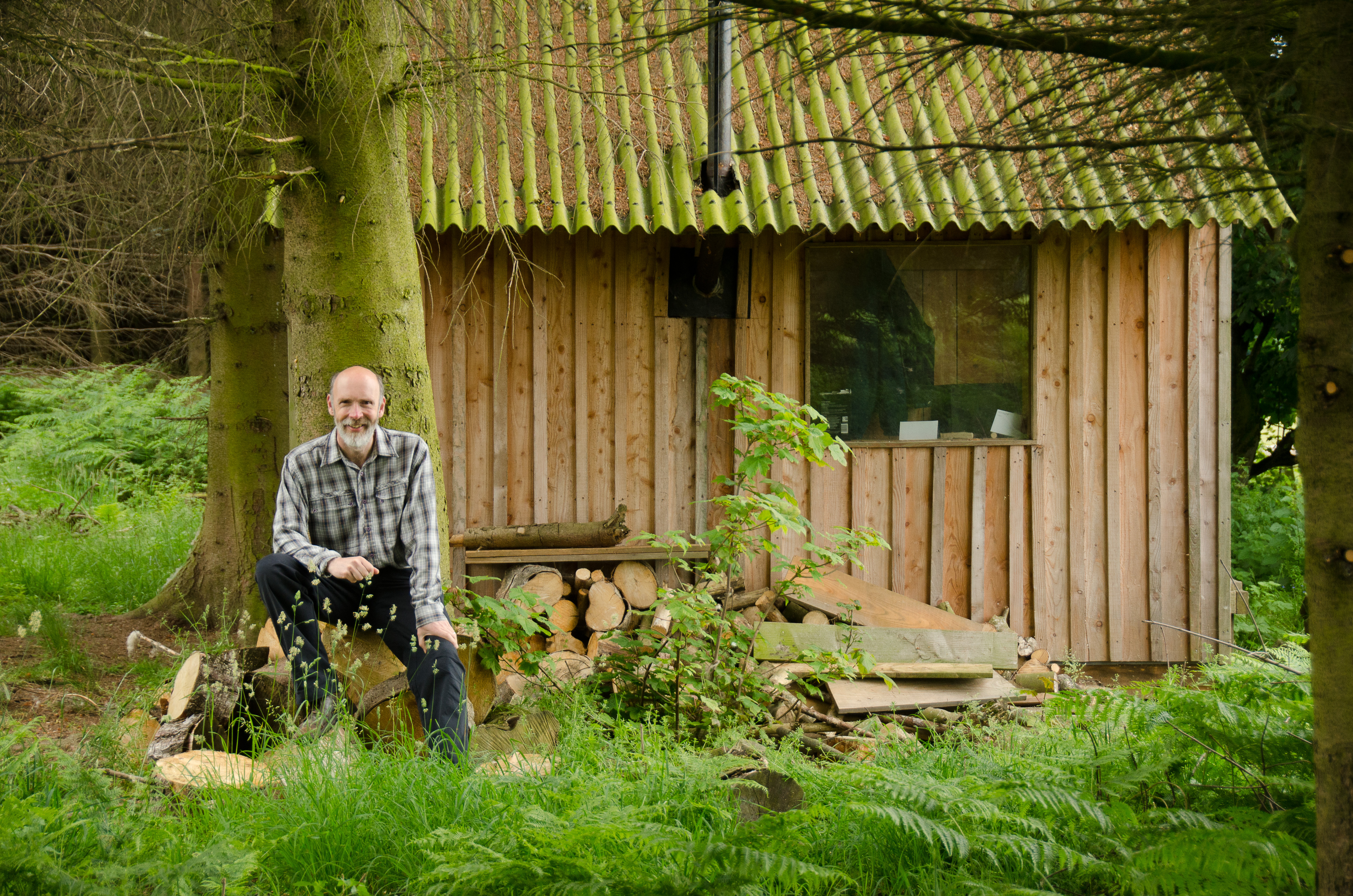
Ninian Stuart at his hut near Falkland

The Thousand Huts campaign is working on guidelines on good practice in hutting development.  It is engaging with the local community with a view to pursuing a pilot development on Forestry Commission land near Saline, in Fife.  Discussions are continuing with the Scottish Government on security of tenure, building standards and possible changes to planning regulations.

Planners can play an important role in ensuring that many more people in Scotland have access to a little hut in the countryside where they can relax and enjoy nature with their families.


This article was published in the Autumn 2014 issue of the Scottish Planner.

Observations on the Western Front

Tags

, , , , ,

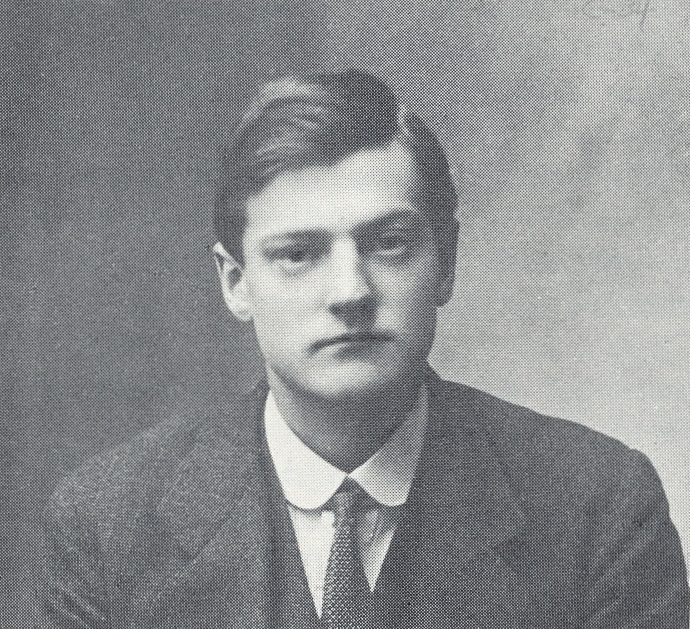
Alasdair Geddes

Alasdair Geddes

It has become a truism that the First World War deprived a generation of many of its most gifted representatives.  One who can be counted amongst these is Alasdair Geddes, eldest son of the botanist, planner and sociologist, Patrick Geddes.  Professor Geddes entertained great hopes that Alasdair would one day succeed him, taking forward his work in civics and regional survey.  To this end, he devised a unique educational programme for his son.  Geddes senior had little time for the dry academic curriculum provided by the schools of the time and so Alasdair was taught almost exclusively by his parents, with the emphasis on observation, artistic expression and practical gardening.  His studies at home were interspersed with periods of work experience in various crafts and industries under the guidance of skilled practitioners.

His father’s insistence on imposing his own educational regime upon his children was frowned upon by the more conventional sections of Edinburgh society, but critics were confounded when Alasdair went on to enjoy a successful university career culminating in the award of prizes and research scholarships.  He provided invaluable assistance to his father in many of his projects, organising the display of the influential Cities Exhibition in Dublin, Ghent and Madras, for example.  At that time, he showed every sign of becoming an able successor.

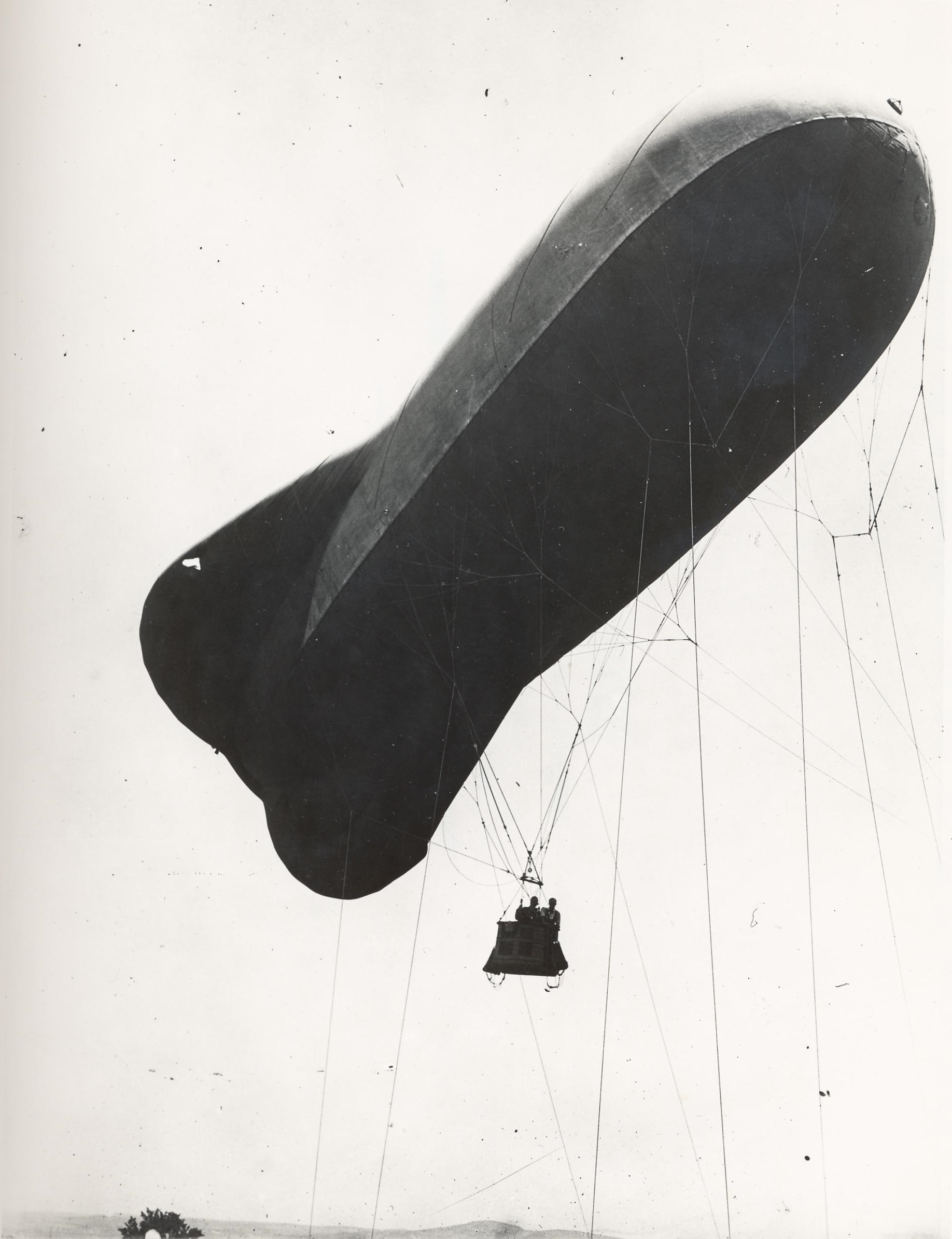
However, like so many young men of his generation, Alasdair was to have his career brought to a halt by the outbreak of the Great War.  He was outraged by the destruction of the Belgian and French towns which he had come to know and love during his travels on the Continent with his father and, in 1915, he volunteered for service with the Royal Naval Air Service.  He was subsequently transferred to the Royal Flying Corps and served as a kite balloon observer on the Western Front.  By the end of 1916 he had been promoted to the rank of Major, the youngest in that branch of the Army and, in recognition of his outstanding ability as an observer, he was awarded the Military Cross.

Kite Balloon

Kite Balloon on the Western Front

His brother-in-law, Frank Mears, served alongside him at this time and, after the war, wrote the following account of their experiences:

“When I went out to France in August 1916, our section went first to the village of Forceville near Albert, but I found myself almost at once transferred to Alasdair’s section which, fortunately, was only a few miles away, just South of Bouzincourt and west of Albert.

The section was in tents, living a peaceful life clear of any shelling and on clear ground. I was supposed to be on loan from my section (No. 18) in order to learn the job quickly and then go back to them.  There was some jealousy, I think, in 13 and 18 Sections, about this alleged “nepotism” as at this time everyone was out for putting in as much time as possible in the air: a little later, ballooning ceased to be such a source of enjoyment.  Balloons up to the Spring of ’17 were comparatively rarely attacked or shelled.  They were only beginning to be taken seriously in the course of ’16, and wer few in number and widely spaced on the line. Later, when there were 50 or so on the British Front, they began to look like beads on a string.

Our work was comparatively simple, straightforward shooting at points, but Alasdair was beginning to get keen on “Counter Battery” work and was constantly in touch with the Corps CB office.  As I look back, I feel as if he regarded it as a sort of club.  He was always in hobnobbing with them.  This work ws really very important.  It consisted of marking down enemy batteries, by their flash, and reporting them either as, if already known, active, or as new positions, in either case to be noted by CB office for strafing.  Sometimes we got one of our batteries turned on on the spot, and later this neutralisation became a very important part of balloon work.  It was this sort of work which Alasdair liked, since it involved good observation of a more difficult order than that required for ordinary, straightforward target work.  It its results were less immediate than the latter, this work counted for more in the end, since on successful countering of enemy batteries depended the success of operations on an attack day.  Our batteries would register by trial rounds on the enemy positions and then on attack day would plaster them with shells and so try to stop them from firing.  On occasion too, we would shoot up one of these enemy positions with a heavy howitzer battery.

Headquarters made a great boom of observations of Alasdair’s on Thiepval, on one of the first occasions when tanks were used.  The balloons were too far back for observation of movements of men in the attack, but Alasdair succeeded on this occasion in following the fortunes, or rather misfortunes, of several poor tanks, and reported their course stage by stage.  He was always very careful with his observations, checking and cross-checking each, and he had a very good memory for what had been, before shelling turned everything but a few landmarks into a sea of shellholes and mud.  He also made a strong point of new observers going to visit batteries so as to get an inkling of the gunners’ point of view.  During the Winter of ’16/17, we all had to spend a fortnight with a battery, in addition to ordinary visits on dull days.

Before this he had the problem of moving his section so as to get a better light for observation during the best part of the day. As a result of the attacks of July 1916, 13 Section Balloon had come to be in a position facing a salient with Thiepval at its apex.  We were thus looking North Eastward, and rather along our part of the line instead of fronting it.

After some prospecting, he got permission for us to go into the next army area, and chose a site in a clearing in Fricourt Wood, three miles East of Albert.  From this site we looked North with the sun behind us and, being in effect in advance of our Corps batteries, we were able to stay in this area until the Germans did their big retreat in March.

The place was far from delectable.  Fricourt had formed a slight salient of the original German front line, the vallage resting on a little ridge with the wood behind it.  Thus it had ample opportunity to get into a thoroughly filthy and shell bespattered state and, in the wet Autumn weather, we were pretty well surrounded by liquid mud.  The village and chateau had disappeared but the trees remained enough to give shelter.  We first had tents, but with indications of the beginning of night bombing and a railway near which drew shells we went in for semi-dugouts.

Although the surface was muddy, one could dig down four feet or so without much dampness.  Two of the other men started a hole but got fed up and in the course of chat Alasdair and I, who had rather favoured tents, became involved in furnishing it.  The work finally devolved mainly on me, since Alasdair was busier.  It became a rectangular hole, eight feet wide by twelve or fourteen long.

I annexed some of the heavy timbers of the belfry of the destroyed church, some Germans having brought them into the wood.  One stuck up at each end supported a great roof beam.  Two tiers of ammunition boxes surrounded the hole forming a series of open lockers, and shhets of corrugated iron spanned over from the beam onto the thrown out earth on each side. An oil drum stove, moveable, could be used to dry one end, and then be moved to the other, and canvas was stretched from the beam to the sides, and hung as a dado to hide the earth sides.  Altogether it wasn’t so bad, but would have been no use against a serious attack.  However, it was never tested.  We shared this hole for a time, but Alasdair was soon moved away on his promotion.

I think he first smelt powder here – as I did.  One night, the Germans, about to retire, threw about a few speculative shells to get rid of them.  We heard an endless long-drawn wail, followed by a crash one hundred yards away and, thinking it was a bomb, and so no more likely to fall near, we two went out to see if it had been too near our balloon.  When we got near the place, we heard a fresh wail getting nearer and nearer and another one plumped down not very far away.  We got under a half fallen tree till the rain of clods etc. ceased and then went home.  These shlls had been fired at very extreme range and made a curiously tired sound in the air.  They were quite active on arrival however.

We had a more strenuous experience one afternoon.  When we got up, we found a heavy gale blowing and couldn’t do much owing to the tossing of the balloon.  I was being sick over my end and Alasdair seemed intent on observation, if rather quiet; he was just showing his head over the edge, back towards me.  I admitted, a little shame-facedly, to sickness, and then found that he was much worse than me and his observation had been mostly downwards.  However, we soon had other things to think of, for a heavy high velocity gun began to explore our area, including ourselves. 9½ inch shells began to drop up and down the clearing and as we could do no work and couldn’t come down we sent the whole crew away to a deep German dugout (where they had their lights blown out by the concussion of one shell) and endured the performance by ourselves.  They did some damage to our camp, pushing in one or two of the shelters, but no-one was touched.  We could see the flash of the gun, at Fremicourt behind Bapaume, and then had to wait 57 seconds for the shell to arrive.  I saw one coming; it must have passed just under our basket.  We struggled at an early stage into our parachute harnesses (this was before the days when we wore them all the time) but we would have been over the line before we knew where we were, with that wind.

After a while the firing ceased, so we made shift to come down, but whether this annoyed them, or whether they had only adjourned for tea, they began again.  An added annoyance was that our 9 inch railway gun was waiting to reply with its nose cocked up ready, but the observing plane which they had arranged for never turned up.  They wouldn’t fire on our observation alone, not that we could have done much at that long distance.  We were a sorry couple when we were finally hauled down.”

On a later occasion, the two men were forced to jump by parachute when their balloon was attacked by an enemy aircraft.  In the evening of 3rd April 1917, Major Geddes and Lieutenant Mears ascended in Balloon FM 26 to a height of 2,800 feet.  In the words of Mears’ subsequent report:

At 7.10 pm the order was given to haul down as anti-aircraft shots were heard and a hostile aeroplane was seen. This descended on the starboard side, flew behind and slightly above the balloon, went on for some distance and then turned sharply back and flew straight at the balloon firing a stream of incendiary bullets many of which pierced the envelope.  The aeroplane then banked and swerved behind the balloon, turned again, and went in the direction of 18 Section.

After jamming with the first three shots, the Section gun got off a burst of 92 shots and jammed again.  By this time the aeroplane was well over towards 18 Section’s balloon and it would have been useless to fire further.  A good deal of rifle and machine gun fire was indulged in by troops in the vicinity.”

As soon as the plane turned to fire, the observers prepared to jump out.  Alasdair Geddes was first to leave the basket.  His parachute opened well and the balloon fell past him about 50 yards away.  However, Frank Mears lost a few seconds in getting out owing to the violet swaying of the balloon which had burst into flames.  His parachute came out of its case but became entangled with the balloon’s handling guys, and did not break loose until he had fallen for some distance with the burning balloon.  When the parachute came free, some of its bridles were broken and others were tangled so that it did not open properly for some time.  When it finally did so, the descent became normal and Mears survived unscathed.

Shortly afterwards, while returning on foot from a ground observation post, Alasdair Geddes was struck and instantly killed by a shell fragment.  He was 25.

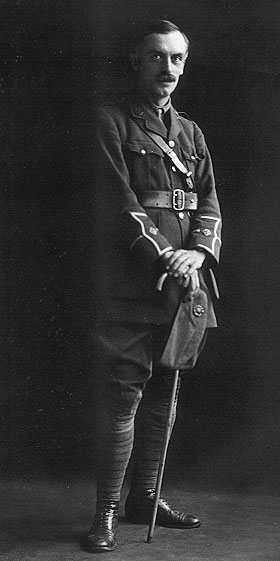
Captain Frank Mears

Captain Frank Mears

After the War, it was Frank Mears who served as Patrick Geddes’ principal assistant and he was to go on to distinguish himself by advancing the cause of town and regional planning in Scotland and giving practical expression to Geddes’ visionary ideas.


This article is based on extracts from the Geddes Papers held by the National Library of Scotland which are reproduced by kind permission of the Library’s Trustees. 

A Vision of Zion

Tags

, , , ,

Nearly ninety years ago a ceremony was held in East Jerusalem to mark the inauguration of a Hebrew University.  This article describes the involvement of two Scotsmen in a project central to the aspirations of the founders of modern Israel.

On 2nd April 1925, a foundation stone was laid on a site on Mount Scopus, to the East of Jerusalem, to mark the formal inauguration of the city’s Hebrew University.  For one of the guests at the ceremony, the pioneer environmentalist, Professor Patrick Geddes, it was an event of particular significance.  In 1919, he had been engaged by the Zionist Commission for Palestine to prepare preliminary plans for the University and advise on a number of other projects which the Zionists were initiating in Palestine.

In November 1917, the Balfour Declaration had committed the British Government to the establishment of a “national home for the Jewish people” in Palestine, thus precipitating large-scale migration to the Holy Land by Eastern European Jews determined to start a new life free from the restrictions and periodic pogroms which they had suffered in the collapsing empires of Russia and Austria-Hungary.  The idealism and dedication of the Zionist pioneers had captured the imagination of many non-Jews, Geddes among them.  Geddes’ biographer, Philip Boardman, suggests that the Professor’s Presbyterian upbringing, with its Old Testament emphasis, made him particularly susceptible.  However, Geddes also saw that the Zionist passion to renew both spiritual and physical contact with the soil of Palestine accorded well with the emphasis which his own social theories placed on restoring the economic and cultural links between communities and their historical environments.

Geddes began work on his proposals for the University during his first visit to Jerusalem in the autumn of 1919.  He had discussed the project at length with the Zionist Leader, Dr. Chaim Weizmann, and his subsequent report to the Zionist Commission was prepared with the assistance of his son-in-law, the architect, Frank Mears.  While Geddes was primarily responsible for the overall conception set out in the initial report, over the ten-year period during which the two Scots were associated with the University project, the task of adjustment and realisation, through the preparation of detailed architectural drawings, was to fall increasingly to Mears.

For Geddes, the self-styled “critic of universities”, the project was a major opportunity to put his ideas for educational reform into practice, and he fell to the task with enthusiasm.  He was immediately inspired by the commanding site on Mount Scopus, writing in a letter published in The Scotsman that it was “…one of the most magnificent in the world, on one side looking West over the most historic of cities, on the other, over that unique and tremendous cosmic spectacle – the perspective view of the desert hills, plunging down to the great rift of the Dead Sea and rising again into the Moab Mountains behind”.

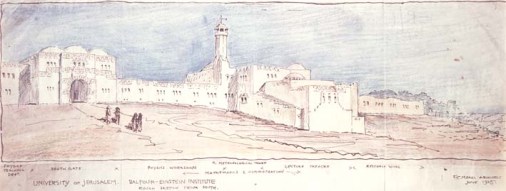
Geddes was critical of previous European architects whose designs for institutional buildings on the hills around Jerusalem had incorporated high towers.  These he regarded as being out of scale and inappropriate, dwarfing the landscape and lacerating the skyline.  For the University, he proposed a series of simple, economical buildings which together would present a long, low architectural profile on the summit of Mount Scopus.  Never­theless, he regarded it as essential that there should be a strong central feature and he proposed that this should take the form of a hexagonal Great Hall, or “Aula Academica”, surmounted by a large dome which he dubbed the “Dome of Synthesis”.  On either side of the Great Hall were to be ranged the various departments of the University, each carefully linked to its neighbours according to a scheme for the organisation of related fields of knowledge.
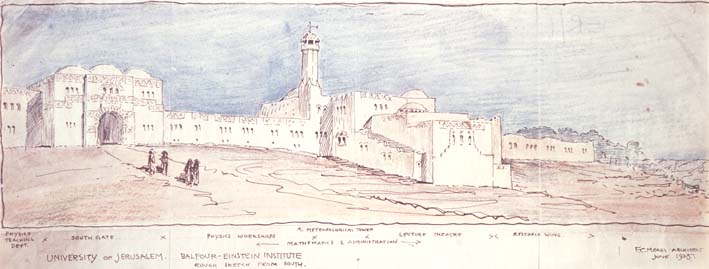
sketch

Perspective sketch of the Hebrew University by Frank Mears

Back in Scotland, Mears discussed the project with the Edinburgh Rabbi, Rev. Dr. Salis Daiches.  David Daiches remembered discussions between his father and Mears and that, on at least one occasion, Patrick Geddes visited the family home.  Mears also sought advice on modern laboratory design from Professor Francis Baily of the Department of Electrical Engineering at Heriot-Watt College.

The University project made little progress until 1924 when the Zionist Organisation set up a University Committee in Jerusalem and fund-raising began for buildings to house the University Library and an Einstein Institute of Physics.  In April 1925, Geddes and Mears were appointed superintendent architects for the Library and Physics buildings.

The two Scotsmen had always believed that the detailed planning of the University should be undertaken by the staff and students of its own Department of Planning and Architecture and envisaged that work on the University and other projects throughout the territory would provide the foundation for a “School of Palestinian Architecture”.   They responded positively, therefore, when, in the summer of 1925, the Zionists suggested that they should collaborate with local Jewish architects.  After an exchange of correspondence, they agreed to work with Mr. Benjamin Chaikin, a Jerusalem-based architect who seemed sympathetic to their scheme.  However, approaches to a German Jewish architect, Alexander Baerwald, met with a less congenial response.  He replied that his experience in Berlin had convinced him that the sort of co-operation which Geddes and Mears proposed would involve an unacceptable compromise of his artistic integrity.  Instead, he proposed that he should prepare his own design for the University Library, leaving detailed work to be completed by Chaikin.  Mears was angered by Baerwald’s attitude and wrote a strongly-worded letter to his father-in-law, saying: “He [Baerwald] has the daring to reply to an invitation to co-operation with an attempt to scoop the job without the risks of competition.  It is a priceless effort and I fear for any dealing with him.  …he is really looking for trouble, it oozes out all through his letter and his weakness is that its not on behalf of his brother Jewish architects but for himself alone”.

From the middle of 1926 onwards, relations with the University’s promoters became progressively more difficult.  Responsibility for various aspects of the scheme was divided amongst a number of committees and there were strong disagreements over policy between different factions in the Zionist Organisation.  In October, Chaikin reported to Mears that the local Architectural Society, of which Baerwald was a leading member, had issued a statement to the Jewish press opposing the appointment of non-Jews to design the University.  Similar criticism appeared in a letter from a “Mr. Berliner” published in the German Jewish periodical, Juedische Rundschau, in January 1927.

In early 1926, Mears heard that a wealthy American widow, Mrs. Rosenbloom, had announced her intention to provide funds for the erection of buildings for the University.  In March, the Rosenbloom Trustees invited Geddes and Mears to prepare detailed plans for the Great Hall and an Institute of Hebrew Studies.  Difficulties soon arose, however, over the design and location of the Great Hall.  Many of the Zionists were unhappy with Geddes’ “Dome of Synthesis”, taking the view that domes were a feature of Moslem rather than Jewish architecture.  Mears was sympathetic to this criticism, and made efforts to modify the design in order to overcome it without detracting from the Hall itself.

By September 1926, a new problem had arisen.  Mears received word from the University Principal, Dr. Magnes, that the Hebrew Studies Council had pressed on Mrs. Rosenbloom the importance of their Institute being the principal building of the University and she had agreed.  In fact, Magnes had himself been instrumental in securing the establishment of the Institute of Hebrew Studies and was strongly committed to it.

Mears travelled to Paris for a hurriedly-arranged meeting with Mrs. Rosenbloom and  Dr. Weizmann.  The Zionist Leader was concerned that the religious lobby was exerting too powerful an influence on the development of the University, so that it “ran the risk of becoming a theological seminary”.  He and Mears argued that, important though the Institute of Hebrew Studies was, it should not be allowed to displace the Great Hall.  A central location was unsuitable for a major department which would require room for further expansion.  Weizmann also stressed that the Great Hall would serve a vital role as the living centre of the University.  Recalling Geddes’ Report of 1919, he pointed out that, in the context of the Zionist struggle, it would not be just another University hall such as one might find on any American campus, but a Hall for gatherings of Jews from all of Palestine and the world beyond.

By the end of the meeting, Mears was convinced that they had won Mrs. Rosenbloom over, although she would not give a decision before consulting her Trustees.  He seemed to have been proved correct when, in November, he received a letter saying that the Trustees had agreed that he should proceed with his plans for the Great Hall and the Institute of Hebrew Studies and that Mrs. Rosenbloom was willing to provide a little more money if necessary.  Early in the New Year, however, the Rosenbloom Trustees reversed their decision and Mears received a cable from the U.S.A. stating:  “Aula idea abandoned.  Substituting central building for Jewish and Oriental Studies with adequate University Hall, await letter”.

It was the symbolism inherent in Geddes’ conception of the Great Hall which aroused the suspicion of many of the Zionists.  Geddes claimed that the domed central hall represented “the great Unity which it is the glory of Israel to have first realised and taught, and which Christian and Moslem alike, despite all their hostility have the candour to confess they have thus inherited”.  However, its detractors argued that it could be interpreted as a commitment to the political unity of the various religious communities in Palestine, and this they were not prepared to countenance.  Geddes afterwards contended that it was intended to have only spiritual and not political significance.  While it is difficult to separate the political from the spiritual considerations in Geddes’ writings on the subject, there is evidence that Weizmann regarded the domed Hall as important from a purely political standpoint.  In 1925, Mears wrote that the Zionist Leader intended it to give assurance that the older domes of the historic city, those of the Dome of the Rock and the Church of the Holy Sepulchre, would remain safely in Moslem and Christian hands.

The University Principal, Dr. Yehuda Leib Magnes, was one of those who were hostile to the symbolism implicit in the concept of the Great Hall and afterwards Mears wrote that: “Dr. Magnes never disguised his dislike of Dr. Weizmann’s ideas for the University.  I had a most difficult task.  My first loyalty was to Dr. Weizmann, and I felt it a duty to maintain what I could of his great conception.  Whenever I hinted Dr. Weizmann’s ideas, Dr. Magnes showed a bitterness, and indeed anger, which led me to avoid the subject most carefully.  Thus we had no real guidance and no-one to whom we could turn for instructions as to policy”.

However, Mears tried to make the best of things and agreed to Dr. Magnes’ proposal that Chaikin be given the position of architect while he and Geddes acted as consultants.  In November 1927, Mears accepted an invitation to return to Jerusalem to prepare plans for a centrally-located Institute of Hebrew Studies incorporating a scaled-down University hall.  In the following January, he returned to the city for the last time and spent three months working on plans for the Institute of Hebrew Studies based on a schedule of accommodation supplied by the Principal’s office.  In accordance with the wishes of Dr. Magnes and the Rosenbloom Trustees, the central dome was abandoned in favour of a stepped roof design.

The final blow fell in May 1929, when Mears received a letter from the University’s lawyer informing him that the Board of Trustees had decided not to avail themselves any further of the services of Geddes, Mears and Chaikin in connection with the design of the Rosenbloom Memorial Building.  The letter blamed the architects for repeated delays and claimed that their design had finally been judged “not acceptable”.  The Rosenbloom Trustees felt that “no useful purpose would be served by any attempt to modify or improve the existing design”.

Mears wrote to Magnes that he was quite at a loss to understand the statement that the design had been found unacceptable.  He had kept very closely to the plan approved by the Principal and Mrs. Rosenbloom and taken great care to incorporate the suggestions of the University staff.  Any delays, he claimed, had arisen out of repeated alterations to specifications initiated by the promoters of the University themselves.

Geddes believed that the decision to terminate their engagement had been taken arbitrarily by Dr. Magnes and the Rosenbloom Trustees and hoped to be able to appeal to the General Body of the University which had originally appointed them.  However, although Geddes’ Zionist friends in Europe and America were sympathetic, they were unable to be of much practical assistance since virtually all responsibility for the University had by then been transferred to Jerusalem.

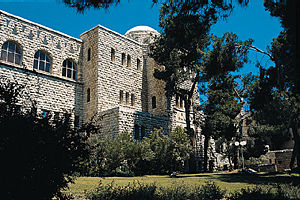
All hope that the University buildings would be completed in the foreseeable future was abandoned in late 1931 when Mrs. Rosenbloom announced that the economic depression compelled her to postpone the building of the Institute of Hebrew Studies for the time being.  Less than five months later, in April 1932, Geddes died suddenly at his Collège des Ecossais in Montpellier.  Only the Library and the Balfour Institute of Mathematics were ever built to Mears’ designs.
Hebrew University

The University Library

Although Geddes was retained by the Zionist Commission, much of his work in Jerusalem was directed towards the development of the civic and cultural institutions which he believed to be essential to the full and vigorous expression of an ethnically-plural Palestinian polity.  Unfortunately, the cultural inheritance of the territory was more complex and fraught with conflict than he was prepared to allow and, ultimately, his vision for the University was to prove incompatible with the aspirations of Jewish cultural nationalism.  Today, the issues of identity and cultural philosophy which the University project raised remain as potent and problematic as ever.

Charles Ashbee, the pro-Arab architect who worked with Geddes on town planning schemes for Jerusalem, wrote in 1923 that: “Geddes’ chief work out here has been the plans, en ebauche, for the Zionist University, a magnificent scheme and a wonderful report.  But it has cleft Jewry in twain.  The orthodox and the ritualists have no use for a Universitas in the real sense of the word, such as he desires, nor have the political propagandists for the scholar and the man of science.  Will it be a university or only a Zionist university?  Geddes has thrown down the glove to Jewry.  It is another challenge to the theocratic state and the old devil of sectarianism who stands between us and our search for truth.  Will the challenge be taken up? …But when all’s said and done, Pat is right.  His prophecy is likely to sound the farthest.  You can have no sectarian university”.

After the event, and from a very different standpoint, the staunch Zionist, Dr. David Eder, came to a very similar judgement.  He wrote:  “That this magnificent conception has not yet been realised is due, not to Geddes, nor to the architects who worked with him and under his directions – Frank Mears of Edinburgh and Chaikin of Jerusalem.  It was not wholly due to want of money, for Geddes was an economical builder and planner…  I do not want to be drawn into any harsh judgements.  Suffice it to say that there are few who could rise to the lofty heights of Geddes’ imagination or of his practical knowledge.  Petty minds have endeavoured to bespoil what Geddes and his two assistants had conceived on noble and enduring lines”.

Dr. Weizmann, the great Zionist Leader whose vision transcended all sectarianism, later wrote in his memoirs that: “The ideal of the Hebrew University was for many of us the noblest expression of our Zionist humanism.  On it were concentrated the dreams of our youth and the endeavours of our manhood.  A Hebrew University in Palestine would mean release from the pariah status which was the lot of Jewish youth in so many of the Universities of Eastern and even Central Europe.  It would provide a focus for the free development of the Jewish spirit.  It would give scientific guidance and moral inspiration to the builders of the new Zion.  It would pave the way for a synthesis between the spiritual heritage of our people and the intellectual movements and aspirations of our age…  I still hope before I die to see the great assembly hall which Geddes designed rising on the slopes of Scopus”.


This article is based primarily on manuscript material held in the National Library of Scotland and the Zionist Archive in Jerusalem. It was first published in The Scottish Review in Spring 2000.

See also Diana Dolev, Architecural Orientalism in the Hebrew University – The Patrick Geddes and Frank Mears Master-Plan.
Glesca to the Ploy

Tags

, ,

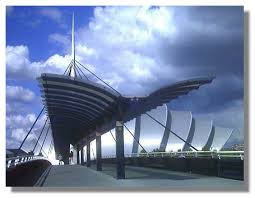
Bell's Bridge

I was standing in contemplative mood on Bell’s Bridge this afternoon when two young ladies carrying commercially branded paper coffee cups bore down upon me in loud and animated conversation.

T’ane: “It would never work economically.”

T’ither: “Of course it wouldn’t!”

T’ane: “…But I’m amazed at the amount of idiots I know wearing Yes t-shirts! I say, “What! Have you had your brains sucked out?””

The ladies then hove to westward and out of earshot, proceeding majestically towards BBC Scotland’s citadel at Pacific Quay.

Sadly, I was not wearing my Leith Says Aye t-shirt. I was about to be interviewed about huts by STV and didn’t want to mix my messages. ‘Not sure where my brains are now.


…with grateful acknowledgement to Robert Garioch, the bard.

Rediscovering the Secret Coast

Tags

, , , , , , , , ,

The first family holiday I remember clearly was at Tighnabruaich when I was seven years old.  The bay window of Mrs. Kirk’s guest house commanded a splendid view down the Kyles of Bute.  Her dog, Kyle, was notorious for loitering with intent outside the bakers.  My memories are of care free sunny days and picnics on beautiful yet empty beaches as well as a more disquieting one of nearly stepping on an adder which was basking on the road.  I therefore jumped at the opportunity to renew my acquaintance with the area when a friend offered the use of their caravan a little down the coast from the village. Today South West Cowal is promoted rather sheepishly as “Argyll’s Secret Coast”, perhaps because parts of the A8003 are still single-track.

On day one I set out from the car park at Kames on the westernmost section of the Cowal Way.  It was a curious experience.  Although the principal walking route in the area and featured on Ordnance Survey maps, this stretch is poorly signposted and only patchily maintained. Beyond Asgog Loch, timber extraction operations have altered the landscape and the mapped route has been obliterated by a holiday cottage development with high fences, locked gates and private property signs; a recent dam on the burn draining the loch; and a new network of forestry tracks.  Before long I found myself struggling through an area recently cleared of trees, up to my oxters in a tangle of brash.

Image

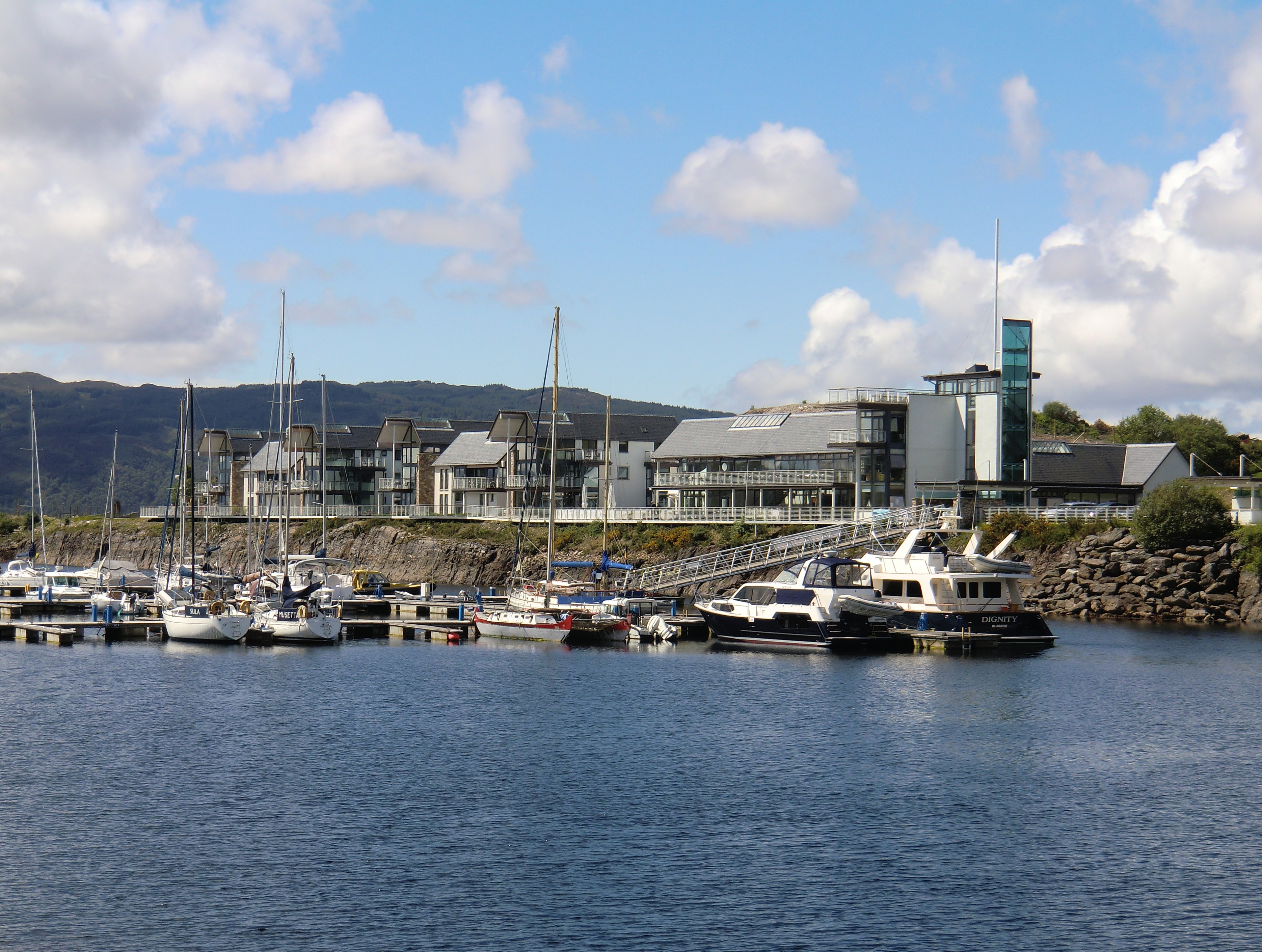
Portavadie Marina

Finally, I found my way onto a forest track and descended to Portavadie, where a deep water yard was developed in the 1970s for oil platform construction work which never came.  Today it has been reborn as the Portavadie Marina, a monoculture of holiday apartments for the yachting fraternity.  I suppose there was a desire to see something happening here, but the modern Portavadie is not a place. It is a corporate tourism development aimed at the leisured classes with their expensive boats and 4x4s.  All it offers is a glitzy but soulless cosmopolitanism and the Brazilian tapas bar is justly deserted.  Round the corner, the dystopian brick and concrete industrial village of Pollphail slowly crumbles back into the soil, surrounded by a ring of security fencing.  There is nothing for walkers here, and certainly nothing to reflect Portavadie’s role as the start or finish of the Cowal Way.  You will look in vain for any friendly pub or Katie Morag general store.

As there was nothing to tempt me to linger, it was brisk march back to the Kames Hotel for a steak pie and a beer in the sunshine.  At the next table, some good ol’ boys from Ayrshire were enjoying a desultory argument about whether to retrace their steps to Port Bannatyne or sail on to Largs, as they supped their third pints of the afternoon.  It felt like a return to civilisation.

On Wednesday I took the Colintraive ferry for a day in Bute, primarily to visit Mount Stuart, the astonishing Gothic palace with its extensive pleasure grounds which the third Marquis of Bute built with the proceeds from his family’s monopoly on Welsh coal.

However, it being a beautiful sunny morning, I decided to stop off in Rothesay for a coffee.  Unlike Portavadie, Rothesay is a real place – with a beautiful setting on the bay, a medieval history, some excellent burgh architecture and a solid legacy from its Victorian and Edwardian heyday.  Some aspects of the town are very trig.  The Winter Gardens and the Castle are surrounded by immaculate lawns but the Bute Discovery Centre and the Rothesay Pavilion are badly in need of a facelift.  The signage around the ferry terminal is unattractive and cluttered.

Image

All the essentials at Bute Tools

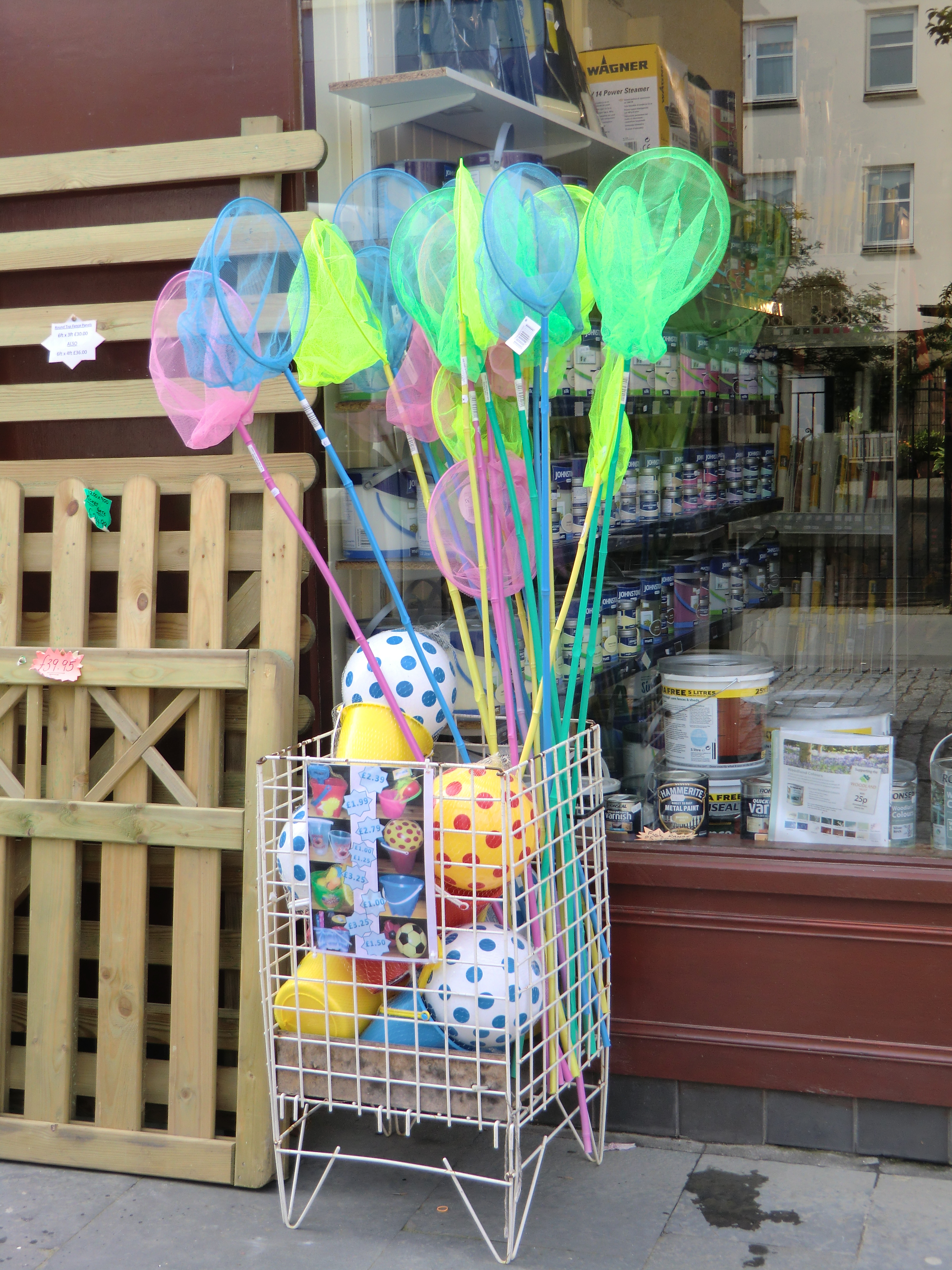
Argyll and Bute Council is doing its bit by providing funding for the Rothesay Townscape Heritage Initiative, but the town centre needs new private sector investment.  The shopping streets look down-at-heel, with most of the shops trading at the bargain basement end of retailing.  It’s the all too familiar picture of charity shops, dilapidated facades, empty units and formica-clad cafes from another age.  Nets, buckets and plastic footballs in gaudy colours sit hopefully outside the hardware store. It’s almost as if local businesses are still chasing the ghosts of a doon-the-water trade which began its precipitous decline in the 1960s.

Rothesay is not the only sturdy seaside town suffering from this malaise.  Despite the prosperity of the Isle of Man, down-town Douglas shows similar symptoms.  But it seems to me that the future of tourism and leisure on the West Coast lies in investment in traditional settlements and local products to attract new business rather than in the corporate sterility of developments like Portavadie Marina.

It has been done elsewhere.  For example, the 19th Century Spanish resort of Donostia / San Sebastian, a neglected backwater under Franco, has reinvented itself as a chic centre of Basque cuisine.  In Cornwall, Rick Stein’s culinary empire keeps little Padstow buzzing.  Nearer to home, in Largs, the refurbished Nardini’s with its art deco façade demonstrates the enduring appeal of seaside nostalgia and glamour.  On the East Coast, North Berwick points the way forward with its Festival by the Sea.  Scotland’s seaside towns have a rich heritage and tremendous potential.  We need to find the confidence to invest in them to create offers which meet modern expectations.

Mapping Europe’s Future

Tags

, , , , , , , , , ,

One of the lesser known agencies of the European Union is the European Observation Network on Territorial Development and Cohesion (ESPON), which analyses and reports on trends in territorial development across the continent. As a geographical observatory, it does the job pioneered by Patrick Geddes at his Outlook Tower in Edinburgh across a European canvas.

The data which ESPON collects and maps help us to understand the geographical dimension of the forces driving change in Europe and where Scotland sits within the wider picture.

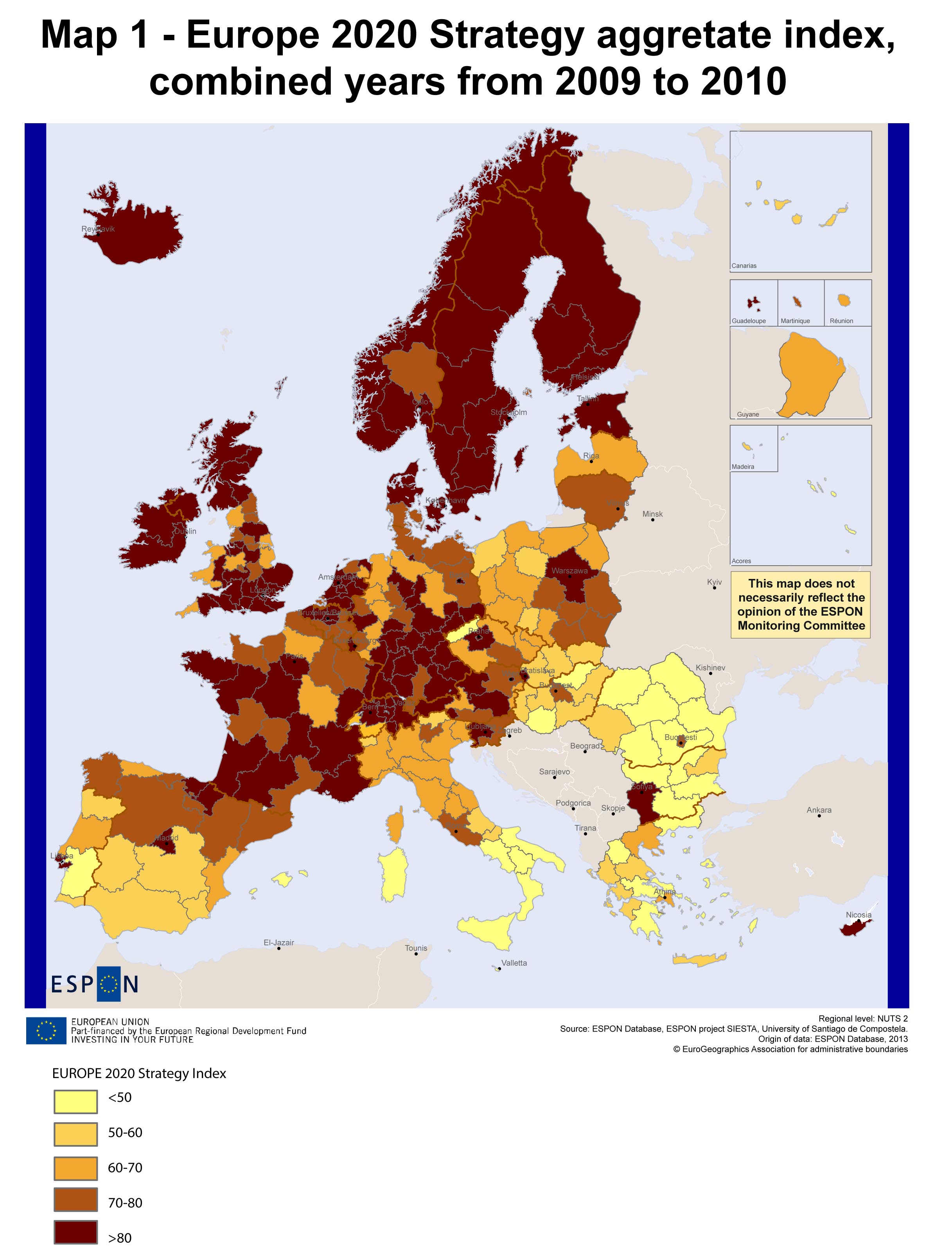
Map 1

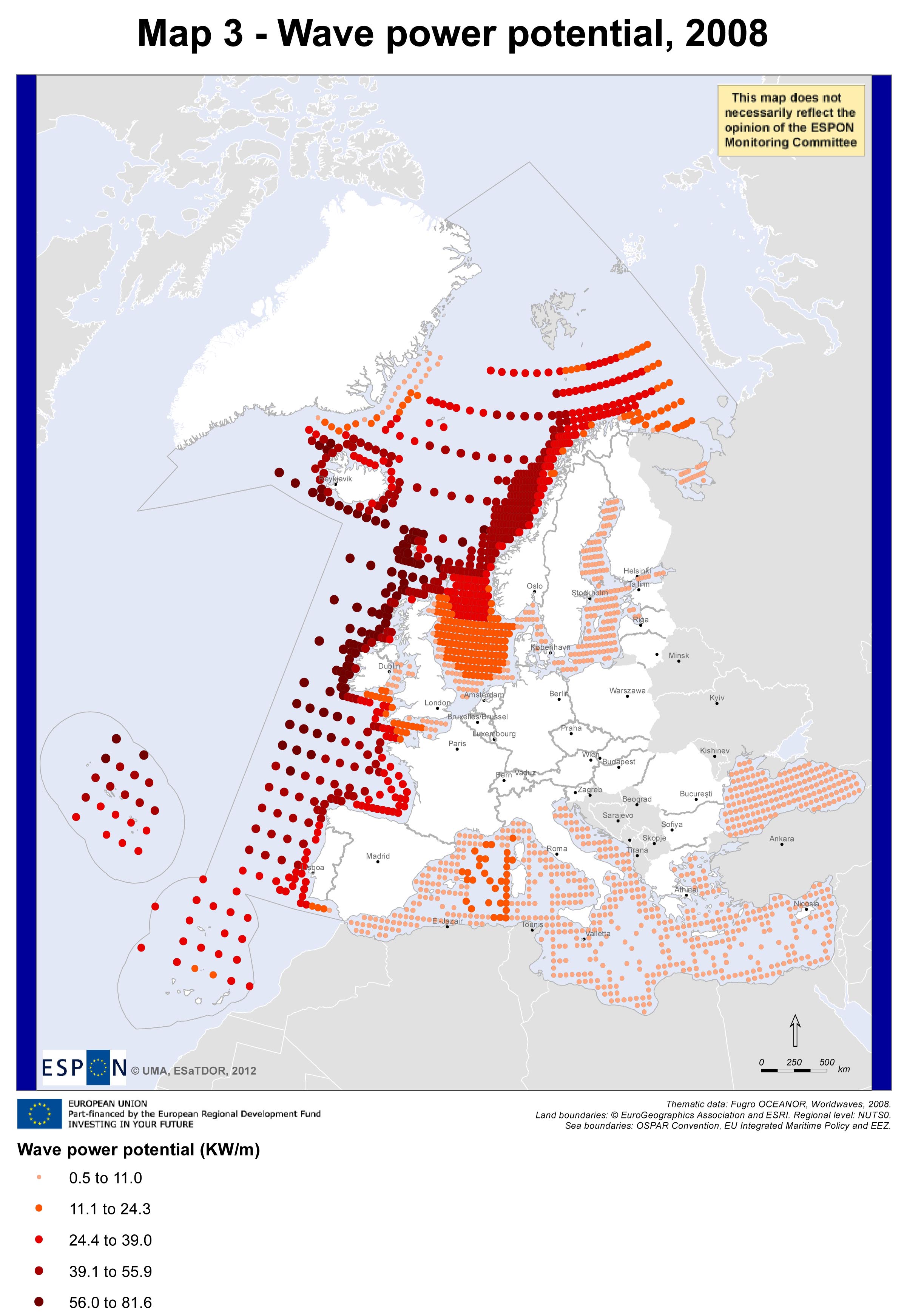
A recent ESPON briefing paper looks at the progress European territories are making towards the achievement of the targets for smart, sustainable and inclusive growth set out in the Europe 2020 Strategy. The analysis shows that performance in relation to the targets is strongest in Central and Northern Europe, with Scotland sitting alongside top-performing countries such as Finland, Sweden, Ireland and Estonia. The paper also highlights the fact that countries exposed to the Atlantic Ocean have strong unrealised potential for harnessing wave power.

Map 3

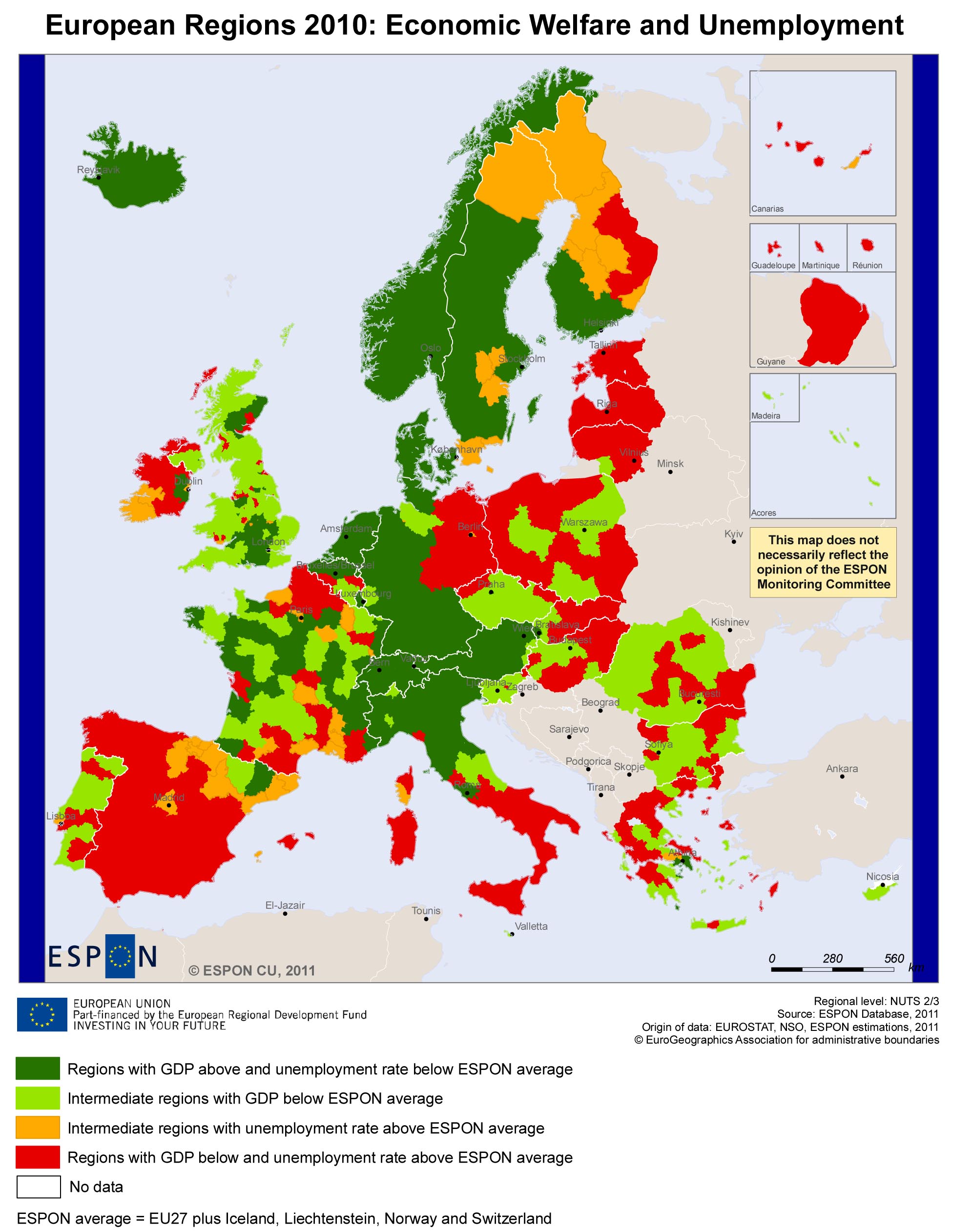
ESPON analysis of economic welfare and unemployment shows that GDP is above the European average and unemployment below the European average in much of Eastern Scotland, but that there are black-spots of poorer economic performance and higher unemployment in Glasgow and the Clyde Valley, the Western Isles, Angus and Fife.

Economic Welfare & Unemployment

Another briefing paper identifies quality of place and the capacity for strategic governance as key factors in the success of Europe’s “second tier cities”. It identifies Glasgow and Edinburgh as two of the UK cities which have been most successful in creating new jobs and notes that Edinburgh outperforms London in terms of the proportion of the population with higher education degrees.  It argues that increasing the strategic capacity to deliver place-based policies at city and regional level is the way forward.

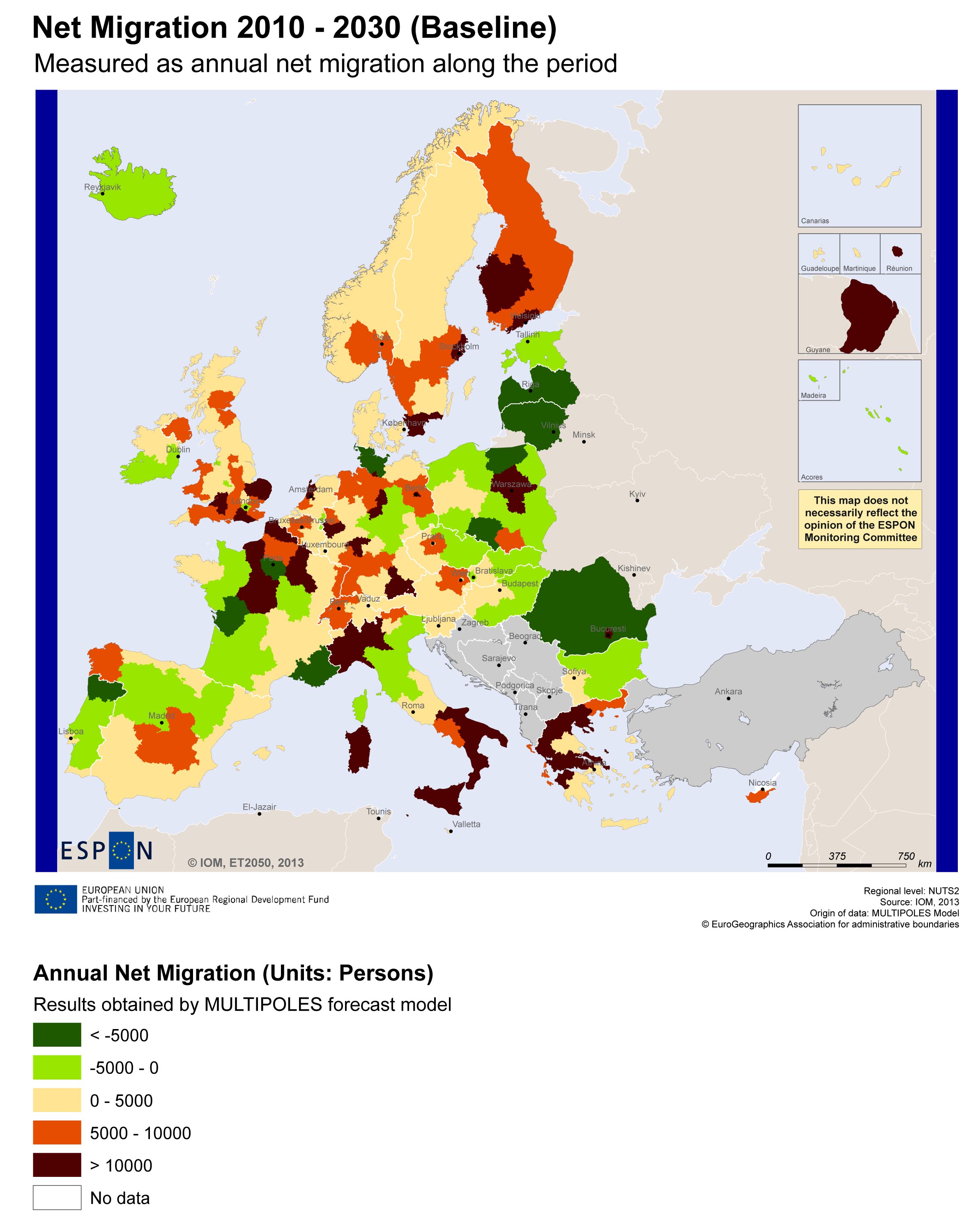
A third briefing paper examines migration trends in Europe in the aftermath of the economic crisis and this was an important focus of an ESPON seminar in Vilnius in December 2013. The analysis showed that the recession has had a major impact on migration flows in Europe, exacerbating the loss of population from countries in Eastern Europe, and reversing recent migration trends in Spain, Portugal, the Czech Republic, Ireland and Iceland.  The economic and social consequences of the loss of skilled workers is a major concern for politicians and policy-makers in countries such as Lithuania, Latvia and Romania.

Map_5_final

ESPON’s quiet mapping of the socio-economic and environmental challenges we face as Europeans may have less lounge bar appeal than the dog-whistle slogans of Nigel Farage, but in pointing to an agenda for collaboration towards a better future it offers something much more positive, purposeful and exciting than UKIP’s remedy of neoliberal economics and political isolation.

Bioregionalism and Frank Mears

Tags

, , , , , , , , ,

An outline of the career of a Scottish planner who sought to apply a Bioregionalist perspective to the challenge of rural regeneration. 

In the Spring 1995 issue of Reforesting Scotland, Douglas Aberley showed that the philosophy and practice of modern Bioregionalism has been strongly influenced by the ideas of Scottish naturalist-activists such as John Muir, Patrick Geddes, Frank Fraser Darling and Ian McHarg. Another figure who can he placed firmly within the Scottish Bioregionalist tradition is the architect-planner, Frank Mears.

central tree

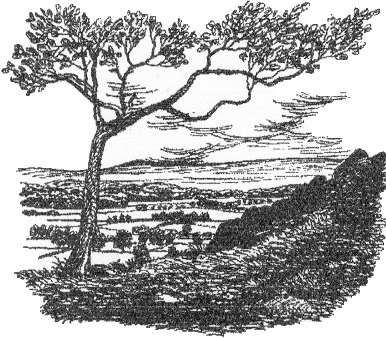
Illustration from the Regional Plan for Central and South East Scotland.

As a young architect, Mears worked as assistant to Patrick Geddes at the Outlook Tower in Edinburgh and was involved in several of Geddes’ overseas projects. As a result of this involvement, he gained early experience in applying what today would be described as “ecological restoration techniques” to problems of rural regeneration.  In Palestine during the 1920s he promoted reforestation schemes as a means of restoring the water table so that long-abandoned cultivation terraces could be brought back into agricultural production.

In his subsequent career in Scotland, Mears was the planner who most faithfully attempted to translate Geddes’ ideas on cultural evolution and regional development into practice.  He had a strong commitment to the revitalisation of Scotland’s rural areas which he regarded as the source of all that was distinctive and valuable in Scottish culture. In lectures delivered before the First World War, he had presented Geddes’ vision of the coming “neotechnic” age in which electricity and modern communications would liberate industry from the old locational constraints, allowing its benefits to be distributed more evenly between town and country and encouraging a revival of skilled craftsmanship.  He had argued that the early Norwegian hydro-electric schemes offered new hope for the Highlands and suggested that the experiments in co-operative agricultural production then being pioneered in Denmark and Ireland pointed the way forward for Scottish rural communities. 

Like Geddes, Mears saw the problems of urban and rural areas as complementary and believed that satisfactory solutions could only he achieved by planning on a regional scale.   In the course of his propaganda work in the Twenties and early Thirties, he took every opportunity to promote the Geddesian concept of regional survey. At the same time, in England, a regional approach to planning was being advocated by organisations such as the Town and Country Planning Association and prominent individual planners such as Abercrombie. However, the concept of the region which gained general currency in the interwar years was not derived directly from the thinking of Patrick Geddes but mediated through a new generation of scientifically-minded regional geographers. For them, the region was primarily a physical and economic entity, with none of the cultural significance which Geddes had ascribed to it.

Mears maintained the cultural emphasis in his own approach to regional planning. He saw the modern Region as the product of continuous interaction between the human species and its environment; each of its communities adapted to its particular geographical setting and responding to changing circumstances by a process of cultural evolution. He frequent1y emphasised the geographical and cultural heterogeneity of Scotland and argued that the diverse cultural traditions which had contributed to its development were still potent forces in the life of the modern nation and should be respected in planning for the future.  He therefore rejected standardised solutions to contemporary problems, believing that planning proposals should he individually tailored to local conditions, with due regard to existing customs and systems of social organisation.

The growth of Scottish national consciousness during the interwar years was reflected in the emergence of a specifically Scottish dimension to planning and as Scotland’s leading planning advocate and practitioner, Mears made a seminal contribution to this development. The principal problem facing Scotland was the increasing centralisation of economic activity within the British State.  While the Midlands and South of England wrestled with the problems of urban expansion, Scotland was confronted with an altogether bleaker picture of industrial stagnation, rural depopulation and chronic bad housing.  Mears believed that Scottish circumstances demanded a planning system capable of initiating as well as controlling development.  His cultural perspective accorded well with the prevailing spirit of national assertiveness and throughout his consultancy work he sought to devise development strategies which built upon indigenous physical and human resources and traditional Scottish settlement patterns.

regions

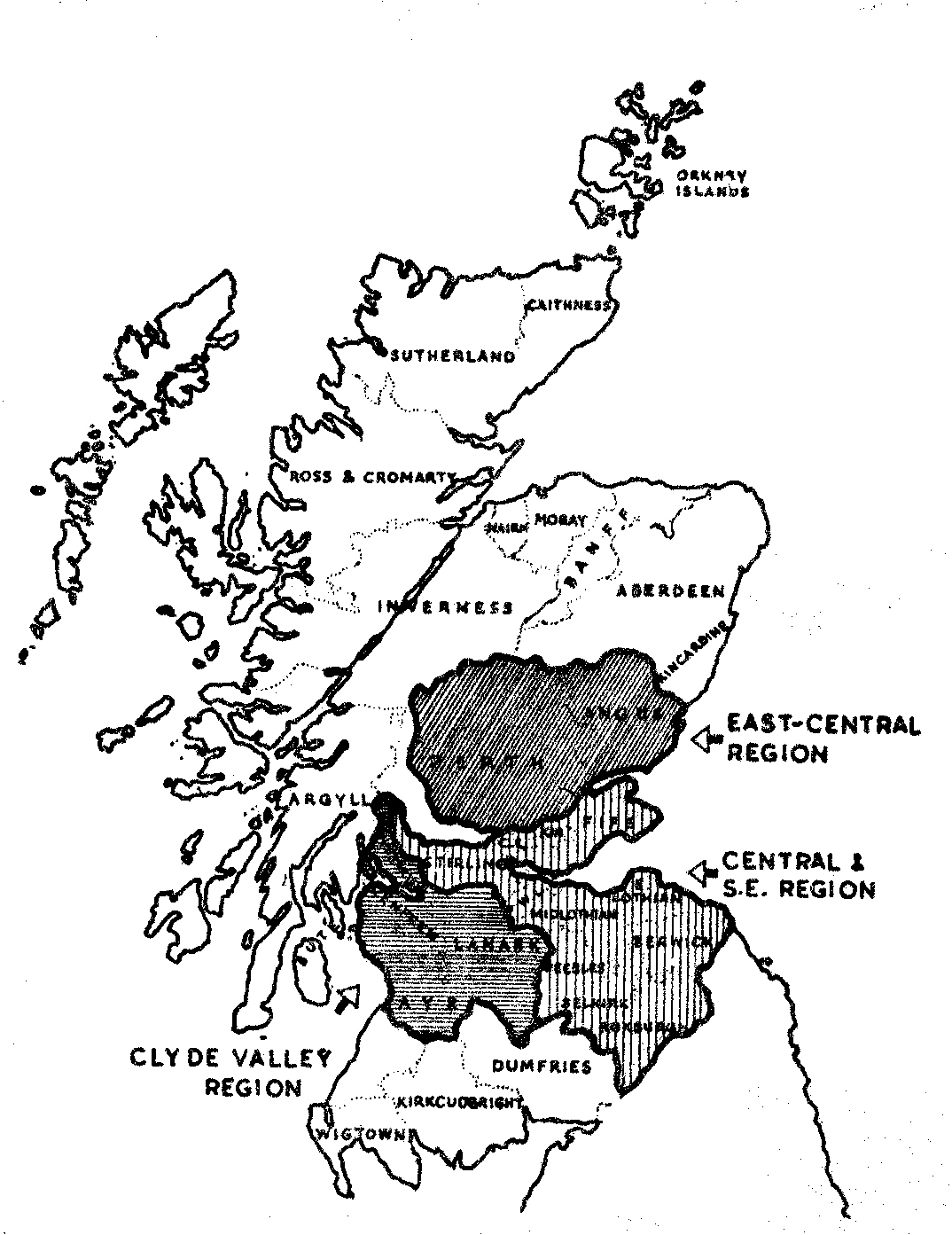
The first generation of Scottish regional plans.

Under the autonomous administration established by the wartime Secretary of State, Tom Johnston, Mears was given the opportunity to apply his ideas about regional planning across a broad canvas.   In 1943, he was asked to prepare a regional plan for Central and South East Scotland.  This was no mean task. The territory to he covered stretched from the Tay to the Tweed and, to the west, at a point near Milngavie, its boundary fell within two miles of the built-up area of Glasgow. While this area contained a wide diversity of physical and social conditions, two principal sub-regions could he identified; the open, semi-industrial landscape of the Forth estuary contrasting sharply with the largely rural character of the steep-valleyed Tweed basin.

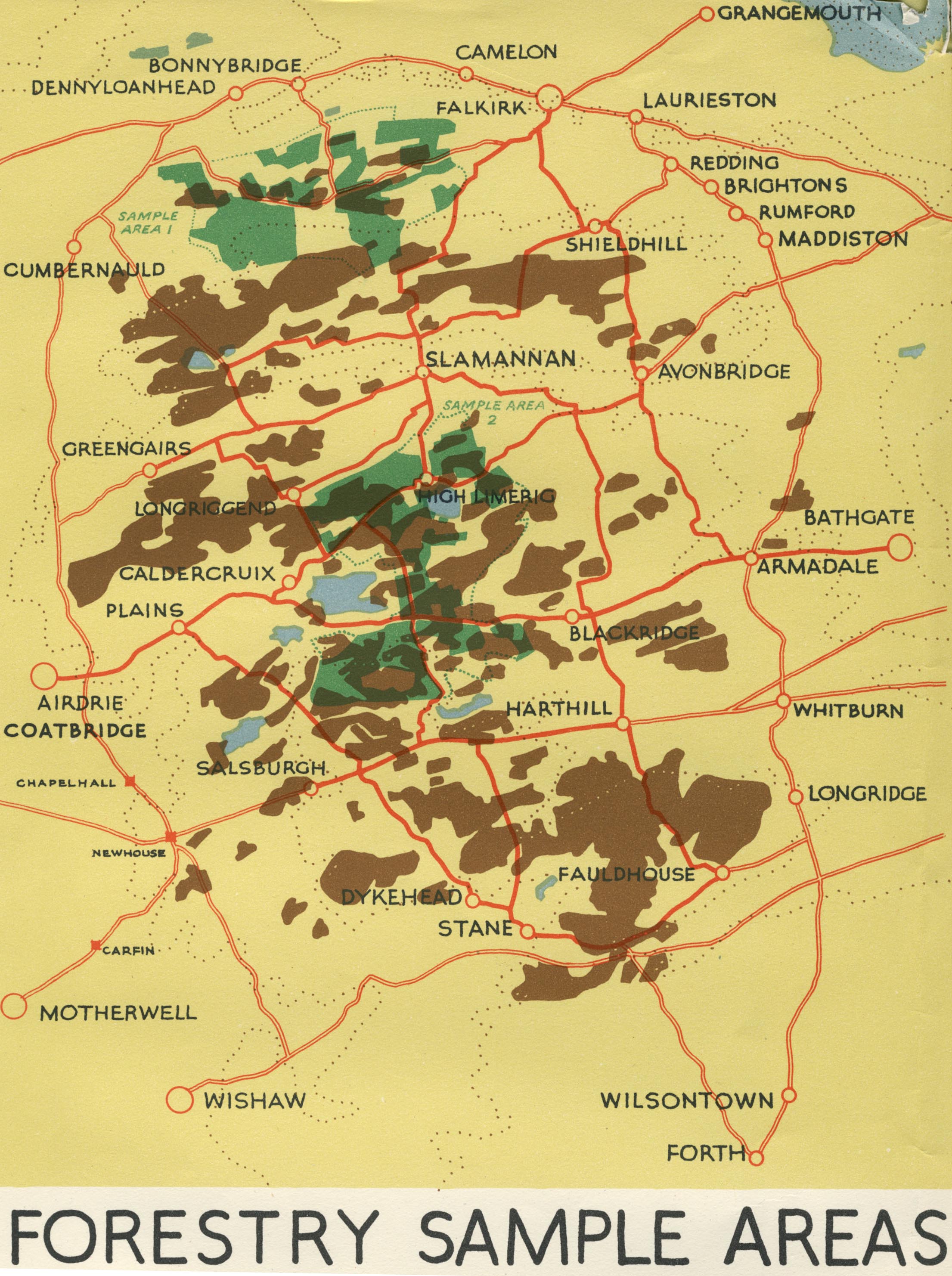
In the 1930s,Mears had been active in the campaign to provide improved infrastructure and modern services to rural communities and had prepared designs for low-cost rural housing.  His Central and South-East Scotland Plan identified rural depopulation as the most pressing problem facing both the region and Scotland as a whole.  It called for a joint campaign by central and local government to encourage “recolonisation” of the countryside, suggesting that the ultimate goal should be the return of approximately 10% of the urban population to the rural areas. One of the most original features of the plan was the application of community planning principles in a rural context to provide a strategy for the resettlement of depopulated Border valleys.  The Plan also contained proposals for the reforestation and recolonisation of the Slamannan plateau, laying the foundations for what was to become the Central Scotland Forest.

Slamannan Plateau

In his 1949 Central and South East Scotland Plan, Mears made proposals for forest planting in Central Scotland.

Towards the end of his career, Mears addressed the problem of rural depopulation in its most acute form in a strategy for the revitalisation of the County of Sutherland.  Against the prevailing wisdom of the time, he rejected the notion that the problem of rural decline could he solved “by a simple process of decanting a given proportion of large-scale industries into partially depopulated areas”.  Instead, in a plan strongly influenced by Fraser Darling’s Preliminary Report on the West Highland Survey, he advocated a strategy based on the regeneration of the crofting economy through measures such as land rehabilitation, tenure reform, investment in agriculture, forestry and fishing, and the encouragement of small rural industries based on indigenous resources.

With the election in 1945 of a Labour Government committed to centralised economic and social management, the initiative in matters of planning and reconstruction passed from the Scottish Office to Whitehall and in the post-war period a technocratic planning profession was to become increasingly preoccupied with systems, procedures and regulation.  In this climate, those aspects of Mears’ Bioregionalist philosophy which did not conform to British planning orthodoxy were largely disregarded. Today, his views on land rehabilitation, community empowerment and the importance of the cultural dimension in regional planning can be seen to have abiding relevance.


This article first appeared in the Spring 1996 issue of Reforesting Scotland.

Scottish Environmentalism – The Contribution of Patrick Geddes

Tags

, , , , , , ,

In his address to the Spring Gathering of the Dunbar John Muir Association in April 1995, Professor Aubrey Manning highlighted the distinctive contributions to modern environmental thought made by the Scottish naturalist-activists John Muir, Patrick Geddes and Frank Fraser Darling.  An article by Douglas Aberley in the Spring 1995 issue of the journal Reforesting Scotland also drew attention to the considerable influence of these three figures.

The contribution of John Muir to the conservation of wild land and our appreciation of the spiritual value of wilderness does not need to be stressed to the readers of this Journal.  However, the vigorous debate which the very terms “wilderness” and “wild land” continue to provoke in a Scottish context testifies to the problematic nature of Muir’s concept of “wilderness” in a country where the human species has been an integral part of the ecosystem for around 10,000 years and all but the most inaccessible areas have been profoundly altered by human activity.

As a result, even our wild land has strong historical and contemporary associations with human communities and our responses to it inevitably reflect the considerable cultural baggage which each of us carries with us.  As James Hunter points out in his seminal exploration of the relationship between people and nature in the Scottish Highlands, On the Other Side of Sorrow, the pronouncements of environmentalists on the natural heritage of the Highlands have too often shown scant appreciation of the history, culture and aspirations of the people who actually inhabit the land which they so earnestly seek to conserve.

The John Muir Trust has been a pioneer amongst environmental organisations in recognising the social and economic dimensions of conservation and committing itself to working closely with local communities to safeguard and restore wild land and develop sustainable land management practices.  However, it is the environmentalism of Patrick Geddes rather than that of Muir which is likely to have most to offer when it comes to discharging that commitment.

Patrick Geddes - portraitPatrick Geddes

Geddes, despite his acknowledged importance as a founding father of modern town and country planning, is a notoriously difficult personality to come to grips with.  His enthusiasms were diverse and idiosyncratic.  He is still variously described as a zoologist, botanist, sociologist or town planner and during the course of his career he was all of these, though never exclusively or conventionally any of them.  The sheer difficulty of categorising Geddes within any of the conventional academic disciplines has discouraged examination of his ideas and this task has only recently been attempted seriously.

Geddes was seventeen years younger than John Muir, being born in 1854.  Like Muir, he developed an interest in the natural world through childhood exploration of the countryside around one of Scotland’s historic burghs (in Geddes’ case it was Perth).  Subsequently, he studied under the eminent English biologist, Thomas Huxley before moving on to Paris where he encountered the ideas of the French sociologist, Frédéric Le Play.

In 1880, Geddes was appointed Assistant in Practical Botany at the University of Edinburgh and took up residence in the city’s Old Town.  He was appalled at the conditions he found there.  Following the construction of a gracious Georgian New Town beyond the Nor Loch, Edinburgh’s middle classes had abandoned the high tenements and narrow closes of the Castle ridge, and the Old Town had rapidly degenerated into a noisome slum.  Geddes responded by throwing himself into the promotion of an ambitious programme of civic and environmental renewal, involving local people in the rehabilitation of tenement property, the improvement of open spaces, and the creation of gardens where the urban population could enjoy the restorative effects of contact with nature.

Geddes was also acutely aware of the significance of the Old Town as the historic home of Scotland’s political and cultural institutions.  The loss of the Scottish Parliament in the early 18th Century had left a vacuum at the centre of the city’s political and cultural life and by the late Victorian period the city had lost the intellectual pre-eminence which it had enjoyed during the golden years of the Enlightenment.  Geddes drew direct inspiration from Edinburgh’s cultural and intellectual heritage and the great variety of environmental and educational projects which he promoted in the city were primarily aimed at stimulating a cultural and intellectual revival.

An appreciation of Geddes’ close engagement with the fate of Edinburgh as a national culture-capital is crucial to an understanding of the particular perspective which he brought to land use planning.  His conception of the nature and purpose of planning was quite different from that of other planning propagandists.  For Geddes, the central concern was not with the technical problems of urban expansion or the creation of brave new utopian settlements but with the task of inspiring communities to an active participation in their own cultural and social renewal.

From his starting point as a natural scientist, Geddes attempted to apply the principles of Darwinian evolutionary theory to the study of modern society.  The objective was to gain sufficient understanding to enable the raw evolutionary forces which were shaping society to be harnessed and guided in positive directions towards the greater fulfilment of Mankind.  Thus his aims were ultimately spiritual rather than material.  What he sought was the restoration of a “harmony” or “balance” to human life and social relationships which he believed to have been lost during the trauma of the industrial revolution; in short, the recreation of physical and social environments in which human beings could enjoy greater personal fulfilment and creative expression.

Geddes’ distinctive contribution to the development of regional theory stressed the interaction between the environment, economic activity and community, expressed in the triad “Place/Work/Folk”.  He saw the modern region as the product of continuous interaction between the human species and its environment; each of its communities adapted to its particular geographical setting and responding to changing circumstances by a process of cultural evolution.  He therefore rejected standardised solutions to environmental and social problems, believing that proposals should be individually tailored to local conditions, with due regard to existing customs and systems of social organisation.

Geddes looked forward to the coming “neotechnic” age in which clean and efficient new technologies would replace the polluting industrial activities of the past.  He also believed that electricity and modern communications would liberate industry from the old locational constraints, enabling its benefits to be distributed more evenly between town and country and encouraging a revival of skilled craftsmanship.  In lectures delivered before the First World War, Geddes and his associates argued that the early Norwegian hydro-electric schemes offered new hope for the Highlands and suggested that the experiments in co-operative agricultural production then being pioneered in Denmark and Ireland pointed the way forward for Scottish rural communities.

While Geddes worked primarily in an urban context, his son-in-law, Frank Mears, applied the same approach to cultural and environmental renewal in his pioneering planning work in rural Scotland.  In the early ‘fifties, Mears addressed the problem of rural depopulation in its most acute form in a strategy for the revitalisation of the County of Sutherland.  Against the prevailing wisdom of the time, he rejected the notion that the problem of rural decline could be solved “by a simple process of decanting a given proportion of large-scale industries into partially depopulated areas”.  Instead, in a plan strongly influenced by Fraser Darling’s Preliminary Report on the West Highland Survey, he advocated a strategy based on the regeneration of the crofting economy through measures such as land rehabilitation, tenure reform, investment in agriculture, forestry and fishing, and the encouragement of small rural industries based on indigenous resources.

John Muir is rightly acknowledged internationally as one of the founding fathers of the modern conservation movement.  However, the contemporary land debate would benefit from a wider appreciation of the contributions of figures such as Geddes, Fraser Darling and Mears to the development of a distinctively Scottish environmental perspective which accords human communities a central role in conservation and land renewal.  More particularly, Geddes’ commitment to community empowerment and the active involvement of local people in the restoration and improvement of their own physical and cultural environments can provide valuable inspiration to the Trust in its work with rural communities.


This article was first published in the John Muir Trust Journal & News No. 22 in January 1997.  I think it remains relevant to contemporary debates about environmentalism, environmental management, rural development and wild land.

Culture Cities and Urban Renaissance

Tags

, , , , , ,

At a European planning conference I attended in Vilnius in December the City Architect quoted Wellington Webb, the first African American mayor of Denver, as claiming that:

“The 19th century was a century of empires, the 20th century was a century of nation states. The 21st century will be a century of cities.”

On that timetable, Scotland may be running about a century late.

In thinking about our aspirations for Scotland’s cities and urban living in the 21st Century, there could hardly be a better place to start than the pioneer Scottish planner, Patrick Geddes.  My own research was on Geddes’ son-in-law, Frank Mears, and how he sought to apply Geddes’ ideas in the practice of urban and regional planning in the mid-20th Century.  Both Geddes and Mears were interested in cities as hubs of cultural creativity and, influenced by Darwin, they saw the job of the planner as being to foster progressive cultural evolution.  They both had a strong engagement with the health of Scotland’s culture and sense of itself.  Hugh McDiarmid, the dominant figure in the literary revival of the nineteen-twenties which came to be known as the Scottish Renaissance, acknowledged Geddes as one of its progenitors.

Patrick Geddes

Patrick Geddes

Geddes’ initial inspiration was the historic culture-capital of Edinburgh and there was an anti-imperial and anti-metropolitan dimension to his thinking.  His knowledge of Scotland’s post-Union history led him to the general conclusion that the excessive dominance of the great imperial capitals of the world was having a negative impact on the social and cultural life of the lesser cities over which they held sway.  He believed that only with the removal of the imperial yoke would it be possible for the subordinate cities to realise their full social and cultural potentials and it was this conviction which drew him to the historic culture-capitals of Dublin and Jerusalem as they each re-emerged from long periods of enforced provincialism.

Geddes and Mears were ultimately concerned with spiritual more than material welfare. Insofar as their criteria for defining evolutionary social progress were ever made explicit, they were described largely in spiritual rather than material terms.  What they sought was the restoration of a “harmony” or “balance” to human life which they believed to have been lost during the trauma of the industrial revolution; in short, the recreation of physical and social environments in which human creativity could once again find full expression.  In this respect, their ideology had closer affinities with the modern environmental or “Green” movement than with the technocratic planning of the mid-20th Century and, considering its distinctly religious aspect, it is perhaps not so surprising that in extolling the environmental virtues of Perth, Mears should describe it as a “Garden of Eden”.

Scotland’s Cities

Scotland’s cities offer urban environments of a high quality and have a key role as drivers of the economy. They are each distinct manifestations of a Scottish urban tradition dating back to the foundation of the burghs by the Canmore kings.  That has physical dimensions such as urban form, tenement living and building in stone, but it has also been reflected in distinctive civic, mercantile and administrative cultures and traditions.  Scottish cities are still arguably more like Continental European cities than most other cities in the UK, though Glasgow wears its love affair with America on its sleeve.  For a small country, Scotland is regionally diverse and our cities reflect that.

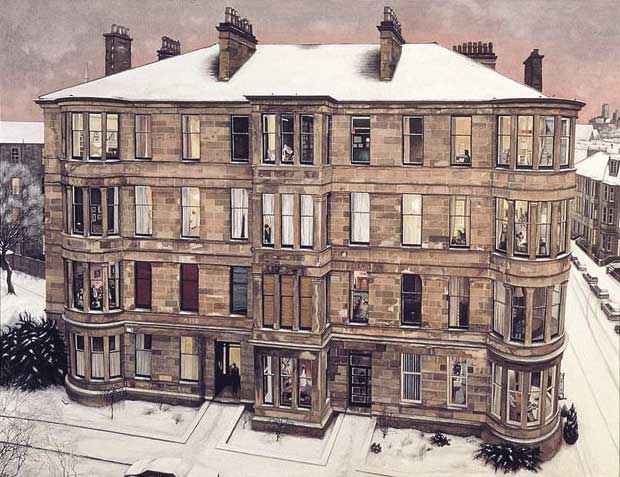
Glasgow tenement

That Glasgow tenement

Scotland’s economy has changed dramatically over the last century and physical and cultural environments have changed to match.  Nowhere is that more evident than Glasgow.  Manufacturing and heavy industry have given way to a more diverse knowledge economy.  Both Glasgow and Edinburgh are strong knowledge economy centres in European terms.  However, past industrial activity, economic change and poor urban management have left a legacy of social and environmental problems.  A sizeable proportion of the population has seen little benefit from opportunities in the new economy. We still have wide geographical disparities in wealth, economic opportunity, health, life expectancy and environmental quality, with persistent concentrations of disadvantage in parts of the West of Scotland and problems of economic overheating in the East.  While Glasgow has seen an economic and physical transformation since the 1980s, the differences between the social profiles of the West and East of Scotland remain.  In employment terms, Glasgow has been less resilient than Edinburgh in the period since the economic crash.

For the past 40 years Aberdeen has played a distinctive role as a major centre for the oil and gas industry. It is now seeking to build on its offshore and engineering strengths to diversify into renewables technologies.  Dundee has transformed the quality of its city centre and is working to transform its waterfront. It has enhanced its cultural facilities and established new centres of expertise in key sectors of biotechnology and the knowledge economy.  A key challenge is to retain a higher proportion of the people who study there once they graduate.

And our four historic cities have recently been joined by three new ones – Stirling, Inverness and Perth.  Inverness is developing its role as Highland capital while Stirling and Perth sit at important strategic locations at the interface between Highland and Lowland Scotland.

Cultural Renaissance

The old imperial cities Geddes talked about are largely gone – we may be witnessing their final swan-song – but we live in an age of global capital where a handful of global mega-cities dominate world markets and the commercial media and have a huge influence on our economic prospects, culture, and tastes.   A recent Centre for Cities report found that the current economic recovery is strongly focused on the South-East of England and deepening the divide between London and most other UK cities.  Professor Tony Travers of the London School of Economics said recently: “London is the dark star of the economy, inexorably sucking in resources, people and energy. Nobody quite knows how to control it.”

In Scotland we are familiar with the challenge.  One of the things the referendum campaign has done is to stimulate a lot of creative thinking about possible futures for Scotland.  So it seems an appropriate time to be asking what our aspirations are for our cities.  What should we be looking for in a Scottish urban renaissance?

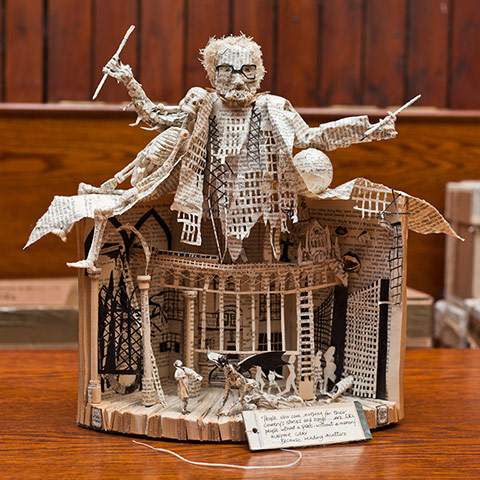
I think some of the developments we have seen in the 20th Century are very much in tune with what people like Geddes and Mears were looking for.  Today Scotland has a very vibrant and diverse urban culture.  In many ways our arts and literature are thriving, and no-one symbolises this better than Glasgow’s ultimate Renaissance man, Alasdair Gray, who urges us to work as if we lived in the early days of a better nation.

Alasdair Gray's Lanark

Alasdair Gray – paper sculpture

Our cities are also much more diverse and cosmopolitan than they were in the post-War years.  Our response to recent immigration has generally been much more enlightened and positive than it was to Irish immigration in the 19th and early 20th Centuries, but our urban culture still bears the dark scars of sectarianism as a legacy of that experience.

Edinburgh has its constellation of Festivals, including the biggest and longest running international arts festival in the world.  Edinburgh is the place to be in August, when the place is buzzing with entertainment and ideas.  But isn’t it odd that amidst all this creative ferment, the organisers of the International Festival seem reluctant to find a space at the table for Scottish culture and concerns?  Festival Director Sir Jonathan Mills has said that he does not intend to include works relating to Scotland’s referendum in the 2014 programme.

In Glasgow the Celtic Connections festival has recently had another great year.  What started as a brave attempt to fill venues at a slack time of year has turned into a major cultural and economic success, with ticket receipts in excess of £1 million for the seventh successive year.  Celtic Connections has raised the international profile of the city and brightened up the dark midwinter.  It has had all sorts of benefits and spin-offs for Scottish musicians and the wider music scene.  For example, we now have Celtic Music Radio broadcasting Scottish, Irish and Roots music across the globe.

And, of course, in August Glasgow hosts the Commonwealth Games.  That will be a great international celebration of culture as well as sporting prowess and a lot of work is being done in the east of the City to provide the facilities and leave a lasting legacy.

But one sector which is conspicuously failing to step up to the mark is film and broadcast media.  The level of cultural activity in Scotland is a tremendous resource for our media to draw on, but much of their output is timid, stale and provincial. Taggart was fun in its day, but Scottish popular drama output looks very dated and derivative in comparison to contemporary Scandinavian Noir!  Why aren’t BBC Scotland and STV signing up Festival talent for Scottish-based television series?  The world-class media facilities at Pacific Quay, incorporating the headquarters of BBC Scotland and Scottish Television, offer the potential for Scotland to become a globally significant player in television and film production for the whole English-speaking world.  There is also scope for building on the media infrastructure and expertise which exists in Aberdeen to develop its role as a media centre for the North East.  There is little sign of anything like this happening at present and I don’t see the potential being realised without a “Yes” vote.

Successful and Sustainable Cities

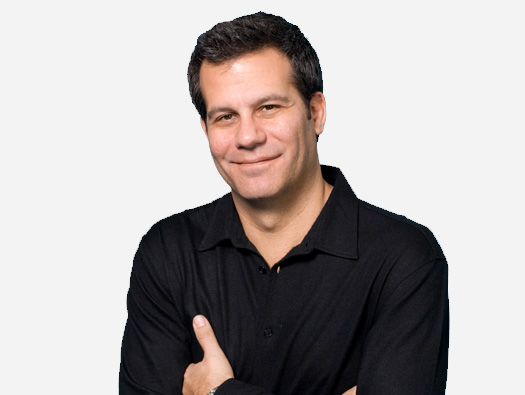
At the time I was working on Scotland’s first National Planning Framework, between 2004 and 2008, Richard Florida’s book The Rise of the Creative Class was having a lot of influence. Everyone at Scottish Enterprise seemed to have been given a copy for Christmas. Florida’s essential message is that to be competitive cities must be well connected and able to offer high quality environments and a first-class quality of life.  Work on the West Coast of America has shown that cities which are good places to live are better at weathering recession.  People tend to stick around and create new opportunities rather than seeking employment elsewhere.

Richard Florida

Richard Florida

City Collaboration was another big idea, and then the emphasis was on collaboration between Glasgow and Edinburgh.  In this technocratic vision the two cities were to function as complementary economic and cultural hubs of a Central Belt conurbation large enough to compete on a global scale.  But thinking has moved on. Now a partnership of all seven of Scotland’s cities is working in collaboration with the Scottish Government under the umbrella of the Scottish Cities Alliance.  The Action Plan for Scotland’s cities states that successful cities tend to be:

  • Connected Cities; with strong digital and transport infrastructure.
  • Sustainable Cities; maximising the benefits and competitive advantage that the transition to a low carbon economy brings for the City, its region and its residents.
  • Knowledge Cities; with high performing research and educational institutions, high value sectors and access to a highly skilled labour pool; and
  • Vibrant and Cultural Cities, which have a distinct quality of place, amenities, retail and cultural offerings to attract and retain talent, investment and visitors.

City investment plans are being prepared to identify key investment and development opportunities in each city.

However, in practice, the challenge of urban renewal is clearly giving us problems.  In Aberdeen, Glasgow and Perth ambitious schemes for transforming the city centres have become mired in public controversy and, of course, Edinburgh has had its tram saga. Repeatedly we are seeing opportunities for progressive change squandered as a result of flawed processes, rampant egotism and cynical party politicking.

The Scottish Government is keen that Scotland should be both an exemplar and a focus of expertise in tackling the challenges of climate change and with transport, buildings and business activity accounting for a high proportion of emissions, their reduction will require substantial changes in our urban fabric.  It has been taking that agenda forward through the Scottish Sustainable Communities Initiative, which seeks to create high quality exemplars of 21st Century low impact development.   However, to date efforts to promote sustainable living and reclaim our cities from the motor car have been fitful, piece-meal and half-hearted in comparison with Continental exemplars.

Eighteen months ago, I heard the Danish architect and design consultant, Jan Ghel, give the Patrick Geddes Memorial Lecture to a packed lecture theatre in Edinburgh.  He pointed out that the transformation of Copenhagen into a people and bicycle-friendly city hadn’t happened over-night.  It is something which demanded consistent commitment from civic leaders and officials over a period of 40 years.  That is something we need to learn.

There is an urgent need for debate about how we agree and deliver the changes needed to create sustainable and liveable cities for the 21st Century. I am somewhat sceptical about technocratic visions of sustainable cities.  There is a widespread feeling that our local government is already far too centralised, technocratic and remote, and that our politicians have become disconnected from the communities they are supposed to serve. In his book Arguing for Independence: Evidence, Risk and the Wicked Issues, Stephen Maxell wrote:

After 10 years of devolution, decision-taking remains highly centralised with local authorities enjoying only marginally more spending discretion than in the rest of the UK…

He believed that there is a need “to consider constitutional reinforcement to the rights of local government and of local communities” in an independent Scotland.

I suspect most of us would want civic change to be led by an active citizenry rather than big capital and power elites.  But how do we mobilize that citizenry and build consensus for a positive programme of action?  How do we achieve an ongoing commitment to delivering that programme?  How do we ensure that the forces of cautious conservatism and negativity will not inevitably prevail?

On the positive side, there is abundant evidence of community spirit and a desire to be active in making our cities more socially and environmentally rewarding places.  We see that in the demand for allotments, the proliferation of community festivals, markets and orchards, phenomena such as urban and guerrilla gardening, and the growing interest in community ownership of a wide range of public assets.  Unfortunately, too often elected representatives see civic activism as a threat to their authority and officialdom finds it difficult to engage with it in a positive way.  We need to build a genuinely local and participative system of local government.  As Lesley Riddoch argues in her book, Blossom: What Scotland Needs to Flourish:

“Capable, connected, powerful communities – based on the kind of dynamism demonstrated by development trusts – could generate electricity, supply district heating, find work for unemployed young people, tackle local flooding problems, fix derelict buildings, build and manage housing and keep an eye on old folk…”

Lesley Riddoch-for use by Lesley Riddoch in all media

Lesley Riddoch

There are also fundamental questions around who benefits from urban development.  As Edinburgh’s new tram line nears completion attention is turning to the development opportunities associated with it.  Campaigners like Andy Wightman argue that radical changes to land ownership and taxation are required to ensure that the benefits from the uplift in land values associated with development accrue to communities rather than rentiers.

As I indicated earlier, Scotland is remarkably diverse for a small country. Its cities are economic and cultural hubs for distinctive surrounding regions and it is important that we do not lose sight of the national and regional dimensions in our desire to give greater power to communities. While we should be guided by the dictum that small is beautiful, we must be realistic enough to recognise that Scotland does not have a Hobbit economy.  Like the Scandinavian neighbours we aspire to emulate, we need democratic structures capable of making big strategic decisions on infrastructure and other matters in the national or regional interest.

Conclusion

As we move towards Scotland’s date with destiny, there are a lot of positive things we can say about our cities.  We have a vibrant, diverse, outward-looking and increasingly confident urban culture and the independence debate has stimulated discussion about possible futures. There has been a flowering of civic and community activism and we have a good understanding of the things which are socially and culturally enriching in urban life.  There is a broad commitment to making our cities more sustainable and liveable places and a recognition that they need to collaborate as well as compete.

However, if we are to get closer to the sort of urban renaissance that Patrick Geddes envisaged, we need to think radically about how best to empower communities and re-engage citizens with decision-making.  We need local government which is genuinely local.  We need to get a lot better at building popular consensus around programmes of urban renewal and seeing them through to delivery over the long term.  We need to pursue the changes in land ownership and taxation required to ensure that communities benefit from the uplift in land values resulting from development.  We need to nurture the role of our cities as the economic and cultural capitals of their respective regions.  We need to reflect Scotland’s strong regional dimension in our approach to decision-making in a way which is consistent with the return of power to communities.


This article was prepared as a paper for the Re-imagining Our Urban Future conference which the International Christian College had planned to host in Glasgow on 21 February 2014. It was published in Bella Caledonia on 5 March 2014.