• Thomas Learmonth o Erceldoune

By Erceldoune

~ Graeme Purves

By Erceldoune

Tag Archives: Frank Fraser Darling

Bioregionalism and Frank Mears

19 Saturday Apr 2014

Posted by Graeme Purves in Frank Mears

≈ Leave a comment

Tags

Bioregionalism, Central Scotland Forest, Frank Fraser Darling, Frank Mears, Patrick Geddes, rural development, Scottish Borders, Slamannan plateau, Sutherland, West Highland Survey

An outline of the career of a Scottish planner who sought to apply a Bioregionalist perspective to the challenge of rural regeneration. 

In the Spring 1995 issue of Reforesting Scotland, Douglas Aberley showed that the philosophy and practice of modern Bioregionalism has been strongly influenced by the ideas of Scottish naturalist-activists such as John Muir, Patrick Geddes, Frank Fraser Darling and Ian McHarg. Another figure who can he placed firmly within the Scottish Bioregionalist tradition is the architect-planner, Frank Mears.
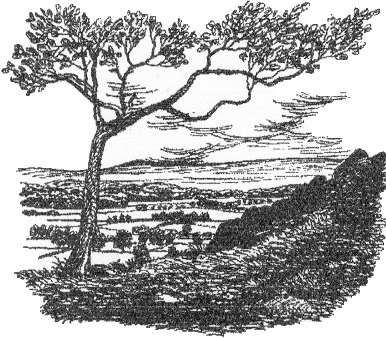
central tree

Illustration from the Regional Plan for Central and South East Scotland.

As a young architect, Mears worked as assistant to Patrick Geddes at the Outlook Tower in Edinburgh and was involved in several of Geddes’ overseas projects. As a result of this involvement, he gained early experience in applying what today would be described as “ecological restoration techniques” to problems of rural regeneration.  In Palestine during the 1920s he promoted reforestation schemes as a means of restoring the water table so that long-abandoned cultivation terraces could be brought back into agricultural production.

In his subsequent career in Scotland, Mears was the planner who most faithfully attempted to translate Geddes’ ideas on cultural evolution and regional development into practice.  He had a strong commitment to the revitalisation of Scotland’s rural areas which he regarded as the source of all that was distinctive and valuable in Scottish culture. In lectures delivered before the First World War, he had presented Geddes’ vision of the coming “neotechnic” age in which electricity and modern communications would liberate industry from the old locational constraints, allowing its benefits to be distributed more evenly between town and country and encouraging a revival of skilled craftsmanship.  He had argued that the early Norwegian hydro-electric schemes offered new hope for the Highlands and suggested that the experiments in co-operative agricultural production then being pioneered in Denmark and Ireland pointed the way forward for Scottish rural communities. 

Like Geddes, Mears saw the problems of urban and rural areas as complementary and believed that satisfactory solutions could only he achieved by planning on a regional scale.   In the course of his propaganda work in the Twenties and early Thirties, he took every opportunity to promote the Geddesian concept of regional survey. At the same time, in England, a regional approach to planning was being advocated by organisations such as the Town and Country Planning Association and prominent individual planners such as Abercrombie. However, the concept of the region which gained general currency in the interwar years was not derived directly from the thinking of Patrick Geddes but mediated through a new generation of scientifically-minded regional geographers. For them, the region was primarily a physical and economic entity, with none of the cultural significance which Geddes had ascribed to it.

Mears maintained the cultural emphasis in his own approach to regional planning. He saw the modern Region as the product of continuous interaction between the human species and its environment; each of its communities adapted to its particular geographical setting and responding to changing circumstances by a process of cultural evolution. He frequent1y emphasised the geographical and cultural heterogeneity of Scotland and argued that the diverse cultural traditions which had contributed to its development were still potent forces in the life of the modern nation and should be respected in planning for the future.  He therefore rejected standardised solutions to contemporary problems, believing that planning proposals should he individually tailored to local conditions, with due regard to existing customs and systems of social organisation.

The growth of Scottish national consciousness during the interwar years was reflected in the emergence of a specifically Scottish dimension to planning and as Scotland’s leading planning advocate and practitioner, Mears made a seminal contribution to this development. The principal problem facing Scotland was the increasing centralisation of economic activity within the British State.  While the Midlands and South of England wrestled with the problems of urban expansion, Scotland was confronted with an altogether bleaker picture of industrial stagnation, rural depopulation and chronic bad housing.  Mears believed that Scottish circumstances demanded a planning system capable of initiating as well as controlling development.  His cultural perspective accorded well with the prevailing spirit of national assertiveness and throughout his consultancy work he sought to devise development strategies which built upon indigenous physical and human resources and traditional Scottish settlement patterns.
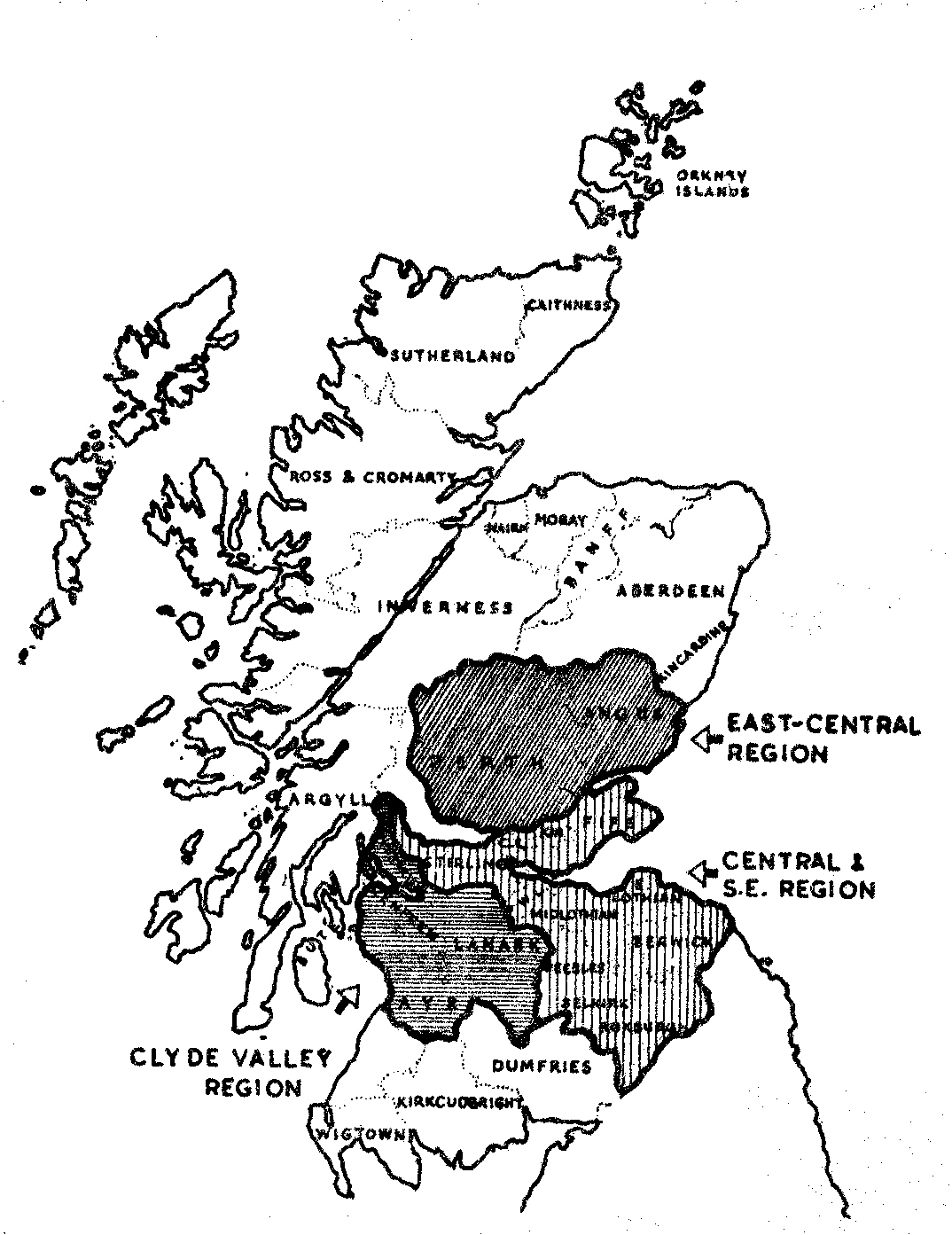
regions

The first generation of Scottish regional plans.

Under the autonomous administration established by the wartime Secretary of State, Tom Johnston, Mears was given the opportunity to apply his ideas about regional planning across a broad canvas.   In 1943, he was asked to prepare a regional plan for Central and South East Scotland.  This was no mean task. The territory to he covered stretched from the Tay to the Tweed and, to the west, at a point near Milngavie, its boundary fell within two miles of the built-up area of Glasgow. While this area contained a wide diversity of physical and social conditions, two principal sub-regions could he identified; the open, semi-industrial landscape of the Forth estuary contrasting sharply with the largely rural character of the steep-valleyed Tweed basin.

In the 1930s,Mears had been active in the campaign to provide improved infrastructure and modern services to rural communities and had prepared designs for low-cost rural housing.  His Central and South-East Scotland Plan identified rural depopulation as the most pressing problem facing both the region and Scotland as a whole.  It called for a joint campaign by central and local government to encourage “recolonisation” of the countryside, suggesting that the ultimate goal should be the return of approximately 10% of the urban population to the rural areas. One of the most original features of the plan was the application of community planning principles in a rural context to provide a strategy for the resettlement of depopulated Border valleys.  The Plan also contained proposals for the reforestation and recolonisation of the Slamannan plateau, laying the foundations for what was to become the Central Scotland Forest.
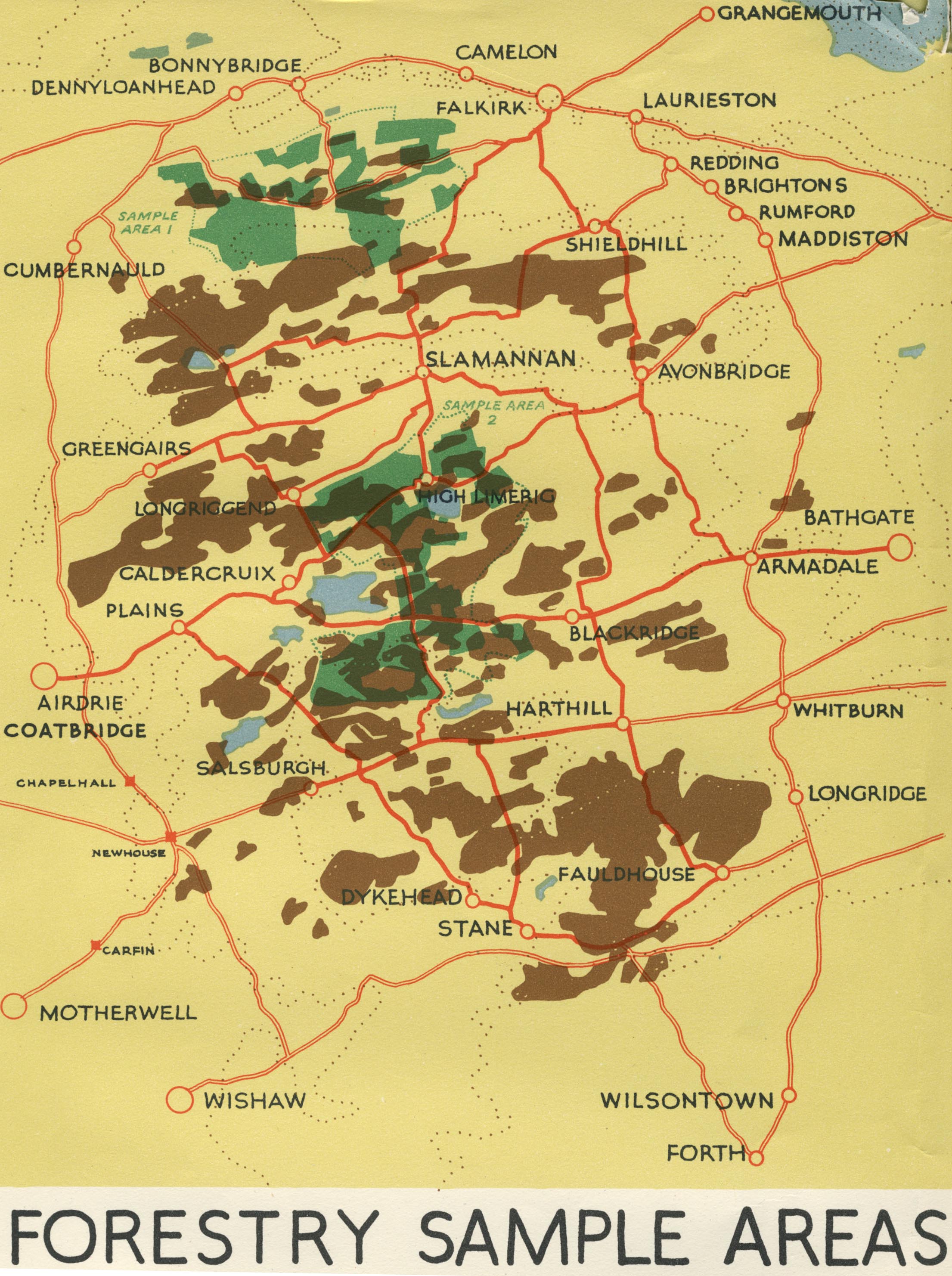
Slamannan Plateau

In his 1949 Central and South East Scotland Plan, Mears made proposals for forest planting in Central Scotland.

Towards the end of his career, Mears addressed the problem of rural depopulation in its most acute form in a strategy for the revitalisation of the County of Sutherland.  Against the prevailing wisdom of the time, he rejected the notion that the problem of rural decline could he solved “by a simple process of decanting a given proportion of large-scale industries into partially depopulated areas”.  Instead, in a plan strongly influenced by Fraser Darling’s Preliminary Report on the West Highland Survey, he advocated a strategy based on the regeneration of the crofting economy through measures such as land rehabilitation, tenure reform, investment in agriculture, forestry and fishing, and the encouragement of small rural industries based on indigenous resources.

With the election in 1945 of a Labour Government committed to centralised economic and social management, the initiative in matters of planning and reconstruction passed from the Scottish Office to Whitehall and in the post-war period a technocratic planning profession was to become increasingly preoccupied with systems, procedures and regulation.  In this climate, those aspects of Mears’ Bioregionalist philosophy which did not conform to British planning orthodoxy were largely disregarded. Today, his views on land rehabilitation, community empowerment and the importance of the cultural dimension in regional planning can be seen to have abiding relevance.


This article first appeared in the Spring 1996 issue of Reforesting Scotland.

Scottish Environmentalism – The Contribution of Patrick Geddes

08 Saturday Mar 2014

Posted by Graeme Purves in The Land o Cakes

≈ Leave a comment

Tags

communities, environmental management, Environmentalism, Frank Fraser Darling, John Muir, Patrick Geddes, rural development, Wild Land

In his address to the Spring Gathering of the Dunbar John Muir Association in April 1995, Professor Aubrey Manning highlighted the distinctive contributions to modern environmental thought made by the Scottish naturalist-activists John Muir, Patrick Geddes and Frank Fraser Darling.  An article by Douglas Aberley in the Spring 1995 issue of the journal Reforesting Scotland also drew attention to the considerable influence of these three figures.

The contribution of John Muir to the conservation of wild land and our appreciation of the spiritual value of wilderness does not need to be stressed to the readers of this Journal.  However, the vigorous debate which the very terms “wilderness” and “wild land” continue to provoke in a Scottish context testifies to the problematic nature of Muir’s concept of “wilderness” in a country where the human species has been an integral part of the ecosystem for around 10,000 years and all but the most inaccessible areas have been profoundly altered by human activity.

As a result, even our wild land has strong historical and contemporary associations with human communities and our responses to it inevitably reflect the considerable cultural baggage which each of us carries with us.  As James Hunter points out in his seminal exploration of the relationship between people and nature in the Scottish Highlands, On the Other Side of Sorrow, the pronouncements of environmentalists on the natural heritage of the Highlands have too often shown scant appreciation of the history, culture and aspirations of the people who actually inhabit the land which they so earnestly seek to conserve.

The John Muir Trust has been a pioneer amongst environmental organisations in recognising the social and economic dimensions of conservation and committing itself to working closely with local communities to safeguard and restore wild land and develop sustainable land management practices.  However, it is the environmentalism of Patrick Geddes rather than that of Muir which is likely to have most to offer when it comes to discharging that commitment.

Patrick Geddes - portraitPatrick Geddes

Geddes, despite his acknowledged importance as a founding father of modern town and country planning, is a notoriously difficult personality to come to grips with.  His enthusiasms were diverse and idiosyncratic.  He is still variously described as a zoologist, botanist, sociologist or town planner and during the course of his career he was all of these, though never exclusively or conventionally any of them.  The sheer difficulty of categorising Geddes within any of the conventional academic disciplines has discouraged examination of his ideas and this task has only recently been attempted seriously.

Geddes was seventeen years younger than John Muir, being born in 1854.  Like Muir, he developed an interest in the natural world through childhood exploration of the countryside around one of Scotland’s historic burghs (in Geddes’ case it was Perth).  Subsequently, he studied under the eminent English biologist, Thomas Huxley before moving on to Paris where he encountered the ideas of the French sociologist, Frédéric Le Play.

In 1880, Geddes was appointed Assistant in Practical Botany at the University of Edinburgh and took up residence in the city’s Old Town.  He was appalled at the conditions he found there.  Following the construction of a gracious Georgian New Town beyond the Nor Loch, Edinburgh’s middle classes had abandoned the high tenements and narrow closes of the Castle ridge, and the Old Town had rapidly degenerated into a noisome slum.  Geddes responded by throwing himself into the promotion of an ambitious programme of civic and environmental renewal, involving local people in the rehabilitation of tenement property, the improvement of open spaces, and the creation of gardens where the urban population could enjoy the restorative effects of contact with nature.

Geddes was also acutely aware of the significance of the Old Town as the historic home of Scotland’s political and cultural institutions.  The loss of the Scottish Parliament in the early 18th Century had left a vacuum at the centre of the city’s political and cultural life and by the late Victorian period the city had lost the intellectual pre-eminence which it had enjoyed during the golden years of the Enlightenment.  Geddes drew direct inspiration from Edinburgh’s cultural and intellectual heritage and the great variety of environmental and educational projects which he promoted in the city were primarily aimed at stimulating a cultural and intellectual revival.

An appreciation of Geddes’ close engagement with the fate of Edinburgh as a national culture-capital is crucial to an understanding of the particular perspective which he brought to land use planning.  His conception of the nature and purpose of planning was quite different from that of other planning propagandists.  For Geddes, the central concern was not with the technical problems of urban expansion or the creation of brave new utopian settlements but with the task of inspiring communities to an active participation in their own cultural and social renewal.

From his starting point as a natural scientist, Geddes attempted to apply the principles of Darwinian evolutionary theory to the study of modern society.  The objective was to gain sufficient understanding to enable the raw evolutionary forces which were shaping society to be harnessed and guided in positive directions towards the greater fulfilment of Mankind.  Thus his aims were ultimately spiritual rather than material.  What he sought was the restoration of a “harmony” or “balance” to human life and social relationships which he believed to have been lost during the trauma of the industrial revolution; in short, the recreation of physical and social environments in which human beings could enjoy greater personal fulfilment and creative expression.

Geddes’ distinctive contribution to the development of regional theory stressed the interaction between the environment, economic activity and community, expressed in the triad “Place/Work/Folk”.  He saw the modern region as the product of continuous interaction between the human species and its environment; each of its communities adapted to its particular geographical setting and responding to changing circumstances by a process of cultural evolution.  He therefore rejected standardised solutions to environmental and social problems, believing that proposals should be individually tailored to local conditions, with due regard to existing customs and systems of social organisation.

Geddes looked forward to the coming “neotechnic” age in which clean and efficient new technologies would replace the polluting industrial activities of the past.  He also believed that electricity and modern communications would liberate industry from the old locational constraints, enabling its benefits to be distributed more evenly between town and country and encouraging a revival of skilled craftsmanship.  In lectures delivered before the First World War, Geddes and his associates argued that the early Norwegian hydro-electric schemes offered new hope for the Highlands and suggested that the experiments in co-operative agricultural production then being pioneered in Denmark and Ireland pointed the way forward for Scottish rural communities.

While Geddes worked primarily in an urban context, his son-in-law, Frank Mears, applied the same approach to cultural and environmental renewal in his pioneering planning work in rural Scotland.  In the early ‘fifties, Mears addressed the problem of rural depopulation in its most acute form in a strategy for the revitalisation of the County of Sutherland.  Against the prevailing wisdom of the time, he rejected the notion that the problem of rural decline could be solved “by a simple process of decanting a given proportion of large-scale industries into partially depopulated areas”.  Instead, in a plan strongly influenced by Fraser Darling’s Preliminary Report on the West Highland Survey, he advocated a strategy based on the regeneration of the crofting economy through measures such as land rehabilitation, tenure reform, investment in agriculture, forestry and fishing, and the encouragement of small rural industries based on indigenous resources.

John Muir is rightly acknowledged internationally as one of the founding fathers of the modern conservation movement.  However, the contemporary land debate would benefit from a wider appreciation of the contributions of figures such as Geddes, Fraser Darling and Mears to the development of a distinctively Scottish environmental perspective which accords human communities a central role in conservation and land renewal.  More particularly, Geddes’ commitment to community empowerment and the active involvement of local people in the restoration and improvement of their own physical and cultural environments can provide valuable inspiration to the Trust in its work with rural communities.


This article was first published in the John Muir Trust Journal & News No. 22 in January 1997.  I think it remains relevant to contemporary debates about environmentalism, environmental management, rural development and wild land.

Subscribe

  • Entries (RSS)
  • Comments (RSS)

Archives

  • March 2025
  • March 2022
  • December 2021
  • March 2021
  • November 2020
  • August 2020
  • May 2020
  • February 2020
  • February 2019
  • October 2018
  • August 2018
  • May 2018
  • April 2018
  • July 2017
  • April 2017
  • February 2017
  • January 2017
  • September 2016
  • July 2016
  • May 2016
  • March 2016
  • December 2015
  • November 2015
  • August 2015
  • June 2015
  • May 2015
  • November 2014
  • October 2014
  • August 2014
  • July 2014
  • June 2014
  • May 2014
  • April 2014
  • March 2014
  • June 2013

Categories

  • Frank Mears
  • Reviews
  • Spatial Planning
  • The Land o Cakes
  • Travellers' Tales

Meta

  • Create account
  • Log in

Blog at WordPress.com.

  • Subscribe Subscribed
    • By Erceldoune
    • Join 29 other subscribers
    • Already have a WordPress.com account? Log in now.
    • By Erceldoune
    • Subscribe Subscribed
    • Sign up
    • Log in
    • Report this content
    • View site in Reader
    • Manage subscriptions
    • Collapse this bar
 

Loading Comments...