Tags
REFLECTIONS: THE LIGHT AND LIFE OF JOHN HENRY LORIMER, edited by Elizabeth Cumming, Sansom & Company, Bristol, 2021
SLAVES AND HIGHLANDERS: SILENCED HISTORIES OF SCOTLAND AND THE CARIBBEAN, by David Alston, Edinburgh University Press, 2021
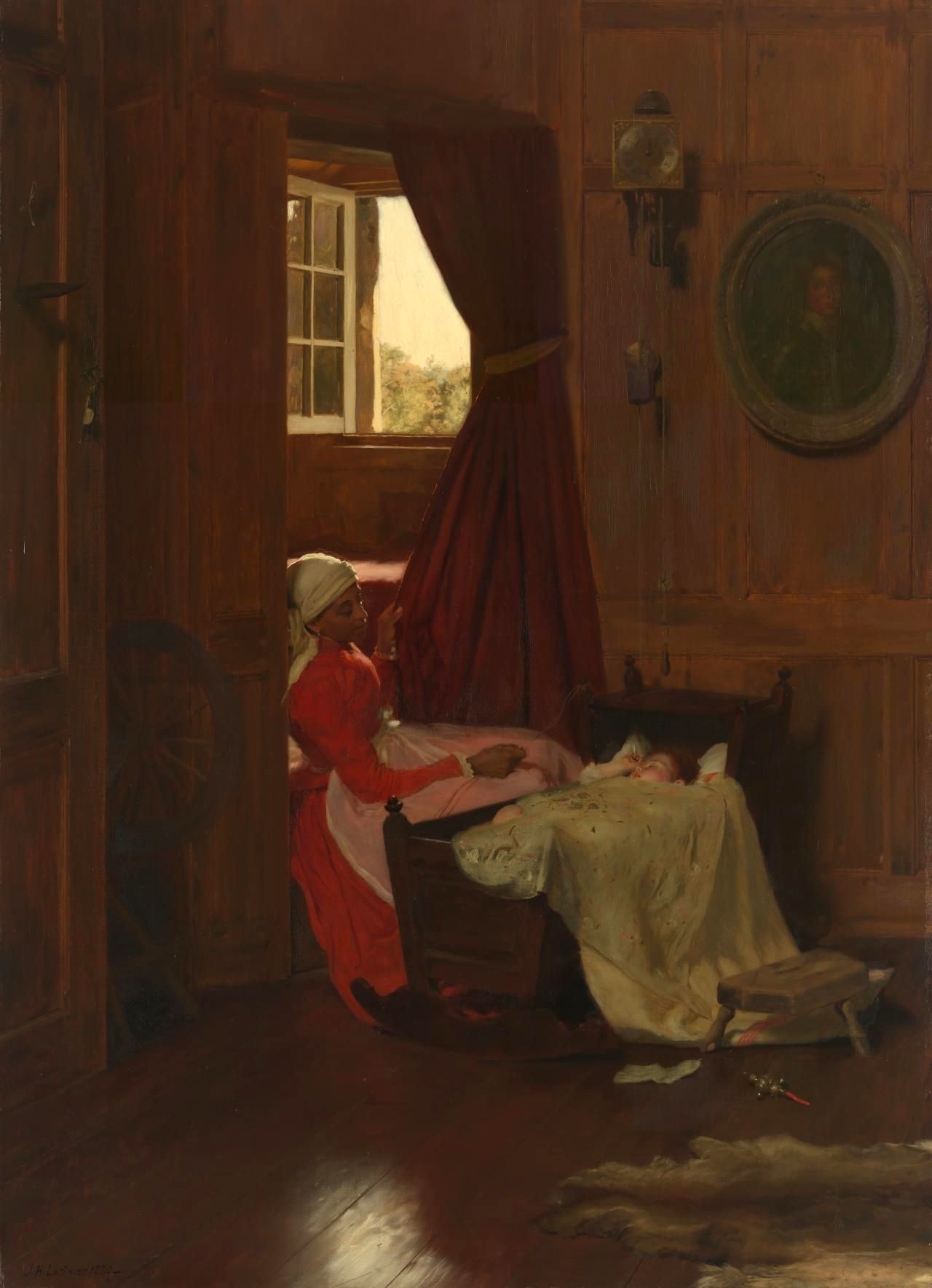
The exhibition Reflections: The Light and Life of John Henry Lorimer at Edinburgh’s City Art Centre includes a reproduction of his painting Lullabye (1889) which features a Guyanese woman, Joanna Herbert, who was employed as nanny to the children of John Henry’s sister Alice for more than twenty years.
Two of John Henry Lorimer’s sisters entered marriages which took them to the South American colony of British Guiana: Alice married Sir David Chalmers, Chief Justice for the colony, in 1878; Hannah married the botanist, anthropologist and explorer Sir Everard Thurn in 1895.
Joanna Herbert’s mother had been born into slavery. The identity of her white father is unknown. She became a valued member of the Chalmers household, accompanying the family on visits to Scotland and moving with them when they returned to live in Edinburgh in 1894. She featured in several of John Henry Lorimer’s paintings. He insisted that she wore a head tie for the sittings, which Joanna did under protest, seeing it as a symbol of slavery and oppression.
Scotland’s close connections with British Guiana and other Caribbean colonies does not feature prominently in her national story. However, as David Alston points out in his book Slaves and Highlanders: Silenced Histories of Scotland and the Caribbean, Scots were quick to take advantage of the opportunities opened in the English sugar islands by the Act of Union. They began to arrive in numbers in Jamaica in the early 1700s, helping to drive the transition from small-scale slave holdings to large integrated plantations and the consequent increase in demand for enslaved Africans. After the Treaty of Paris of 1763 ceded French colonies in the Lesser Antilles to Britain, Scots were prominent in establishing new plantations on the islands of Grenada and St. Vincent.
British Guiana was the last frontier of Caribbean colonisation. Scots had established themselves as plantation owners in Essequibo, Demerara and Berbice when they were still Dutch colonies. The three colonies were surrendered to British forces in 1796 and formally ceded to Britain in 1814. They united to become British Guiana in 1831. Under British control, the Guianas were to become the most Scottish of the Caribbean colonies. The Royal Scots garrisoned Demerara and Berbice during the first decade of the 1800s. By 1802, Scots, mainly with a Highland connection, were in possession of one-third of the new coastal cotton plantations in Berbice and directing vast engineering works to bring them into cultivation. Scots dominated the colony’s Court of Policy and Criminal Justice and the later Council of Government. Merchant houses with Scottish origins controlled the sugar trade. At emancipation, Glasgow merchants held more wealth in British Guiana than in any other Caribbean colony.
Scotland’s involvement in the slave economy of the Caribbean was to have profound impacts at home. The West Indies became an important market for Scottish exports, including the rough linen known as ‘slave cloth’ and salt herring, which was used as a cheap source of protein on the plantations. By 1813, 65% of Scottish exports were to the Caribbean colonies. After the American War of Independence, the West Indies became the principal source of cotton for the textile industry. The slave economy also drove the development of the financial sector, particularly insurance and banking. Wealth derived from the plantations, including substantial sums in compensation on the abolition of slavery, was invested in land and agricultural improvement in Scotland. In the mid-nineteenth century, men like John Gordon of Cluny and George Rainy applied a cold-eyed approach to land management honed on Caribbean plantations to the clearance of tenants from their estates in the Highlands and Islands. Long after the abolition of slavery, Guyana was providing distinguished colonial careers for men like Alice Lorimer’s husband, Chief Justice David Chalmers.
David Alston has carried out extensive research on Highland Scotland’s involvement in the slave economy of the Caribbean, detailed on his Slaves & Highlanders website. His valuable book highlights Scotland’s strong colonial relationship with Guyana. The images of Joanna Herbert in the John Henry Lorimer exhibition, which is accompanied by a beautifully illustrated book edited by Elizabeth Cumming, give us a discomfiting glimpse of the continuation of that relationship into the late 19th Century.
 By Erceldoune