
• Thomas Learmonth o Erceldoune

By Erceldoune

~ Graeme Purves

By Erceldoune

Tag Archives: housing delivery

Spatial Planning for Recovery in Wales and Scotland

07 Sunday Mar 2021

Posted by Graeme Purves in Spatial Planning, The Land o Cakes

≈ Leave a comment

Tags

COVID-19, housing delivery, Place-Making, Post-Pandemic Recovery, Rural Repopulation, Scotland, Spatial Planning, Wales
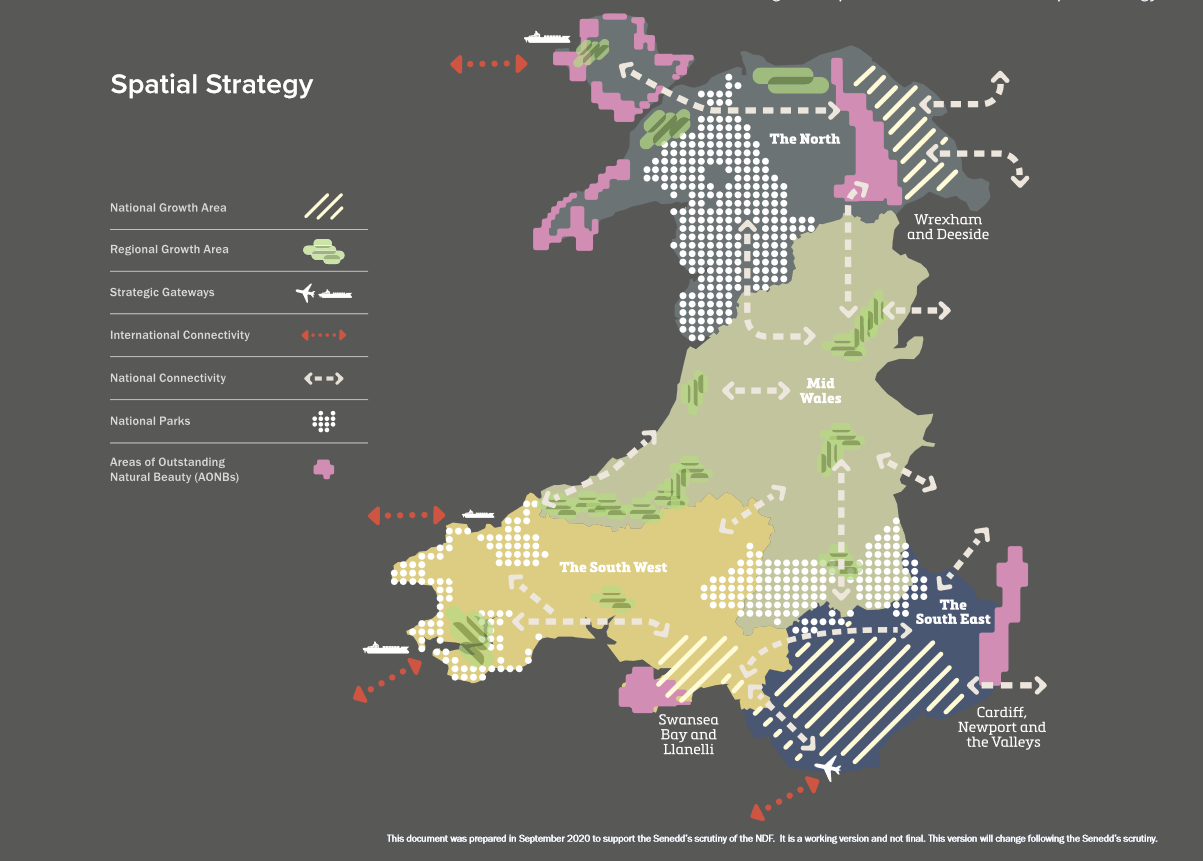
As the initial consultation on Scotland’s fourth National Planning Framework (NPF4) draws to a close, the Welsh Government is preparing to publish the final version of the National Development Framework for Wales, Future Wales: the National Plan 2040.  Some of the issues raised during the Senedd’s final scrutiny of Future Wales are also of relevance for NPF4.  This blog compares approaches being taken by the two devolved administrations to highlight some strategic planning challenges.

Post-Pandemic Recovery

Along with taking forward the pressing Climate Change agenda, one of the major challenges in both countries will be economic and social recovery from the effects of the COVID-19 pandemic. While the Scottish Government’s post-COVID Economic Recovery Implementation Plan reflects the neoliberal narrative set out in the Higgins Report, Towards a Robust, Resilient Wellbeing Economy for Scotland, Scottish Ministers do appear to recognise some role for strategic planning in recovery.  The Implementation Plan indicates that NPF4 will be brought to Parliament in September.  It also states that the Regional Land Use Partnerships should have a role in regional economic development as well as meeting climate change goals.  In his foreword to the Position Statement on NPF4 published in November, Planning Minister Kevin Stewart states that the experience of the pandemic has highlighted the importance of a good local environment, with good access to open space and amenities, but post-pandemic recovery is not developed as a theme in that document.

In a report Go Big – Go Local published in October, the UK2070 Commission warned that the pandemic may exacerbate regional inequalities and have disproportionate impacts on the elderly and opportunities for young people. It recommended that strategies for recovery should place emphasis on investment in infrastructure with a view to building resilience and strengthening connectivity.

During committee scrutiny of the draft Future Wales in the Autumn of last year, the Welsh Minister for Housing and Local Government, Julie James, argued that the strategy it set out is sufficiently robust and flexible to respond to the societal changes arising from the pandemic and that experience over the past year had validated its focus on climate change, place-making and resilience.  However, the Senedd’s Climate Change, Environment and Rural Affairs Committee has pressed for more.  Drawing on the work of the UK2070 Commission, it has called for Future Wales to include a clear statement reflecting the lessons learned from COVID-19 and explaining how the framework will help to further post-COVID recovery.  It has pressed for explicit recognition of the potential contributions of investment in infrastructure, housing, connectivity, heat networks and natural capital, and increasing capacity in the foundation economy.  There may well be similar calls in Scotland.

The Regional Dimension of Recovery

While the Higgins report played down the role of the public sector, particularly local authorities, in recovery, some of its recommendations were very much in tune with the thinking of the UK2070 Commission.  It called for an investment-led recovery.  It recognised the need to address regional disparities in Scotland and advocated a regionally focused model of economic development.

Future Wales has a strong regional dimension.  The Welsh Government will rely on strategic development plans for North, Mid, South-East and South-West Wales to take forward key aspects of policy development and implementation.  How enthusiastic the Scottish Government will be about a strong regional dimension to recovery strategy remains to be seen.  It has blown hot and cold over regions over the past decade.  In 2014 it reaffirmed its commitment to strategic development plans at the regional level, yet the planning review initiated by Alex Neil in 2015 led to a proposal to end regional agency and centralise strategic planning in the National Planning Framework.  As a result of opposition in the Scottish Parliament, the Scottish Government was obliged to accord a role to Regional Land Use Partnerships.  The Position Statement for NPF4 states that “Our strategy will be informed by emerging regional scale spatial and economic strategies.”

The Chief Secretary to the Treasury, Stephen Barclay, announced in January that the UK Shared Prosperity Fund is to be disbursed from London.  This creates a real danger that Scottish discretion on spatial priorities will be significantly curtailed. The Scottish Government may count itself fortunate that its attempt to abolish regional strategic planning failed.  Without it, its flank might have been even more exposed to UK Government interventions than it is.  It will be important for the Scottish Government to build strong relationships with local authorities and work closely with regional partnerships on spatial strategies.

Barclay’s announcement makes it even more important to be clear about the relationship between strategic spatial planning and growth deals.  They reflect different ideological perspectives, and there is potential for them to pull in different directions.  The Position Statement on NPF4 states only that regional spatial and economic strategies “will align with city and regional growth deals.”  There is no indication that growth deals should reflect spatial strategies.  In Wales, the Senedd’s Climate Change, Environment and Rural Affairs Committee has recommended to the Welsh Government that “Future Wales should explicitly state the need for a reciprocal and iterative relationship between strategic development plans and growth deals over time.”  Stakeholders should insist on the same relationship between spatial strategies and growth deals in Scotland.

Place-Making and Housing Delivery

There is contrast between the Welsh and Scottish Governments in their approach to place-making and housing delivery.  Future Wales accords the public sector the lead role in urban development, regeneration and the delivery of affordable housing, though the Welsh Government remains coy about specific delivery mechanisms.  In the NPF4 Position Statement, the public sector and local authorities barely get a mention.  The Scottish Government appears to prefer a developer-led model, with the role of planning authorities being merely to provide developers with “a steady pipeline of land.” While there is a lot of aspirational rhetoric about place-making in the Position Statement, the Scottish Government shows little inclination to empower the public sector to take the necessary lead.  Better places and 20-minute neighbourhoods are public policy objectives, but we are given no hint as to the mechanisms which will be used to deliver them.  There is no reference, for example, to the work the Scottish Land Commission has been doing on land value capture and sharing for several years now.

Rural Repopulation

Finally, it is interesting that the repopulation of rural areas has re-emerged as an objective of spatial planning in Scotland and Wales, something we have not really seen since the strategic plans for post-Depression and post-War recovery in the middle of the last century.  In autumn 2018, Community Land Scotland successfully promoted an amendment to the Planning (Scotland) Bill which requires the NPF to consider the potential for rural resettlement.  The NPF Position Statement says that rural repopulation will be a key theme for emerging regional spatial strategies for the South of Scotland, Argyll and Bute, Western Isles, Orkney and the Highlands.  The Welsh Senedd’s Climate Change, Environment and Rural Affairs Committee has called for Future Wales to include further locational guidance on addressing rural depopulation.  It has also pressed for the Welsh framework to recognise opportunities for people to live and work sustainably outside towns and cities.


This article was originally published as a blog for Built Environment Forum Scotland (BEFS) in February 2021.

Can We Restore Civic Consciousness and Public Enterprise?

19 Saturday Dec 2015

Posted by Graeme Purves in The Land o Cakes

≈ Leave a comment

Tags

civic consciousness, Community Planning, Culture, entrepreneurial state, housing delivery, public enterprise, Review of the Scottish Planning System


The Scottish Government’s Programme for Government for 2015-16 announced a Review of the Scottish Planning System to identify “the scope for further reform with a focus on delivering a quicker, more accessible and efficient planning process, in particular increasing delivery of high quality housing developments.”

Crawford Beveridge

Crawford Beveridge

In mid-September, the Cabinet Secretary for Social Justice and Communities, Alex Neil, announced that review would be undertaken by a three person panel chaired by Crawford Beveridge, the other members being Petra Biberbach of Planning Aid Scotland (PAS) and John Hamilton of the Scottish Property Federation.  The omission of any qualified planner from the panel ruffled the feathers of the profession in Scotland.

The remit of the review is broader than initially announced, focusing on 6 key issues:

  • development planning;
  • housing delivery;
  • planning for infrastructure;
  • further improvements to development management;
  • leadership, resourcing and skills; and
  • community engagement.

However, the suspicion remains that the primary purpose of the review is to ease the regulatory burden on volume house builders.

Leadership and Resources

Not listed first in the panel’s remit, but of crucial importance, is the question of leadership and resources.  If we are to get the best from our planning system, the Scottish Government needs to set out a vision for future development which is inspiring and empowering rather than simply sticking with the narrow and increasingly tired narrative on speedy and efficient delivery.

The challenges we face around delivering development are frequently attributed to deficiencies in the planning system, but to rely solely on that explanation is to take far too narrow a view.  Technical fixes alone will not provide a solution.  We need a broader revival of civic consciousness and public enterprise and that means culture change.

We have lost the civic vision which informed and inspired burgh development in previous generations and new development in our towns and cities is too often seen in narrow commercial terms.  Since the financial crisis in 2008, public policy has, understandably, been strongly focused on the delivery of development as a means of promoting economic recovery.  We should now be looking to move beyond that to a broader perspective on development and urban renewal, one which embraces not only its economic and commercial benefits, but also its importance in social and cultural terms.  Consensus can only be built if there is a vision people can buy into.  Scottish Ministers should be giving a lead by promoting a revival of civic consciousness.

There is widespread concern that cuts in public expenditure are reducing the capacity of local authorities to lead, innovate and initiate projects in the public realm and depriving planning authorities of the expertise they need to assess development proposals with implications for the historic or natural environment.  The planning service is asked to deliver on a wide range of public interest agendas.  It needs to be adequately resourced if we are to achieve our aspirations for new development in terms of scale, quality, social well-being and climate change targets.  An increase in planning fees could certainly make a contribution towards that.

Community Empowerment

There is abundant evidence of community spirit and a desire to be active in making our towns and cities more socially and environmentally rewarding places.  We see that in the demand for allotments, the proliferation of community festivals, markets and orchards, phenomena such as urban gardening, and the growing interest in community ownership of a wide range of public assets.  Some elected representatives see civic activism as a threat to their authority and officialdom finds it difficult to engage with it in a positive way.  Sometimes local authority responses to attempts to develop the potential of community assets can be very negative.  But I suspect that resource constraints and community expectations will drive things in a more enlightened and positive direction.   Planning authorities and their officials need to get better at working in partnership with communities to realise the economic, social and cultural potential of local assets.  Confidence will grow with experience.

It is high time we repudiated the outdated corporate model of community planning imposed by the Local Government (Scotland) Act 2003 and replaced it with one which is genuinely focused on communities and reflects the community empowerment agenda.  The efforts to improve links and communication between spatial and community planning are to be welcomed, but if we see the challenge solely in these terms we are in danger of simply making planners more complicit in a top-down and technocratic approach to community development which falls short of contemporary needs.

Housing Delivery

Craighall Road 002

Flats under construction in Edinburgh

The questions about housing delivery posed by the review reflect the perspective of volume housebuilders and appear to assume the continuation of a private-sector led model which has been failing to deliver since the crash of 2008.  That model cannot meet the social aspirations which animated public debate during and after the independence referendum.  The public sector should play a more active and assertive role in the delivery of strategically important development and place-making, as it does widely on the Continent.  It should be prepared to intervene in the land market to assemble the sites required and then provide the necessary supporting infrastructure, funding the process from the uplift in land values.

Underpinning the current review is the familiar neoliberal narrative of creative and dynamic private enterprise held back by the bureaucracy and inefficiency of the public sector. The economist Mariana Mazzucato has very effectively debunked that narrative in her book ‘The Entrepreneurial State’, and the Scottish Government has been enlightened enough to appoint her to its Council of Economic Advisers.  Let us hope the current review will lead to a reinvigorated planning system empowered to play an important role in building the constructive partnership between public and private sectors which is essential to a successful social democracy.

The Scottish Government is hosting an online forum on the review of the planning system.  The review panel is expected to submit its report to Scottish Ministers in March.


This article first appeared in Bella Caledonia on 30 November 2015.  I gave oral evidence to the panel undertaking the Review of the Scottish Planning System on 23 February 2016.

Subscribe

  • Entries (RSS)
  • Comments (RSS)

Archives

  • March 2025
  • March 2022
  • December 2021
  • March 2021
  • November 2020
  • August 2020
  • May 2020
  • February 2020
  • February 2019
  • October 2018
  • August 2018
  • May 2018
  • April 2018
  • July 2017
  • April 2017
  • February 2017
  • January 2017
  • September 2016
  • July 2016
  • May 2016
  • March 2016
  • December 2015
  • November 2015
  • August 2015
  • June 2015
  • May 2015
  • November 2014
  • October 2014
  • August 2014
  • July 2014
  • June 2014
  • May 2014
  • April 2014
  • March 2014
  • June 2013

Categories

  • Frank Mears
  • Reviews
  • Spatial Planning
  • The Land o Cakes
  • Travellers' Tales

Meta

  • Create account
  • Log in

Blog at WordPress.com.

  • Subscribe Subscribed
    • By Erceldoune
    • Join 29 other subscribers
    • Already have a WordPress.com account? Log in now.
    • By Erceldoune
    • Subscribe Subscribed
    • Sign up
    • Log in
    • Report this content
    • View site in Reader
    • Manage subscriptions
    • Collapse this bar
 

Loading Comments...