• Thomas Learmonth o Erceldoune

By Erceldoune

~ Graeme Purves

By Erceldoune

Tag Archives: Planning

Greenock Plans Ahead

21 Wednesday Sep 2016

Posted by Graeme Purves in Frank Mears

≈ Leave a comment

Tags

American Parkway, Frank Mears, Garden City, Greenock, Planning, reconstruction, redevelopment

greenockflats

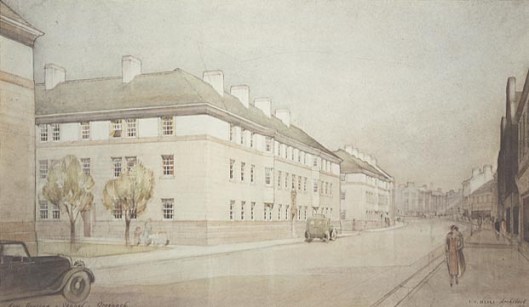
Council flats on the Vennel, Greenock, by Frank C. Mears

Frank Mears was appointed planning consultant to the Corporation of Greenock in 1940.  It was the only consultancy in which he directly confronted the problems of the industrial west of Scotland.  The plan he prepared, entitled Greenock: Portal of the Clyde, was published in 1947.  It outlined a programme for the long-term development of the part of Renfrewshire lying to the north of a line between Kilmacolm and Wemyss Bay.  Besides Greenock, it encompassed the burghs of Port Glasgow and Gourock and the villages of  Inverkip and Wemyss Bay.

During the Depression, the slump in shipbuilding had resulted in high levels of unemployment in Greenock and Port Glasgow.  As in Scotland’s mining areas, reliance on a single heavy industry had resulted in a particular vulnerability to recession.  Mears argued that future security depended on diversification of the area’s industrial base, with particular emphasis on the creation of employment for women.

On the basis of an analysis which traced Greenock’s history to its 18th century origins, Mears concluded that the town should should seek to build on its long-standing local industries based on tobacco, sugar, distilling and marine engineering, and that priority should be given to industries geared to export.

greenock-open-space-deficiency

Clyde Valley Regional Plan, 1949

Patrick Abercrombie’s Clyde Valley planning team had identified a serious deficiency of open spaces in the lower part of the town.  In Greenock: Portal of the Clyde (1947) Mears proposed redevelopment at lower densities, the creation of new industrial areas, and accommodation of the displaced population in a constellation of new neighbourhoods laid out in the Kip Valley on American Parkway lines to create a “federal Garden City”.

Mears also prepared layouts and designs for council housing in Greenock and a scheme for the redevelopment of part of the town centre which had been badly damaged by wartime bombing.

Mears’ proposals for Greenock received considerable publicity.  The work of the documentary film-maker John Grierson had stimulated an interest in film-making in Scotland.  The Scottish Office had been quick to appreciate the usefulness of film as a means of informing and influencing the public and had sponsored a number of documentaries on aspects of social and economic reconstruction.  Inspired by these precedents, in 1948 Greenock Corporation commissioned a documentary film on Frank Mears’ planning work in the burgh to complement an exhibition in the Town Hall. Greenock Plans Ahead was directed by Hamilton Tait and narrated by Frank Phillips.
A Man with a Plan

24 Sunday Jul 2016

Posted by Graeme Purves in Frank Mears, Reviews

≈ Leave a comment

Tags

Frank Mears, Frank Tindall, Planning, woodland


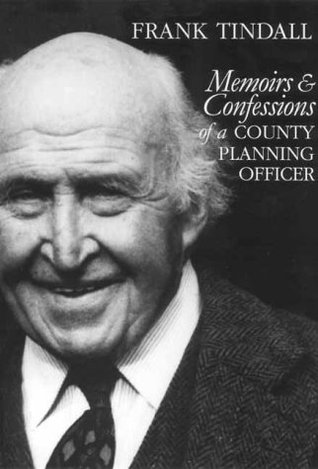
Frank Tindall

‘Memoirs and Confessions of a County Planning Officer’ by Frank Tindall (1998), The Pantile Press

This book provides a fascinating account of the professional career of Frank Tindall, who was Planning Officer for the County of East Lothian between 1950 and 1975.

Tindall acknowledges his debt to the holistic planning philosophy of Patrick Geddes and his son-in-law Frank Mears. Indeed, he followed directly in the footsteps of Mears, who was planning consultant for East Lothian from 1937 until 1950. Between them, Mears and Tindall established a tradition of sensitive conservation and renewal from which the area has greatly benefited.

Like Mears, Tindall promoted policies designed to check rural depopulation. Considerable effort was put into the improvement of infrastructure and the environment, safeguarding rural schools and consolidating villages through the provision of new housing, small workshops and community facilities.

The book contains numerous references to Tindall’s efforts to safeguard and extend woodland cover. Notable achievements included the saving of a number of the County’s remaining fragents of ancient oakwood, securing public access to Pressmennan Wood and the transformation of Woodhall Bing at Pencaitland into a popular recreational woodland. He made a particular point of encouraging tree planting in development schemes and concern over the potential impact of commercial afforestation of the Lammermuir Hills led him to advocate that planning control be extended to cover forestry schemes.

For the last ten years of his working life Tindall was Director of Physical Planning for Lothian Region. During that time he was instrumental in creating the Regional Council’s Land Reclamation Unit. He was also responsible for the establishment of the Central Scotland Woodlands Project, which had its origins in Mears’ Central and South-East Scotland Plan of 1949.

Survey work for the County Development Plan revealed the extent of neglected and degraded woodland in East Lothian. Tindall and his staff sought to promote positive woodland management and were ground-breaking in encouraging the planting of upland catchments to tackle problems of flooding and erosion. There remains considerable scope for extending tree cover in East Lothian and a renewal of effort in that area would be a fitting tribute to Frank Tindall’s memory.

_________________________________________________________________

This review first appeared in Reforesting Scotland 20, Spring 1999.

Staying Smart about Place

25 Tuesday Nov 2014

Posted by Graeme Purves in The Land o Cakes

≈ Leave a comment

Tags

Built Environment, Place, Planning, Scottish Government, Scottish Ministers

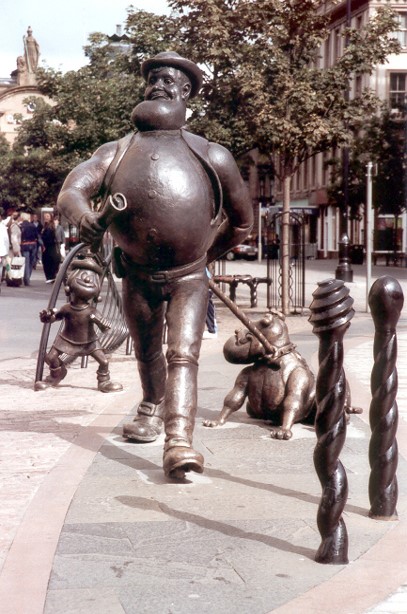
Desperate Dan

As a planner, one of the things I was interested to find out following the announcement of Nicola Sturgeon’s team of Ministers is where the built environment features in the new Ministerial portfolios.  The answer is not as clear as it might be.  Most noticeably, there is now no Minister with the word “Planning” in their title.  Aspects of the built environment, place-making and strategic planning remain scattered across a number of portfolios.  Planning, building standards, business improvement districts, town centres, housing and community planning sit within Alex Neil’s Social Justice and Communities portfolio, while architecture and the heritage aspects of the built environment sit with the Cabinet Secretary for Culture, Fiona Hyslop. Cities fall within Keith Brown’s Infrastructure and Investment portfolio.  Sustainable development is the responsibility for the Cabinet Secretary for Rural Affairs, Richard Lochhead.  But how does it all hang together?

A recognition of the importance of place has been a key feature of Scottish policy-making in relation to the built environment.  It is prominent in “Our Place in Time”, the strategy for our historic environment which underpins the merger of Historic Scotland and the Royal Commission on Ancient and Historic Monuments of Scotland.  Place and place-making are given considerable emphasis in the new Scottish Planning Policy and the third National Planning Framework (NPF3) published earlier this year.  Creating successful, sustainable places delivers major benefits for the economy, health and wellbeing and the environment.

In Scotland we are fortunate that planning is seen as part of the solution to the economic, social and environmental challenges we face, rather than part of the problem.  Our built environment disciplines possess a wealth of expertise in place-making and we have maintained a strong strategic planning capability at national and city region levels.  As Planning Minister, Derek Mackay gave clear leadership, with an emphasis on improving planning authority performance.  Planning is in better shape and better heart than it is South of the Border.  On the other hand, Scotland’s cities agenda seems to have lost momentum and lacks the strategic perspective which underpinned it in the days when Scottish Enterprise took an interest in the spatial dimension of economic development.

In going forward, the new Ministerial team will need to counter the impression that planning is being progressively subordinated.  It will be important for them to show that they have not lost sight of the importance of place in realising economic and social potential and the roles which planning, design and creative conservation can play in building a better Scotland.  They will need to continue to foster a view of architecture which places emphasis on place-making rather than iconic buildings.  Perhaps there a need to identify a Ministerial champion who will maintain an overview of the built environment and show leadership in taking forward the place-making agenda?

Accentuating the positive, brigading planning under Community Empowerment might offer the prospect of moving it closer to the community-focused activity which pioneers like Patrick Geddes envisaged.  It also offers the opportunity to develop an approach to community planning which is genuinely centred on communities and not simply an exercise in corporate liaison.  Realising the potential of people and places should be seen as one of the key objectives of land reform.

Planning for a Revival in Hutting

14 Tuesday Oct 2014

Posted by Graeme Purves in The Land o Cakes

≈ Leave a comment

Tags

Carbeth, Huts, Hutting, Planning, Scottish Planning Policy

The importance of the reference to huts in the new Scottish Planning Policy.

Simple huts for recreational use have been a feature of our rural landscape since the 1920s.  They played an important part in the development of the interwar outward bound movement, providing a way for people of modest means to get out of the cities and enjoy the countryside.  Scotland’s hutting movement is part of a wider tradition most frequently associated with Scandinavia, but found right across northern Europe.

In the post-War period, hutting went into decline in Scotland.  In the 1960s, rising disposable incomes ushered in the era of package holidays abroad.  Tenure was found to be precarious as new landowners proved to be less sympathetic to the movement than their predecessors and sought to remove huts from their land.  But the successful campaign by the Carbeth hutters to secure their future through community ownership of their site has contributed to a revival of interest in hutting more generally.

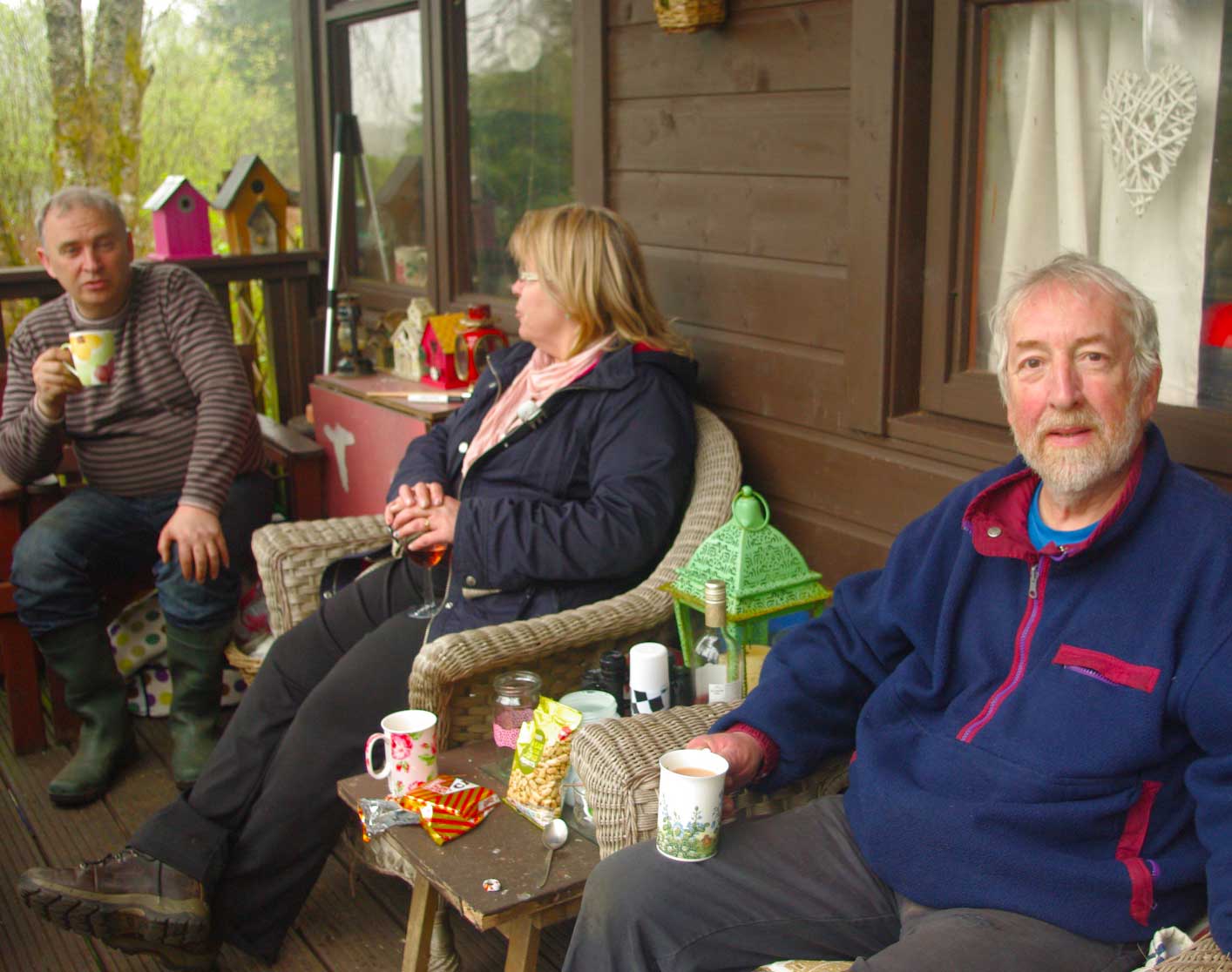
Tea-with-the-neighbours---credit-M-Gregor Hutters relaxing at Carbeth

The inclusion of a supportive reference to huts in the new Scottish Planning Policy (SPP) is seen as important to the revival of our hutting tradition. Until now, there has been no specific provision for huts in Scottish policy or legislation and many aspiring hutters have seen this as an obstacle to new development.  Paragraph 79 of Scottish Planning Policy identifies huts as one of the types of leisure accommodation for which development plans should make provision where appropriate.   A hut is defined as “a simple building used intermittently as recreational accommodation (i.e. not a principal residence); having an internal floor area of no more than 30m2; constructed from low impact materials; generally not connected to mains water, electricity or sewerage; and built in such a way that it is removable with little or no trace at the end of its life.”  SPP indicates that huts may be built singly or in groups.

One of the attractions of hutting is the opportunity it offers to apply or develop design and building skills.  For many, the community dimension of hutting is an important element of its appeal and for groups of huts an accessible site will be important.  However, for some, the goal may be a secluded retreat in a more remote rural location.  There is room in Scotland’s countryside to accommodate both types of development provided care is taken to avoid adverse impacts on communities and the environment.

DSC_9178

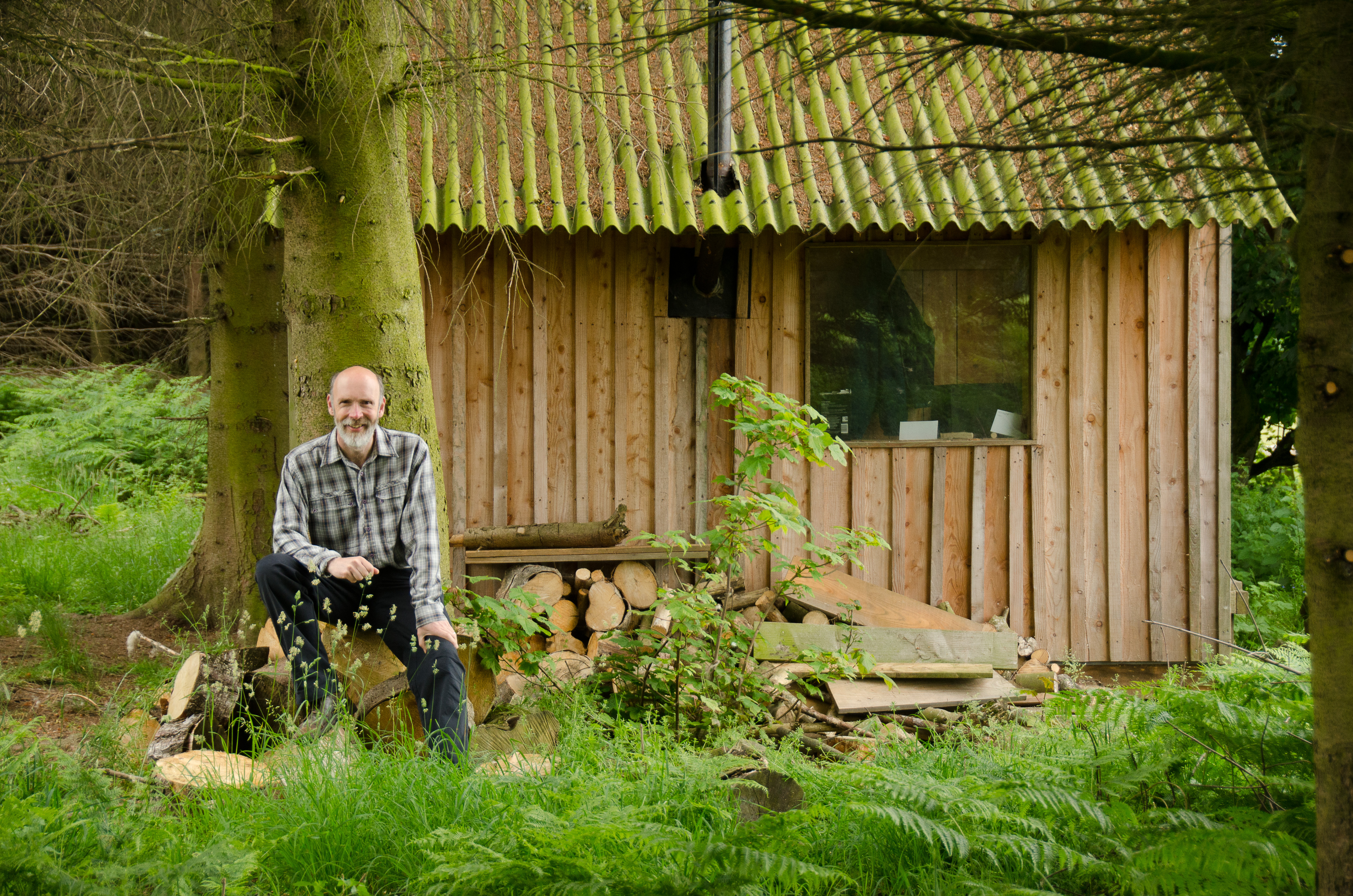
Ninian Stuart at his hut near Falkland

The Thousand Huts campaign is working on guidelines on good practice in hutting development.  It is engaging with the local community with a view to pursuing a pilot development on Forestry Commission land near Saline, in Fife.  Discussions are continuing with the Scottish Government on security of tenure, building standards and possible changes to planning regulations.

Planners can play an important role in ensuring that many more people in Scotland have access to a little hut in the countryside where they can relax and enjoy nature with their families.


This article was published in the Autumn 2014 issue of the Scottish Planner.

Subscribe

  • Entries (RSS)
  • Comments (RSS)

Archives

  • March 2025
  • March 2022
  • December 2021
  • March 2021
  • November 2020
  • August 2020
  • May 2020
  • February 2020
  • February 2019
  • October 2018
  • August 2018
  • May 2018
  • April 2018
  • July 2017
  • April 2017
  • February 2017
  • January 2017
  • September 2016
  • July 2016
  • May 2016
  • March 2016
  • December 2015
  • November 2015
  • August 2015
  • June 2015
  • May 2015
  • November 2014
  • October 2014
  • August 2014
  • July 2014
  • June 2014
  • May 2014
  • April 2014
  • March 2014
  • June 2013

Categories

  • Frank Mears
  • Reviews
  • Spatial Planning
  • The Land o Cakes
  • Travellers' Tales

Meta

  • Create account
  • Log in

Blog at WordPress.com.

  • Subscribe Subscribed
    • By Erceldoune
    • Join 29 other subscribers
    • Already have a WordPress.com account? Log in now.
    • By Erceldoune
    • Subscribe Subscribed
    • Sign up
    • Log in
    • Report this content
    • View site in Reader
    • Manage subscriptions
    • Collapse this bar
 

Loading Comments...