• Thomas Learmonth o Erceldoune

By Erceldoune

~ Graeme Purves

By Erceldoune

Tag Archives: Scottish Literature

The Literary Politics of Scottish Devolution: Voice, Class, Nation

15 Saturday Feb 2020

Posted by Graeme Purves in Reviews

≈ Leave a comment

Tags

Cencrastus, Radical Scotland, Scottish Culture, Scottish Devolution, Scottish Literature, Scottish Nationalism, Small Magazines
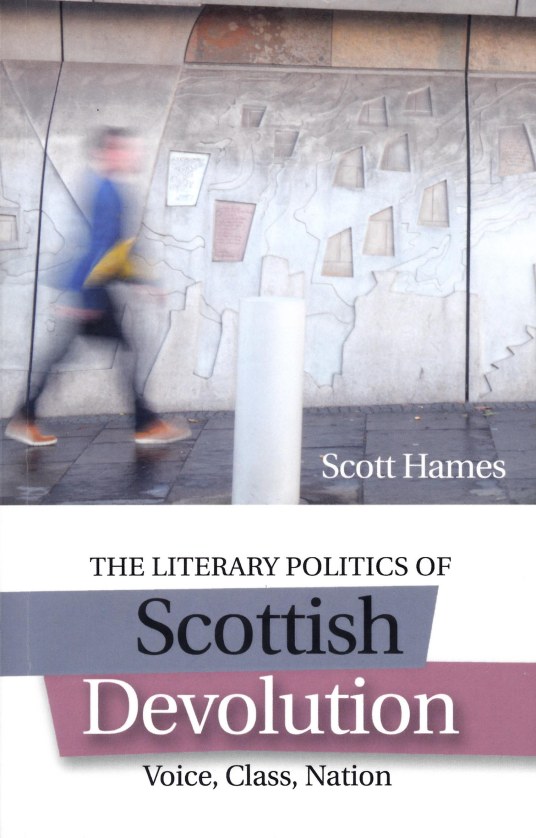
Literary Politics of Scottish Devolution

by Scott Hames, Edinburgh University Press (2019)

Scott Hames is Lecturer in Scottish Literature at the University of Stirling.  He has edited two books of essays on modern Scottish literature and national identity and is an occasional contributor to Bella Caledonia.  In The Literary Politics of Scottish Devolution: Voice, Class, Nation he examines the influence of writers and intellectuals in shaping the campaign for constitutional change in Scotland from the 1970s to the establishment of a devolved Scottish Parliament in 1999, exploring the relationship between the ‘dream’ of national empowerment and the ‘grind’ of electoral strategy, and examining critically how the work of authors such as William McIlvanney, A.L. Kennedy, Irvine Welsh and James Kelman relates to the concern with articulating a distinctive and authentic Scottish voice during the period of the Thatcher and Major governments.

Hames highlights the influence of writers and thinkers such as Tom Nairn, Stephen Maxwell, Jack Brand, Neal Ascherson and Christopher Harvie in shaping the initial response to the unsatisfactory outcome of the devolution referendum of 1979, but a distinctive feature of the book is a strong focus on the small magazines which engaged with Scottish political and cultural debates in the pre-internet period, particularly Radical Scotland, Calgacus, Cencrastus and Edinburgh Review.

While Hames is sympathetic to the cause of Scottish self-government, he is at pains to maintain a critical distance from his subject.  He is right to subject the sometimes exaggerated claims of cultural vanguardism to critical scrutiny, but his scepticism often becomes mannered, not to say loaded and laboured.  Scotland’s claims are ‘uncertain’.  Assertions of popular sovereignty are dismissed as ‘nationalist notions’.  Scottish nationalism contrives to be perversely ‘a-cultural’ while retaining a ‘tweedy aura’.   When not being expressed through the ballot box, Scottish national consciousness is only ‘latent’.  Home rule activists are characterised as ‘obsessives’ fretting over ‘nebulous difference’ and nursing ‘national injury’.  Scots is only a ‘semi-separate tongue’.  The Scotland of the 1990s is reduced to being ‘marginal’ and a ‘semi-nation’. Scots appear to have only a ‘half-belief in national belonging’, and Scottish identity is a ‘provisional choice’.  In this narrative, Scotland exhibits a peculiar form of exceptionalism, a unique ambivalence about its authenticity.  One is left wondering how this etiolated, twilight entity, with only a tenuous grip on national consciousness, could have come to possess the distinct ‘intelligentsia’ and ‘densely-networked’ civic realm which Hames identifies as key drivers of the campaign for devolved government.
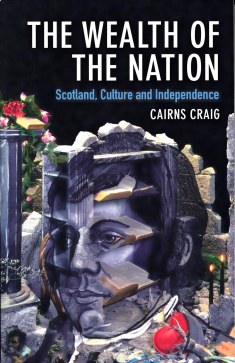
Wealth of the Nation

Hames acknowledges the salience of Cairns Craig’s work on Scottish culture, specifically referencing his recent book The Wealth of the Nation: Scotland, Culture and Independence which I reviewed a year ago; yet he makes no reference to Craig’s analysis of the changing nature of Scottish nationalism in the period since the Union.  As Craig points out, throughout the nineteenth century, Scots saw the British Empire as an effective vehicle for projecting Scottish identity and influence across a global canvas, not least in the Dominion of Canada.  It was only after this became untenable after the First World War that there emerged a ‘resistant nationalism’ of the sort we are familiar with in other small European nations, and one which was aggressively dismissive of what had gone before.  Craig argues that this ‘nostophobic’ phase, which sometimes became a self-flagellating preoccupation with the perceived inadequacies of Scottish culture, had begun to exhaust itself by the 1970s.  The cultural revival led by writers and artists such as Edwin Morgan, Alasdair Gray, Liz Lochhead and Ian Hamilton Finlay after the devolution referendum of 1979 was able to combine respect for Scotland’s indigenous cultural resources with an openness to ideas from elsewhere.  Oddly, Hames doesn’t attempt to engage with any of this, preferring to wear his studied scepticism about the existence and viability of a distinct Scottish cultural identity as a badge of detached academic rigour.

Hames’ relentlessly sceptical stance tends to undermine his own account of the influence of writers and intellectuals in establishing consensus around a post-referendum narrative in the early 1980s.  He writes of the assembly offered in the 1970s dismissively as only ‘half-wanted’ and ‘nobody’s dream’.  But if the feeling that the failure to grasp it was a lost opportunity had not been widely shared, that narrative would have had little traction.

Hames is curiously uncurious about the social, political and cultural networks which took the cause of Scottish self-government forward in the 1980s and 1990s, the people involved and the connections between them.  His analysis of the forces at play during the period remains at the level of airy academic abstractions such as ‘the intelligentsia’, ‘Civic Scotland’ and the ‘elite’.   He argues that ‘the Scottish elite took over a half-constructed, semi-derelict project’ of devolution after 1979, though this elite is not defined or examined in any depth.  While the Constitutional Convention established in 1989 can be seen as an elite project, the Campaign for a Scottish Assembly (CSA) which preceded it, and was up and running the year after the referendum, was by no means an elite organisation.  It grew out of the links which had been established between activists of various parties and none during the referendum campaign.  It was grass-roots and multi-faceted.  It included members of the SNP, the Labour Party and Jim Sillars’ Scottish Labour Party, as well as Liberals, Communists and Greens.  The Scottish Ecology Party, forerunner to today’s Scottish Green Party, had been established just in time to campaign on the ‘Yes’ side in 1979.  Hugh Miller of the Scottish Republican Socialist Party was a key figure in the Edinburgh Branch and nationally.  Activists with widely different political perspectives admired his enthusiasm and commitment and respected his organisational skills.  Pace George Kerevan, in its diversity and activist-driven creativity, the CSA was more closely akin to the local ‘Yes’ groups of the 2014 referendum campaign than John MacCormick’s douce Covenant Movement.

Hames’ focus is on the literature of the period, which is well and good, but in places he appears to expect literature carry the whole burden of Scotland’s claim to a distinctive cultural identity, even although the writers he cites often explicitly deploy a wider frame of reference encompassing music, film, drama and the visual arts.  In his quest for authentic radicalism, he is discomfited to find Radical Scotland 27 (June-July 1987) devoting twice as much space to a positive review of The Proclaimers as to a review of James Kelman’s latest novel; Kelman being in Hames’ view ‘the outstanding political novelist  of 1980s-90s Scotland’ (Hames edited The Edinburgh Companion to James Kelman).   But, of course, Radical Scotland never had any pretensions to being a literary magazine.  Its interest in cultural matters was always more catholic and utilitarian.  Surprisingly, given Hames’ concern with authenticity of voice, he dismisses The Proclaimers rather sniffily as a ‘pop group’!  And it is odd to find a book which consciously focuses so strictly on literature ending with an admonition not to forget that ‘large fraction of Scottish society who have never read (or indeed heard of) the writers consecrated in the Canongate Wall.’
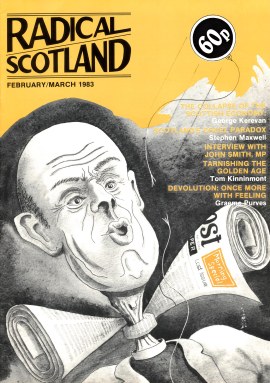
Radical - Scotland - February 1983

Hames suggests that there was little examination of the content of Scottish culture by writers and intellectuals in the period after the 1979 referendum.  In fact, there was rather a lot.   Scottish Journey (1935), Edwin Muir’s bleak assessment of Scottish culture and identity was widely referenced during the period.  A new edition had been published by Mainstream in 1979, with an introductory essay by T.C. Smout.  Barbara and Murray Grigor’s Scotch Myths exhibition (1981) stimulated a series of articles examining aspects of the representation of Scottish identity and culture in The Bulletin of Scottish Politics and Cencrastus, but Hames’ strict focus on literature allows him to confine his acknowledgement of this fact to a footnote, on the ground of lack of space.  The cover of the first issue of the relaunched Radical Scotland published in the spring of 1983 illustrates the quote attributed to Tom Nairn, that ‘Scotland will be free when the last minister is strangled by the last copy of the Sunday Post.’   Here, the new Editorial team were not asserting a tentative or questionable Scottish cultural identity but contesting the nature of Scottish identity and signalling a break with the past.  It is noteworthy that the Kirk and Presbyterianism barely surface in Hames’ survey of the writing of the period, though in his criticism of the work of James Robertson the Disruption of 1843, a singularly Scottish event, does get a mention.

Hames quotes the following passage from Robertson’s novel, And the Land Lay Still (2010):

“There were magazines recording and encouraging this process of self-exploration. They were small-scale, low-budget, sporadic affairs, and their sales were tiny – a few hundred, a very few thousand – but the people running them weren’t doing it for the sales.  They were doing it to address the pervasive sense of wrongness.  And the people who read them – culturally aware, politically active people – were hungry for what they provided.  More than anything, perhaps, the magazines said you are not alone.”

Sadly, we learn less than might have been expected about these people.  Kevin Dunion and Alan Lawson, the successive editors of Radical Scotland are identified, as are Joy Henry, the editor of Chapman, and Peter Kravitz, the editor of Edinburgh Review.  Norman Easton, editor of the predecessor to Radical Scotland, Crann Tára, is not identified, neither is Ray Burnett, Editor of Calgacus, or Ian Dunn, the co-founder of the Scottish Minorities Group who edited two issues of Radical Scotland prior to the relaunch of the magazine in 1983.  With the exception of Cairns Craig, the members of the editorial team at Cencrastus remain anonymous.

Several members of the new editorial team at Radical Scotland had been active in the SNP 79 Group, and involved in the production of its newsletter, 79 Group News.  Following the proscription of the 79 Group by the SNP in the autumn of 1982, they were in need of an alternative vehicle for the promotion of their ideas.  However, Hames is mistaken in his claim that the magazine was taken forward by ‘an entirely new editorial team’.  There was an element of continuity, and that played a part in facilitating the change to the new regime, but it is worth noting that an interesting strand of writing on sexual identities and minorities in Scotland did not survive the transition.  Hames references an excellent essay by Douglas Robertson and James Smyth on the story of Radical Scotland, about which Robertson has first-hand knowledge as a member of the editorial team.  I remain astonished that it was rejected by the journal Scottish Affairs and is still unpublished.

While my personal knowledge of the period has led me to be acerbically critical of several aspects of this book, I do believe that it is a valuable piece of work, breaking important new ground in exploring the ‘complex and pervasive intermingling of Scottish literature and politics over the past few decades’ and highlighting the part which small political and cultural magazines played in bringing that about.  Hames is right to warn against a reductive critique of Scottish writing and writers.  He provides valuable insights, such as the suggestion that ‘Loosening the grip of MacDiarmid’s acolytes on ‘Scotland’ as a topic and possibility was arguably the crucial legacy of Scottish International.’  He draws our attention to observations by Scottish writers which remain all too relevant.  Tom Nairn’s comment that English nationality has little political horizon beyond Anglo-Britain and its imperial residues remains true today as we teeter on the edge of Brexit.  James Kelman’s parody of the stand-off between Civic Scotland and the Major Government over devolution, in which ‘the height of their defiance is to carry on waiting until they give us power,’ has an uncomfortable resonance in the political predicament in which Scotland now finds itself.  Hames is correct to conclude that Scottish devolution is not only a set of political structures but a cultural condition, but surely mistaken in suggesting that it is “a condition just short of independence” – as we are currently finding out.

There is much more to explore and much more that can and should be written about the relationship and interactions between culture and politics in the period between the referendums of 1979 and 1997.  Scott Hames has made a welcome start.


A version of this article was published in Bella Caledonia on 30 December 2019.

The Wealth of the Nation: Scotland, Culture and Independence

16 Saturday Feb 2019

Posted by Graeme Purves in Reviews

≈ Leave a comment

Tags

Cairns Craig, national identity, Scottish Culture, Scottish Literature

Wealth of the Nation

by Cairns Craig, Edinburgh University Press (2018)

Cairns Craig is a leading scholar in Scottish and modernist literature. He has been Professor of Irish and Scottish Studies at the University of Aberdeen since 2005. Before that, he taught at the University of Edinburgh, serving as Head of the English Literature Department from 1997 to 2003. In the 1980s he was a member of the Advisory Committee and Editorial Board of the literature, arts and cultural affairs magazine Cencrastus. His The Wealth of the Nation: Scotland, Culture and Independence explores how recurrent cultural revival has successfully sustained Scotland as a nation through 300 years of Union. It is an important and ambitious work, and was recently shortlisted for the Saltire Society Literary Awards History Book of the Year.

Craig invokes Adam Smith in seeing the true wealth of the nation as lying in its culture and sees the explanation for Scotland’s survival as lying in the successful accumulation and reinvestment of cultural capital. In examining Scotland’s cultural resilience, he deploys a number of unfamiliar concepts, with which the reader must try to get to grips. The first of these is that Scotland’s sense of itself as a distinctive cultural entity took a ‘xeniteian’ form during the period of the British Empire, with Scots migrants taking advantage of the opportunities Empire created to take Scotland out across the world, and busily reconstructing the institutions of their homeland throughout the Imperial territories. This influence was strong enough to survive the loss of the American colonies. Scottish thinkers like Adam Smith, Hugh Blair, Francis Hutcheson and Thomas Reid had a profound influence on the institutions of the emergent United States. The Scots Presbyterian minister John Witherspoon was a signatory to the Declaration of Independence and was a key figure in the development of the College of New Jersey which would later become Princeton University.

Scotland’s ‘Imperial nationalism’ continued to project Scotland as an independent cultural entity through the celebration of its writers throughout the Nineteenth Century. Thus, Craig argues:

“In the very period when, according to the standard view, Scottish intellectual life was in decline in Scotland, Scottish ideas were achieving their greatest world-wide influence.”

It is estimated that at their peak the Edinburgh-based journals the Edinburgh Review and Blackwood’s Magazine enjoyed an international readership of over 100,000. In the 1820s, Francis Jeffrey’s Edinburgh Review was selling 4,000 copies per issue in the USA, as much as any USA-based publication in the period.

At home, Walter Scott and the dramatist Daniel Terry were engaged in a theatrical reconstruction of Scottish identity which served the needs of Empire. For George IV’s visit to Scotland in 1822:

“Scott and Terry created a political theatre in which a Hanovarian monarch could appear upon the stage of Edinburgh to act the part of a Stuart king.”

Craig distinguishes between two contrasting manifestations of nationalism in Nineteenth Century Europe – resistant and projective nationalism. Scotland’s nationalism was decidedly of the latter variety.

“Scotland had no need of a ‘resistant nationalism’ precisely because it was an imperial nation engaged in projecting its national culture to the world. The historical problem of Scotland’s ‘absent nationalism’ in the nineteenth century is a non-problem because far from lacking a nationalism, Scottish nationalism was vigorously engaged on imposing itself wherever Scots had achieved a determining or a significant role within the territory of the British Empire. Scottish nationalism did not need to assert itself within the British state because the ‘world was its field’, and its aim was to make Scotland the spiritual core of the imperial project.”

Craig argues that the trauma of the First World War fatally undermined Scotland’s xeniteian empire and the assumptions underlying her projective nationalism. While the British Empire soldiered on until after the Second World War, the Age of Empires had ended. The Scottish industries which had served the British Empire were plunged into Depression between the Wars. Core areas of the Empire where Scottish culture had taken root were asserting their own independent national identities. The Scottish Renaissance which Scotland’s writers and artists promoted from the 1920s was resistant in character and whereas Scott’s imperial nationalism had indulged a nostalgia for Scotland’s past, the new nationalism was aggressively dismissive of what had gone before – what Craig describes as ‘nostophobic’. Hugh MacDiarmid’s modernist manifesto demanded the rejection of what had passed for Scottish culture since the Reformation.

Craig argues that nostophobia, a pessimistic pre-occupation with the cramping, provincial inadequacies of Scottish culture, became the dominant intellectual discourse in Scotland in the period following the Second World War, with figures as diverse as Edwin Muir, Allan Massie, Alexander Trocchi and the film-maker Bill Douglas contributing to the construct. Perhaps the Strichen runaway Nora Low should be seen as the pioneer poster-girl of the nostophobes? As Lorna Moon she achieved success in Hollywood as a screenwriter for the early talkies and died in a tuberculosis sanatorium in Albuquerque, New Mexico in 1930.

By the 1970s, nostophobia had achieved its ultimate distillation and, as Craig points out:

“Far from being the minority opposition in modern Scottish culture, nostophobia was, in fact, the ideology of much of the cultural ‘establishment’.”

In an article in the house magazine of Scottish nostophobia, Bob Tait’s Scottish International, Tom Nairn argued that the Scots, liberated from the debilitating constraints of a failed national culture, were well placed to provide the intellectual vanguard of a new post-nationalist world. It is therefore richly ironic that Scottish International’s What Kind of Scotland? conference in the Spring of 1973, at which John McGrath’s The Cheviot, the Stag and the Black, Black Oil was given an enthusiastic standing ovation, can be seen as marking the exhaustion of the nostophobic impulse. I still remember with relish the censoriousness with which the commissars of internationalism greeted the play’s popular appeal.

Meanwhile, through the efforts of American scholars, as well as Duncan Forbes and George Elder Davie, Scotland’s Eighteenth Century thinkers and their Nineteenth Century successors had become the subject of renewed interest. Craig reminds us that the concept of a ‘Scottish Enlightenment’ only gained currency in the 1960s, and that:

“The ‘Scottish Enlightenment’ did not send out its intellectuals to populate the world – rather, Scottish ideas swept around the world and returned to remake Scotland’s past into an Enlightenment.”

Craig uses the term ‘theoxenia’ to describe the cultural response to the political hopes dashed by the result of the Devolution Referendum of 1979 – a perspective which is able to combine respect for Scotland’s indigenous cultural resources with a receptiveness to the gifts of gods who come as strangers. He sees Edwin Morgan, Alasdair Gray, Liz Lochhead and Ian Hamilton Finlay as leading contributors to this latest phase of cultural revival.

Craig is strongly focused on Scottish literature and philosophy, with nods to art and drama. He engages primarily with the intellectual dimension of Scottish culture. In Popular Literature in Victorian Scotland (1986), another Aberdeen-based academic, William Donaldson, has drawn attention to the important part which newspapers, notably the Dundee-based People’s Journal and the Aberdeen Free Press, played in sustaining popular Scottish culture in the Nineteenth Century. In seeking explanations for the remarkable survival of Scotland as a cultural entity, the roles of the popular press, music hall, pantomime and folk and popular music would repay further examination, bringing figures like William D. Latto, Hamish Henderson, Stanley Baxter, Jimmy Logan, Rikki Fulton, June Imrie, Michael Marra, Elaine C. Smith, Sheena Wellington and Karine Polwart into the frame. A full exploration of the part played by popular media in cultural resilience would also require us to examine broadcasting and the problematic role of the BBC. There is clearly scope for a lot more work in this area.

In a final short chapter, Craig addresses the ambivalence of Scottish politicians towards Scottish culture. The Labour Party and the SNP have both pursued essentially neoliberal culture strategies, seeking to recruit artistic and literary creativity into the service of global capital and enterprise. Craig asserts the value of cultural capital on its own terms as the real basis of a nation’s wealth. In the independence referendum of 2014, it was neither the SNP’s technocratic 649-page white paper nor the worthy and stolid official Yes campaign which pushed support for independence from 30 to 45%, but the explosion of creativity from writers, artists and local activists. The SNP would be smart to learn lessons from that for any future independence campaign. As Craig concludes:

“Financial capital, as was shown in the case of the Royal Bank of Scotland, is no guarantee of sustained independence; cultural capital guarantees a country’s ability to resist dependence, even if, in Scotland’s case, it has not proved – as yet – able to deliver political independence. But without cultural independence a country ceases to exist…”


This review was published in Bella Caledonia on 12 January 2019.

Where the Ettrick meets the Tweed

09 Saturday May 2015

Posted by Graeme Purves in The Land o Cakes

≈ Leave a comment

Tags

David I, David Purves, Ettrick, River Tweed, Scots language, Scottish Borders, Scottish Literature

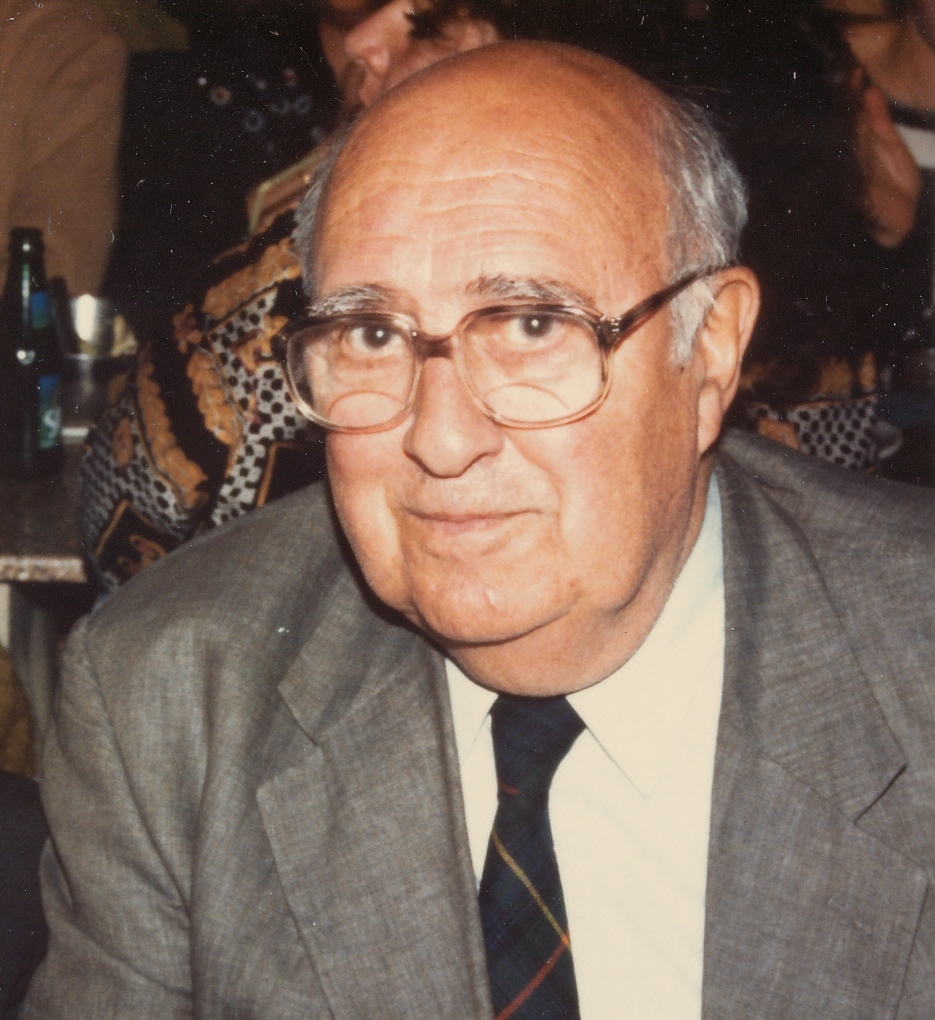
David Purves

David Purves (1924 – 2015)

My father was born in Selkirk and spent his childhood in Galashiels.  It was his love of the language he grew up with in the Borders that led to him becoming a champion of writing in Scots.  After his death in January, I found a letter amongst his papers in which he asked that his ashes be scattered at the confluence of the Ettrick and the Tweed.

As we drove down the A7 on a bright May morning, birds were singing and the trees were bursting into vibrant green.  Teams of men in orange overalls were busy with engineering and landscaping works along the route of the Waverley Line.  In Stow, where my grandfather had a shop and I spent the first three years of my life, we passed a large placard for SNP candidate Calum Kerr in somebody’s garden.  Dad would have been tickled by Calum’s victory in the constituency he contested back in February 1974.

At Ochiltree’s restaurant at Abbotsford we met Jamie, Nicola and their labrador, Bella, who had traveled up from Cornwall.  Then we made our way down to the river crossing on the Selkirk road.

The Puddock

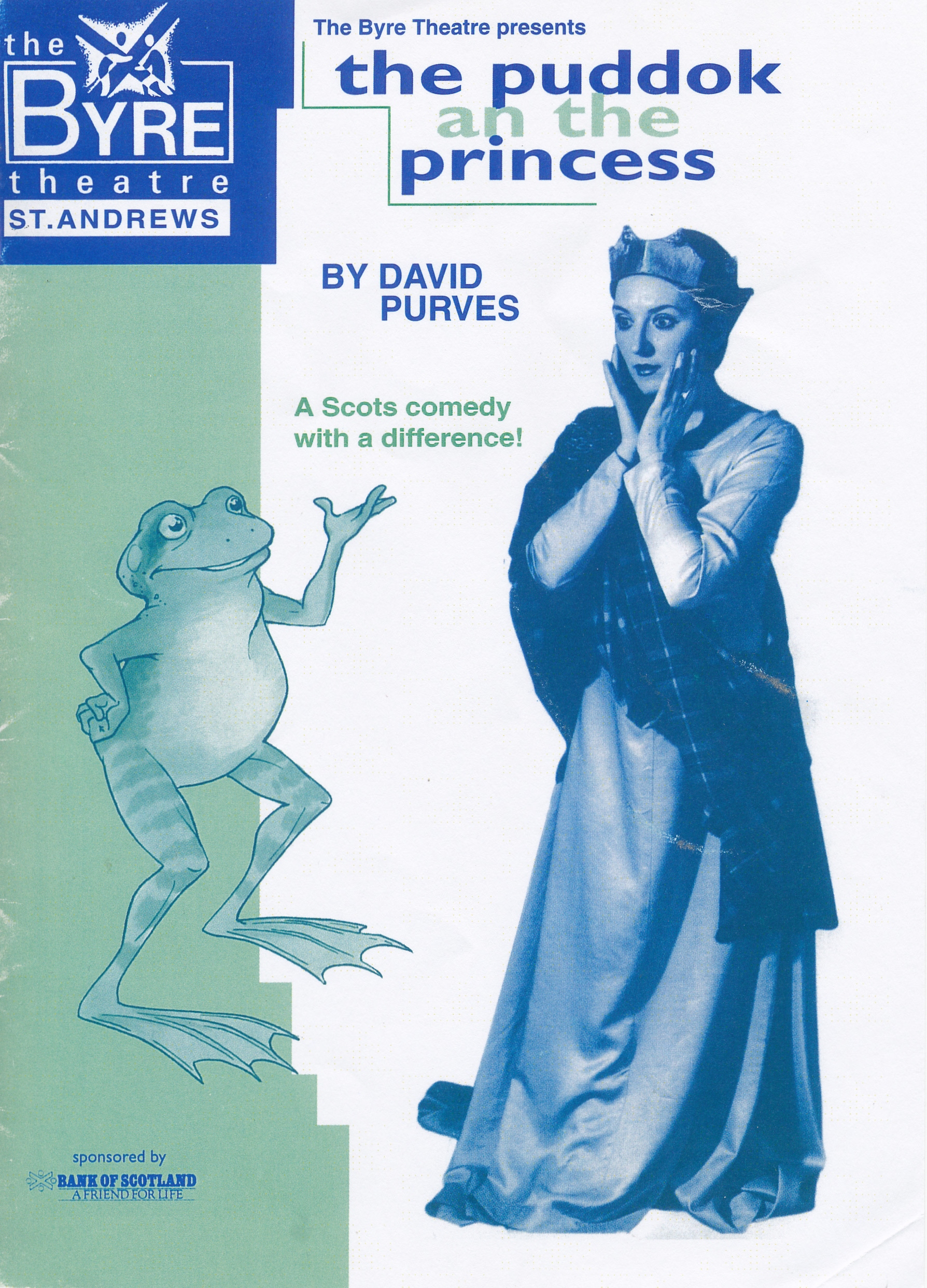
The Puddok an the Princess – Edinburgh Fringe First Winner 1985

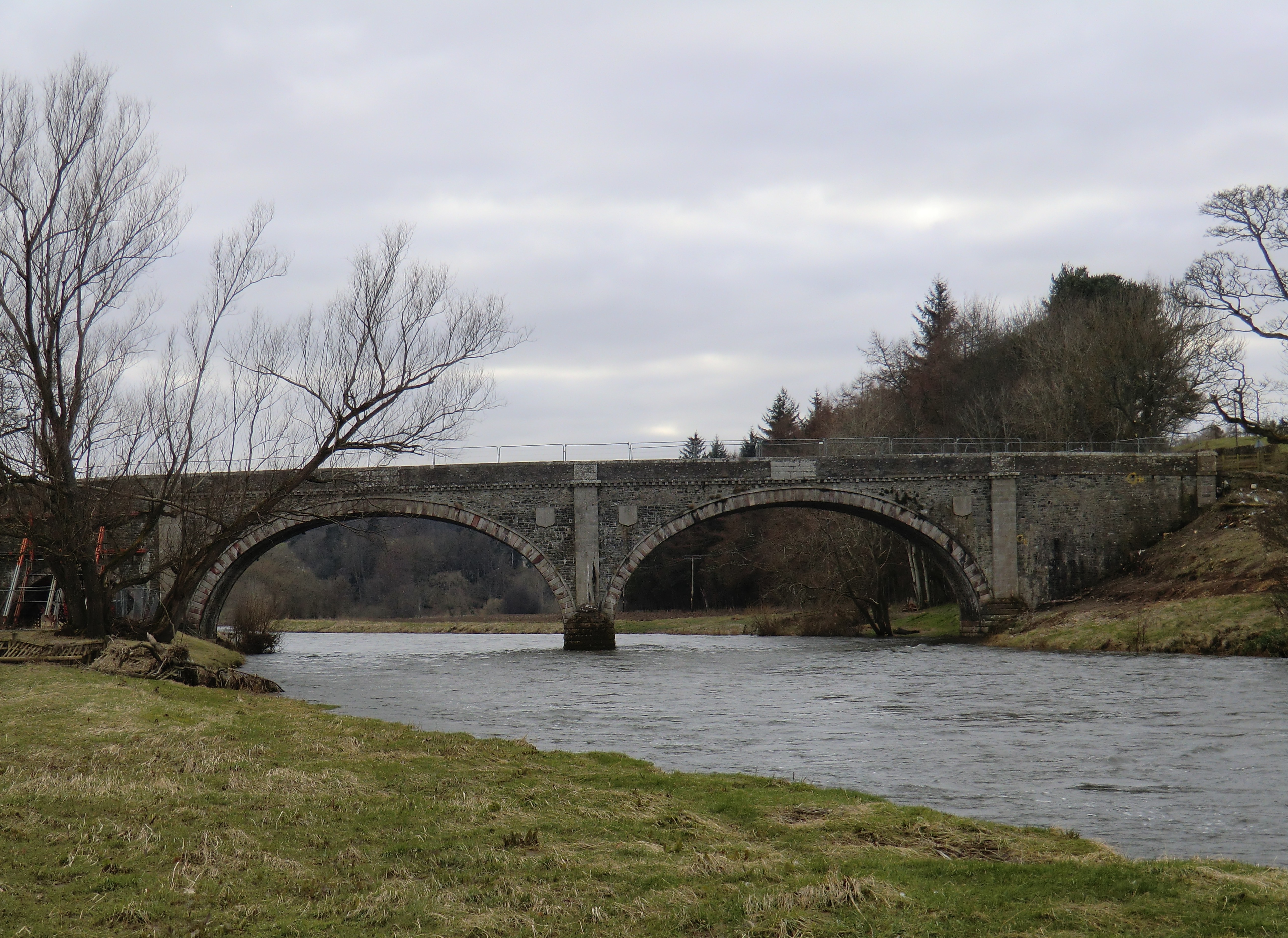
When Neil and I did our reconnaissance in March, we discovered that the old Tweed Bridge had been closed due to structural deterioration and was completely fenced off.  This made access to the point where the rivers meet more difficult and would have prevented mum from getting down to the waterside.  Luckily, the bridge is now open for cyclists and pedestrians and we were able to get to the desired spot quite easily.

Tweed Bridge

Old Tweed Bridge

As was traditional in many families, in our branch of the Purveses male children were named after Scottish kings.  In our case, the favoured names were James, Alexander and David.  It was Scotland’s first David (1083 – 1153) who, first as Prince of the Cumbrians and then as King of Scots, brought political stability to the contested territory of the Borders and through the religious houses he endowed, established a strong and enduring literary culture. Drawing on Celtic, Anglo-Saxon and Norman influences, this led to such notable achievements as The Romance of Thomas the Rhymer, the earliest surviving chivalric romance written in Quant Inglis.  Through the medium of the stark Border Ballads,  this tradition survived the social and economic disruption of the Wars of Independence to inform the work of writers like James Hogg and Sir Walter Scott in the 19th Century.

The rivers were high and the water was moving briskly.  The ashes of a man swirled into the continuing stream in a grey-white cloud and the torrent swept them eastwards to our mother the sea. “Fareweel Soutar Davie!  Ye’ll be at Berwick in nae time!”

_________________________________________________________________

A short biography of David Purves can be found on the website of the Scottish Poetry Library.  An obituary was published in The Scotsman on 6 January 2015.

55.568110
-2.812398

Subscribe

  • Entries (RSS)
  • Comments (RSS)

Archives

  • March 2025
  • March 2022
  • December 2021
  • March 2021
  • November 2020
  • August 2020
  • May 2020
  • February 2020
  • February 2019
  • October 2018
  • August 2018
  • May 2018
  • April 2018
  • July 2017
  • April 2017
  • February 2017
  • January 2017
  • September 2016
  • July 2016
  • May 2016
  • March 2016
  • December 2015
  • November 2015
  • August 2015
  • June 2015
  • May 2015
  • November 2014
  • October 2014
  • August 2014
  • July 2014
  • June 2014
  • May 2014
  • April 2014
  • March 2014
  • June 2013

Categories

  • Frank Mears
  • Reviews
  • Spatial Planning
  • The Land o Cakes
  • Travellers' Tales

Meta

  • Create account
  • Log in

Blog at WordPress.com.

  • Subscribe Subscribed
    • By Erceldoune
    • Join 29 other subscribers
    • Already have a WordPress.com account? Log in now.
    • By Erceldoune
    • Subscribe Subscribed
    • Sign up
    • Log in
    • Report this content
    • View site in Reader
    • Manage subscriptions
    • Collapse this bar
 

Loading Comments...